
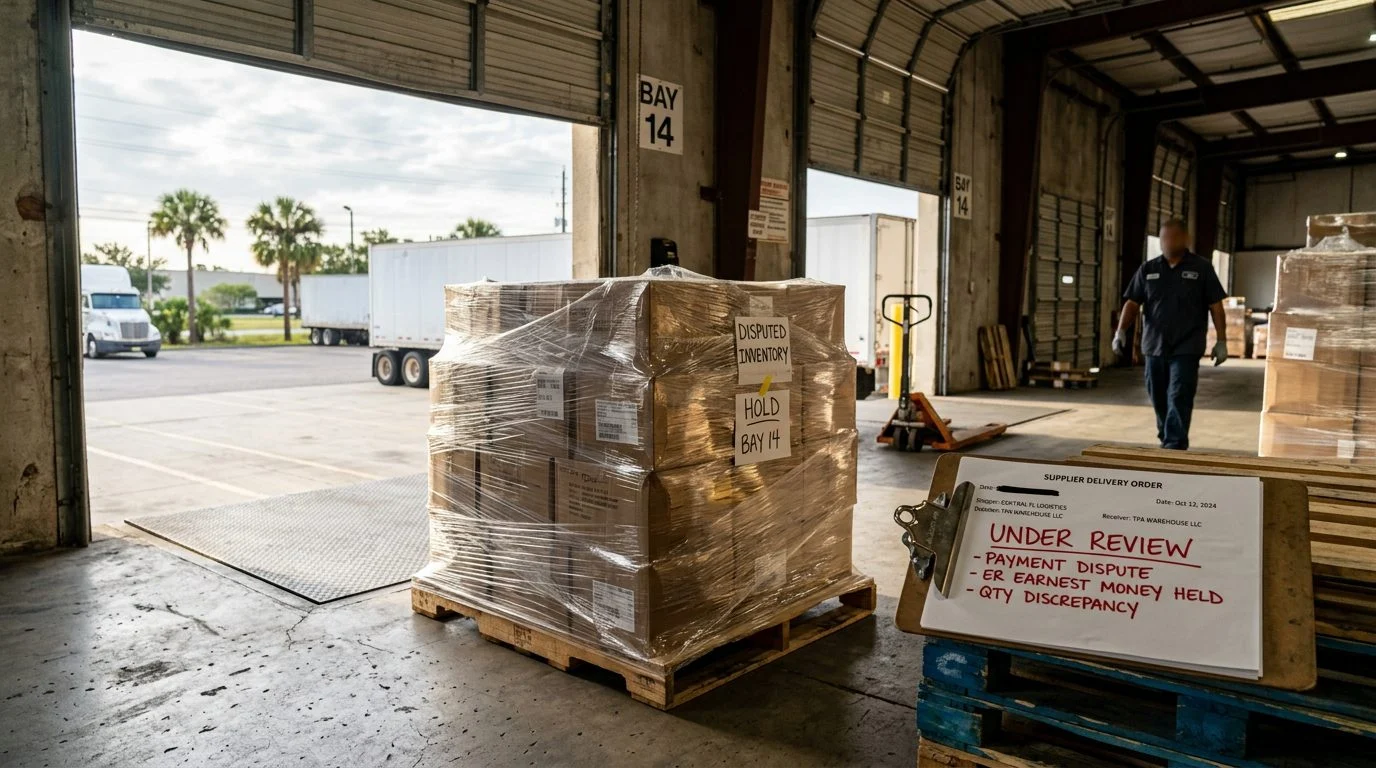
If a seller is holding your earnest money on a Tampa commercial deal, your purchase contract is the place to start. This page explains your options in an earnest money dispute on a commercial contract in Tampa and Hillsborough County.
Whether a seller can keep the deposit turns on the contract’s default terms and what happened before the default. Your options usually include a written demand, an escrow release request, mediation or arbitration if the contract requires it, or a lawsuit.
What an Earnest Money Dispute on a Commercial Deal Involves
An earnest money dispute is a fight over who gets a deposit the buyer paid to show it intends to close. The deposit is usually held in escrow by a title company, closing agent or broker, as the contract directs.
A dispute usually starts in one of two ways. The seller says the buyer defaulted and keeps the deposit. Or the buyer says the seller breached, or a contract condition failed, and wants the money back.
This page is for business owners, investors and commercial property parties in Tampa and Hillsborough County facing either claim. A deposit fight can also raise broader contract disputes and real estate litigation questions. Under Fla. Stat. § 26.012, circuit courts have exclusive original jurisdiction over cases in equity and actions involving the title to real property.
If a seller is keeping your deposit and a deadline is getting close, our team can review your contract and your options with you, so you don't have to face it alone. Talk it through with our team — we can walk you through how a situation like yours is usually handled and what your options are.
Why a Seller May Be Keeping Your Deposit
A seller usually keeps a deposit by claiming the buyer broke the contract. Common reasons include:
- Missing the closing date set in the contract.
- Failing to deliver financing, approval or other documents the contract requires.
- Walking away without a reason the contract allows.
- Disputing whether a due diligence, financing, zoning or environmental contingency was properly invoked before its deadline.
Many commercial contracts say the deposit is the seller’s remedy if the buyer defaults. This is often called liquidated damages (an agreed amount paid for a breach). The exact wording decides whether that clause applies.
Notice steps matter too. In general terms, a condition precedent is an act or event that must occur before a party has a right to immediate performance and before there is a breach. A Florida condition precedent case sets out that definition. A common mistake is assuming one missed step ends the deal, or that it never matters. Read the exact words first.
Your Options When the Seller Is Holding the Deposit
Your main options are a written demand, an escrow release request, mediation or arbitration, a lawsuit, or a defense to the seller’s claim. Each fits different facts.
- Written demand. A letter cites the contract terms, the default or breach at issue, and a response deadline. It creates a clear written record.
- Escrow release. Read the escrow instructions first. They set out how the deposit may be released.
- Mediation. Under Fla. Stat. § 44.102, a court must, on one party’s request, refer many filed money damage actions to mediation, provided the requesting party is willing and able to pay the costs of the mediation or the costs can be equitably divided between the parties, with listed exceptions. Mediation communications are generally confidential, but a signed written settlement is not. See Fla. Stat. § 44.405.
- Arbitration. A written agreement to arbitrate is valid and enforceable, except on grounds that exist for revoking any contract. See Fla. Stat. § 682.02. If the other side refuses to arbitrate, the court decides whether an agreement to arbitrate exists or whether a controversy is subject to one, under Fla. Stat. § 682.02.
- Lawsuit. Under Fla. Stat. § 47.011, suit must be brought where the defendant resides, where the cause of action accrued, or where the property in litigation is located. This rule does not apply to actions against nonresidents. For a Tampa property, Hillsborough County may be the right county.
- Specific performance and lis pendens. A buyer who wants the seller to close may ask the court to order it. Under Fla. Stat. § 48.23, that action has no effect on title, except as between the parties, unless a notice of lis pendens is recorded in the county where the property sits and has not expired or been withdrawn or discharged. A notice generally expires one year after the action starts, unless the pending pleading shows the relief is founded on a duly recorded instrument or a chapter 713 lien, or the court extends the time on reasonable notice and for good cause.
- Defenses. If the seller sues for the deposit, you can raise contingency, cure or seller-breach defenses that fit the facts.
Settlement talks have limits too. Under Fla. Stat. § 90.408, an offer to compromise a disputed claim, as well as any relevant conduct or statements made in negotiations concerning a compromise, cannot be used to prove liability or the value of the claim.
How a Deposit Dispute Typically Unfolds
Most deposit disputes move through the same steps. Each step can end the dispute or lead to the next one.
- Review the paperwork. Read the purchase agreement, amendments, deposit receipt, escrow instructions and every default or termination notice. Check each deadline.
- Send or answer a written demand. Preserve emails, texts, inspection reports and lender letters.
- Try to resolve it. Negotiate, request an escrow release, or use any mediation step the contract requires. Many disputes end here.
- File suit or demand arbitration if needed. Follow the contract’s dispute clause for where and how.
Timing varies with the court calendar, the dispute clause and whether the parties settle. Don’t wait too long. A contract clause that shortens the time to sue below the statute of limitations is void, under Fla. Stat. § 95.03.
What to Gather Before You Contact a Lawyer
Gather the signed contract, deposit records and every notice before your first call. Organized papers make that first conversation more useful.
- The fully signed purchase agreement, with all addenda, counteroffers and amendments, and their dates.
- The earnest money receipt, escrow agreement and proof of when and how the deposit was paid.
- Every notice exchanged, including termination, default, cure and contingency notices, and proof of delivery.
- Inspection reports, due diligence results, lender or appraisal letters and title documents.
- A written timeline of key events, including the closing date and any extensions.
How Ayala Law PA Handles Commercial Deposit Disputes
Ayala Law PA focuses its practice on business litigation, commercial litigation, contract disputes and real estate litigation in Florida courts and arbitration.
- The firm serves Tampa, Hillsborough County, Brandon, Riverview, Plant City, Temple Terrace and the wider Tampa Bay area from its Tampa office at 1646 W Snow Ave, Tampa, FL 33606.
- Eduardo A. Maura is the responsible lawyer for this page. The firm’s lawyers and support staff review the contract language and the documented timeline together.
- Our team identifies the remedies the contract and Florida law make available, then lays out the options and likely next steps in plain terms.
- We can also explain how a deposit dispute may affect a pending sale, financing or lease deadline.
Not sure what your next step is?
Talk it through with our team — we can walk you through how a situation like yours is usually handled and what your options are.
Frequently Asked Questions
Can a seller keep the whole deposit?
The default and liquidated damages wording in the contract decides that. Read those clauses before assuming the seller keeps everything.
Who decides who gets the deposit?
The contract and escrow instructions set how the deposit is released. If the parties disagree, a court or arbitrator may decide.
Does one missed deadline end my claim?
Not automatically. Florida courts generally do not treat a contract term as a condition unless the language plainly requires it.
Is there a deadline to sue?
Yes. A contract cannot shorten the time to sue below the statute of limitations.
Do I always have to sue?
No. Many disputes resolve through a written demand, an escrow release or a required mediation step.
Talk With Ayala Law PA About Your Deposit
If a seller is keeping your earnest money and a notice or closing deadline is near, don’t let the clock run without a plan. Call Ayala Law PA at (813) 414-5715 or request a case evaluation. Bring the purchase agreement, your deposit records and any default notices. The Tampa office is at 1646 W Snow Ave, Tampa, FL 33606.



