
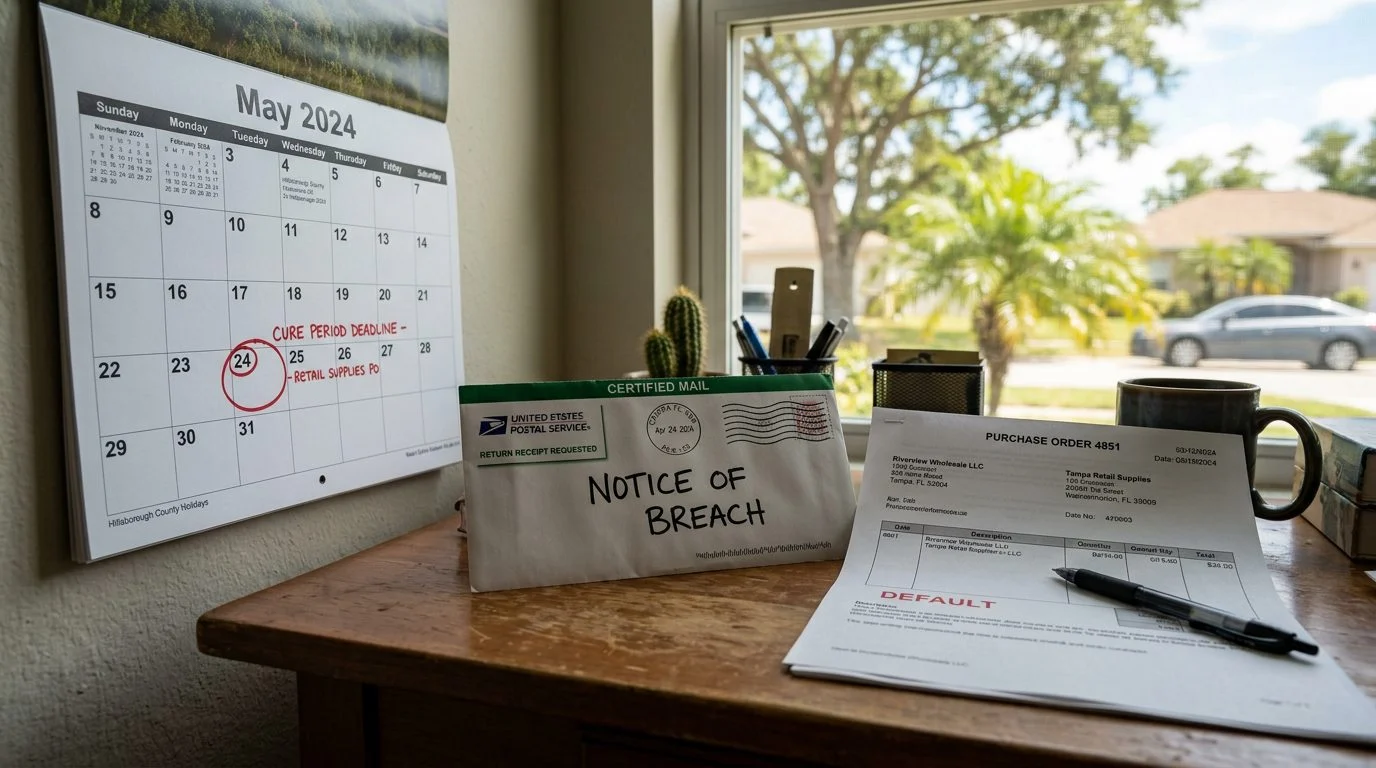
If a bank, landlord or supplier says you owe a company’s debt personally, the answer turns on what you signed. If a business creditor is now asking you to pay its debt personally, the first step is to check what you actually put your own name to.
This page explains what a personal obligation covers, how creditors pursue the person who signed, and which documents to gather now. It is written for the signer, a co-owner or a spouse trying to make sense of a demand letter.
What a Personal Obligation Is and Who It Affects
A personal obligation is a separate promise by an individual to pay or perform if the business does not. Lenders and landlords ask for one because an LLC or corporation is a separate legal entity. The company’s own assets may not cover the debt, so the creditor wants a second person on the hook.
You’ll often see personal obligations in:
- Small business loans
- Commercial leases
- Vendor credit accounts
- Equipment financing
- Construction financing
Signing one is different from owning the company. As the court explained in Wurtzebach v. Flooring Depot FTL, Inc., this “showing of improper conduct” requires proof that “the corporation was actually organized or used to mislead creditors or to perpetrate a fraud upon them.” A creditor who wants to reach an owner’s own assets must prove improper conduct, such as using the company to mislead creditors or defraud them (Florida veil-piercing decision).
If you signed a personal document, co-own the company, or received a demand letter, the points below apply to you.
Not sure what your next step is?
Talk it through with our team — we can walk you through how a situation like yours is usually handled and what your options are.
What a Personal Obligation Can Cover
A personal obligation covers only what its wording says. The exact language controls what the signer can owe.
- Limited or unlimited. A limited version caps what the signer can owe personally. An unlimited version has no cap.
- One-time or continuing. A continuing version can reach renewals, extensions or future advances. Check the scope before you assume it ends with the first loan or lease.
- Covered amounts. Documents often name unpaid principal, interest, late fees, collection costs and attorney fees. Look for the items the document lists.
Attorney fee terms deserve a close look. Under Florida’s contract fee statute § 57.105, when a contract allows fees to a party forced to enforce it, a court may award reasonable fees to the other side if that side prevails, but this subsection applies only to contracts entered into on or after October 1, 1988. A fee clause can cut both ways.
Read the personal document and the underlying contract side by side. They can say different things.
How Lenders and Landlords Pursue a Personal Obligation
Creditors usually start with a default notice or demand letter. If the debt stays unpaid, they may sue the company and the person who signed personally. Whether a creditor can sue the signer alone, or must first pursue the business, depends on the wording of the personal document.
Time limits can be short. Florida’s limitations statute § 95.11 sets different deadlines for written and unwritten contracts. Under section 95.11(3)(j), Florida Statutes, a lawsuit on an oral or other unwritten contract, including a claim for the sale and delivery of goods, must be filed within 4 years. Don’t wait on a demand letter or summons.
After a win, the creditor can use liens. Under Florida’s lien statute § 55.10, a judgment becomes a lien on real property in a county once a certified copy is recorded there with the lienholder’s address. Under Fla. Stat. § 55.10, a judgment, order, or decree becomes a lien on real property in any county when a certified copy of it is recorded in the official records or judgment lien record of that county, provided that the judgment, order, or decree contains the address of the person who has a lien as a result of it, or a separate affidavit stating that address is recorded simultaneously with it. Without that address, or a simultaneously recorded affidavit, it does not become a lien on real property. For a certified copy first recorded on or after July 1, 1994, the lien lasts an initial 10 years from the date of recording.
Defenses and Issues to Review in a Personal Obligation Dispute
The core questions are whether you signed a valid writing, whether it covers this debt, and whether the amount claimed is correct.
- Check whether the signature is genuine and appears on the right document.
- Electronic signatures. Under electronic signature statute § 668.004, an electronic signature has the same force as a written one unless another law says otherwise. An e-signed page still needs review.
- Scope and cap. Does the document cover this loan, this lease or this amount?
- Changes. Did the lender or landlord change the underlying deal, such as the rent or term, without your written consent? Read what the personal document says about changes.
- Unfair terms. Under the Florida Supreme Court’s unconscionability ruling, a court must find both unfair deal-making and unfair terms before it refuses to enforce a term.
- Payments and charges. Payment records, offsets and disputed fees can change the amount owed.
Have questions about what happened?
Ask our team directly. Tell us what you are dealing with and we will explain how the process works from here.
How a Personal Liability Dispute Is Handled With Ayala Law PA
Our team starts with the documents, measures the claim against them, and then outlines options.
- Gather the file. Collect the underlying contract, the personal document, all amendments, the demand or default notice and the payment history.
- Review the claim. Compare the amount demanded with the signed terms, the scope and any notice the contract requires.
- Outline options. These may include responding to a demand, negotiating with the creditor or defending a lawsuit. The right path depends on the facts.
- Track deadlines. Court papers carry short response periods, so timing matters from the first day.
Florida’s offer-of-settlement statute, Fla. Stat. § 45.061, does not apply to causes of action that accrue after its effective date, so whether it governs a particular claim depends on when that claim accrued. Under offer-of-settlement statute § 45.061, any party may serve a written offer more than 60 days after service of a summons and complaint but not less than 60 days (or 45 days if it is a counteroffer) before trial, and the offer remains open for 45 days unless withdrawn sooner. The section does not apply to causes of action that accrue after its effective date. Fla. Stat. § 45.061 reads: “The offer shall remain open for 45 days unless withdrawn sooner by a writing served on the offeree prior to acceptance by the offeree.” It stays open 45 days unless it is withdrawn or accepted.
Timelines vary by case, and we cannot predict how any matter will resolve.
Why Work With Ayala Law PA on Business Contract Disputes
Ayala Law PA focuses on business litigation and contract disputes in Florida courts and arbitration.
- Practice areas. Business litigation, commercial litigation, contract disputes, shareholder disputes, construction litigation, real estate litigation and international trade litigation.
- Clients served. Businesses and entrepreneurs in Hillsborough County, Brandon, Riverview, Plant City, Temple Terrace and the wider Tampa Bay area.
- Responsible lawyer. Eduardo A. Maura is the lawyer responsible for this page.
- Office. The firm’s only office is at 1646 W Snow Ave in Tampa, Florida. The firm serves businesses in Tampa and Hillsborough County from that office.
Our team includes assistants and office staff who support each matter.
Frequently Asked Questions
Can a lender sue me personally if my LLC signed the loan?
Usually only if you also signed a personal obligation that covers the loan.
Does a landlord automatically collect from someone who signed a lease personally?
No. The lease and the personal document control what the landlord can pursue.
Can a personal obligation cover future debts?
Some can, such as continuing versions that reach renewals or future advances. The scope wording decides it.
What should I do first after a demand letter?
Keep every document and payment record, write down the dates, and act before any response deadline.
Ayala Law PA does not waive fees for case evaluations, so ask about fees when you call. If a demand letter or lawsuit has named you personally over a company’s debt, you don’t have to sort out your options alone. Reach out to Ayala Law PA at (813) 414-5715 or through the contact form.



