
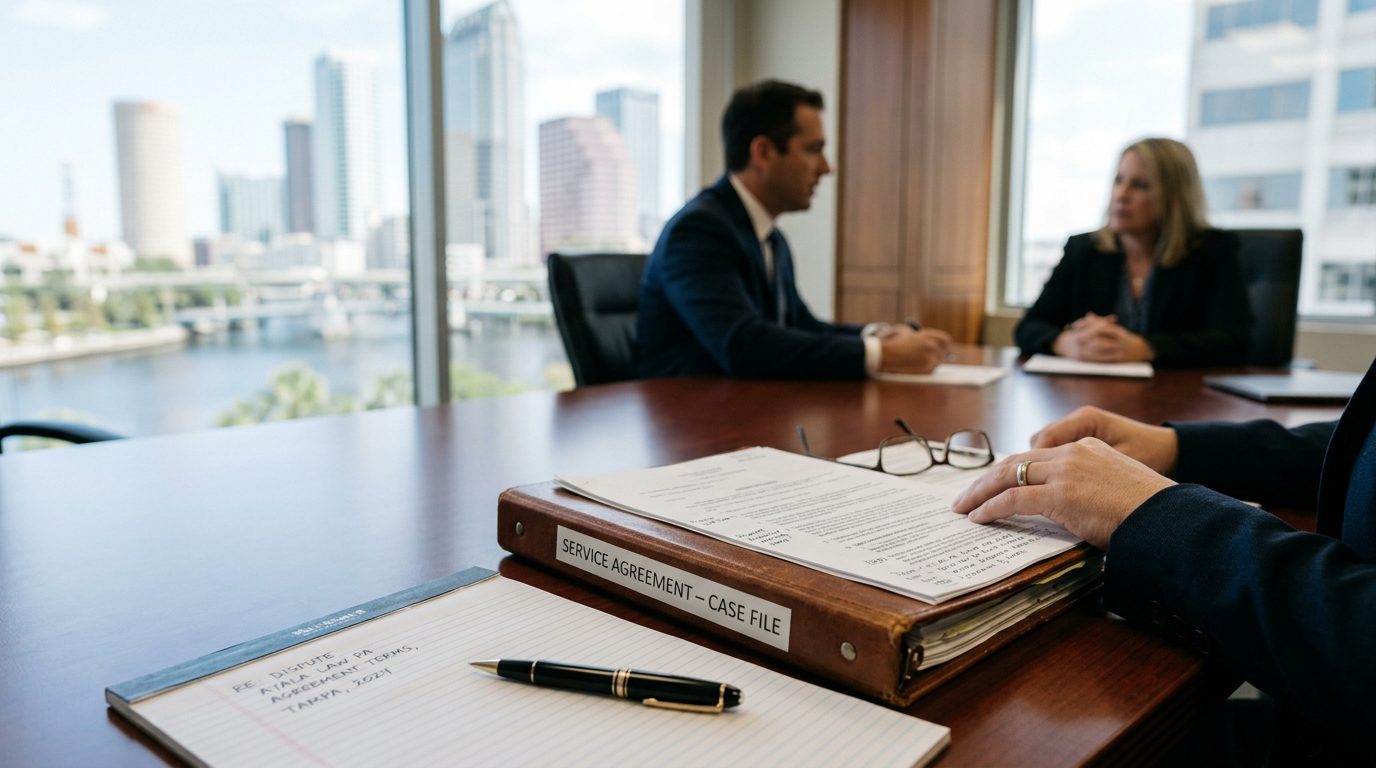
A service agreement dispute happens when two businesses disagree about a written contract for services. The usual fights are over unpaid invoices, work that doesn’t match the contract, and how the deal ended. Ayala Law PA handles these disputes for businesses in Tampa, Hillsborough County and the Tampa Bay area, in Florida courts and arbitration.
What a Service Agreement Dispute Involves
A service agreement is a contract where one party performs work for another in exchange for payment. Think maintenance, staffing, cleaning, logistics, IT support or marketing work.
Disputes come from both sides. A provider may say the client owes for work already completed. A client may say the provider missed deadlines or delivered work that doesn’t meet the agreed terms. Either way, the written contract is the starting point.
The firm works with businesses in Tampa, Brandon, Riverview, Plant City, Temple Terrace and across Hillsborough County and the Tampa Bay area. If you’re dealing with one of these disputes now, you can reach the firm at (305) 570-2208.
Not sure what your next step is?
Talk it through with our team — we can walk you through how a situation like yours is usually handled and what your options are.

Disputes Ayala Law PA Handles Under Service Agreements
Ayala Law PA handles business contract disputes that arise under service agreements. The most common ones involve money, performance and termination.
- Unpaid invoices. Disputes over the contract price, late fees and interest, when the contract provides for them.
- Scope and performance. Disagreements over what the statement of work requires, unapproved extra work and whether the work meets the agreed specifications.
- Termination. Claims that a termination notice ignored the contract’s notice or cure period, or that a termination was wrongful.
- Missed deadlines and service failures. Breach claims tied to late delivery, missed service levels or defective work.
- Liability and damages clauses. Questions about indemnity, limitation-of-liability language and liquidated damages.
- Restrictive covenants. Disputes over non-compete or non-solicitation terms after a service relationship ends.
Service work tied to a construction project, such as disputed change orders, can also raise construction litigation issues.
Contract Terms That Usually Decide the Dispute
Most service disputes turn on a handful of written terms. Know which clauses matter before you make any decisions.
- Scope of work and change orders. Look for the statement of work, any amendments and the written process for approving extra work.
- Payment and invoicing. Note the due dates, invoice requirements and any process for disputing an invoice.
- Termination, notice and cure periods. Many contracts require written notice and a chance to fix a problem first. Check whether the contract allows termination for convenience.
- Liability, indemnity and damages. These clauses set how losses are divided and what damages can be claimed.
- Dispute resolution and fees. The contract may require court or arbitration and may include an attorney fee clause.
Three Florida rules matter here. A contract clause that shortens the time to sue is void (Fla. Stat. § 95.03). And when an express contract covers the same subject, unjust enrichment generally can’t be used for that same work (Williams v. Johnson).
Before calling, gather the signed agreement, all amendments, invoices, emails and any termination or default notices.
How the Process Works, Step by Step
A service agreement dispute usually moves from document review to notice and negotiation, then to a filing in court or arbitration. Here is the typical order.
- Intake and document review. The firm reads the agreement, the invoices and the messages that show how the work went.
- Case evaluation. The lawyer discusses the facts, the clauses that apply and the options available.
- Pre-suit steps. A demand letter or notice of breach may be required by the contract or useful on the facts.
- Negotiation or mediation. Many money disputes settle at this stage. Under Florida law, on one party’s request, a court must refer to mediation any filed civil action for monetary damages, provided the requesting party is willing and able to pay the mediation costs or the costs can be equitably divided between the parties. Actions filed for the purpose of collecting a debt are an exception. Under Florida’s offer-of-settlement statute, section 768.79, Florida Statutes, in a civil action for damages, a defendant who files an offer of judgment that the plaintiff does not accept within 30 days is entitled to reasonable costs and attorney’s fees incurred from the date the offer was filed (the statute’s fee-award subsection measures them from the date the offer was served) if the judgment is one of no liability or at least 25 percent less than the offer. A plaintiff whose demand for judgment the defendant does not accept within 30 days is likewise entitled to reasonable costs and attorney’s fees incurred from the date the demand was filed if the judgment is at least 25 percent greater than the demand. In either case, the court may, in its discretion, determine that an offer was not made in good faith and disallow the award of costs and attorney’s fees. A valid offer must be written, must state that it is made under section 768.79, must name the party making it and the party to whom it is made, must state with particularity any amount offered to settle a claim for punitive damages, and must state its total amount. It is accepted by filing a written acceptance with the court within 30 days after service, and it may be withdrawn in writing served before the written acceptance is filed.
- Venue lies only in the county where the defendant resides, where the cause of action accrued, or where the property in litigation is located, and this rule does not apply to actions against nonresidents (Fla. Stat. § 47.011). If the contract requires arbitration, Florida generally enforces that agreement (Fla. Stat. § 682.02). Federal cases in the Tampa Division follow the Middle District of Florida local rules.
How long each step takes depends on the facts, the forum and the court’s or arbitrator’s schedule. The lawyer will walk through the expected steps for your matter.
Why Businesses Work With Ayala Law PA on Contract Disputes
Ayala Law PA focuses on business litigation, commercial litigation and contract disputes in Florida courts and arbitration. The firm also handles construction litigation, shareholder and partnership disputes, real estate litigation and international trade litigation.
Eduardo A. Maura is the responsible lawyer for this page. Our team, including assistants and office staff, helps with intake, document organization and scheduling, so you have one clear point of contact through each step.
The firm’s only office is at 1646 W Snow Ave, Tampa, FL. The firm represents businesses in Tampa and Hillsborough County, and its office is in Tampa. Our approach starts with the contract. Each step is built around the clauses that decide the dispute, not general advice.
Common Questions About Service Agreement Disputes
Can we pause work while the dispute is pending?
Check the contract’s termination and suspension terms first. Walking away from the work without following them can create a breach claim of its own.
Do we have to send a demand letter before suing?
The contract’s notice provisions usually decide this. If the contract calls for notice, sending it is part of the process.
Will the dispute go to court or arbitration?
The dispute resolution clause usually decides the forum. Florida generally enforces valid arbitration agreements (Fla. Stat. § 682.02).
Can we charge a late fee on unpaid invoices?
Florida law addresses one specific situation, a commercial installment contract. Under Fla. Stat. § 687.03, a contract may provide for a delinquency charge of not more than 5 percent on each installment that is in default for at least 10 days, and only one such charge may be collected on any installment. The charge is available to a qualifying holder of that contract. That holder is any lessor or merchant, or any person who lends money or extends other credit, who is regularly engaged in selling or leasing merchandise, goods or services for other than personal, family or household purposes, or any assignee of such a person. The holder must also be subject to the laws of a jurisdiction of the United States, a state, the District of Columbia, the Commonwealth of Puerto Rico, or a U.S. territory or insular possession. That provision speaks to installments under such a contract, not to every unpaid invoice.
Who pays attorney’s fees in a Florida contract dispute?
Each side generally pays its own fees unless a contract or statute says otherwise (Price v. Tyler). Case evaluations carry a fee, and the firm will explain it when you call (305) 570-2208.
Not sure what your next step is?
Talk it through with our team — we can walk you through how a situation like yours is usually handled and what your options are.
Talk to Ayala Law PA About Your Service Agreement Dispute
If a client isn’t paying your invoices, or sent a termination notice you think breaks the contract, Ayala Law PA can review the agreement with you. Have the signed contract, amendments, invoices and termination notices ready. Call (305) 570-2208 or use the contact page to book a case evaluation.
Responsible lawyer: Eduardo A. Maura. Office: 1646 W Snow Ave, Tampa, FL. Attorney advertising.



