
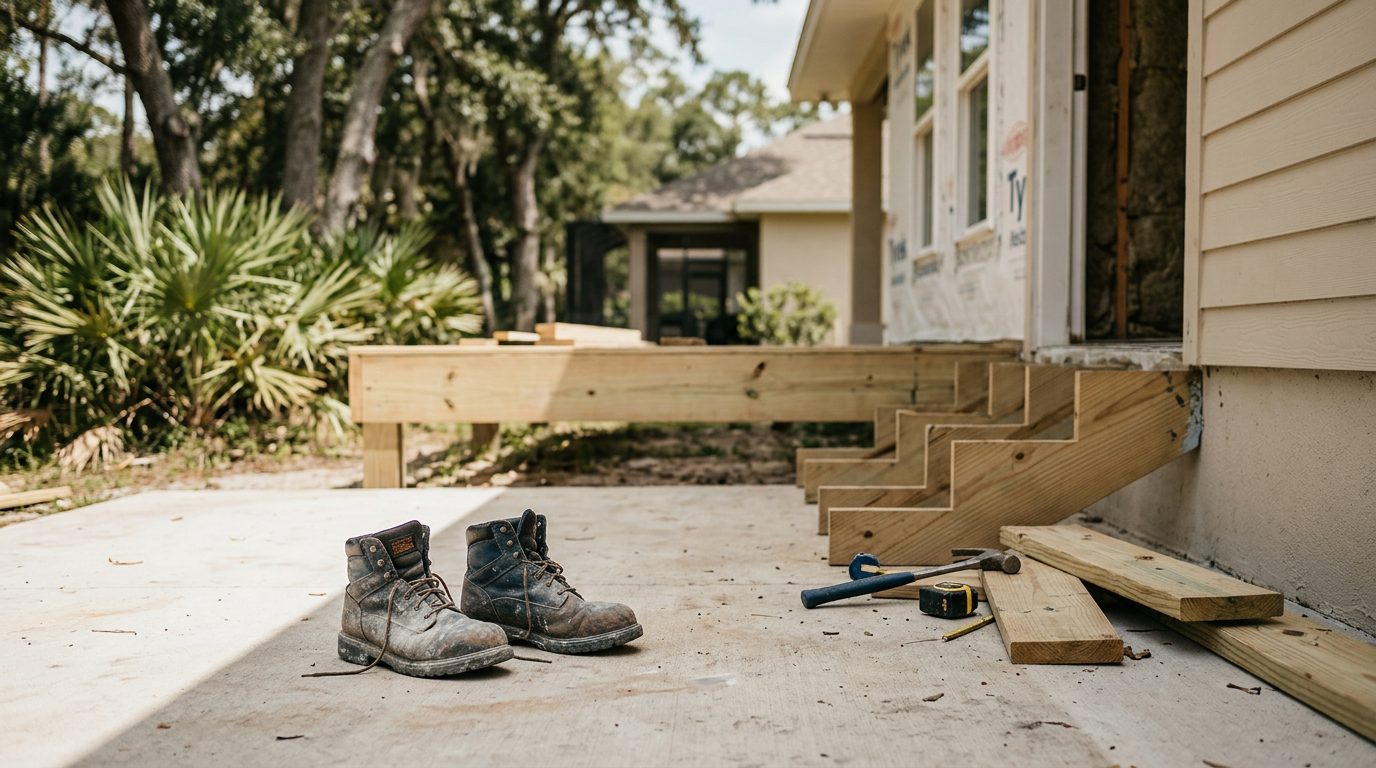
What Happens If a Contractor Walks Off the Job in Florida?
When a contractor walks off the job in Florida without a valid reason, the owner usually has a breach of contract problem. The contract, the timeline and your written records shape what comes next. Acting early helps you keep those records intact.
This page explains the first steps, the common legal questions and the deadlines that can apply. It is general information, not advice on your specific project.
If your contractor stopped showing up and your money is tied up in an unfinished project, you don't have to sort out the contract alone. Call Ayala Law PA at (305) 570-2208 to talk through what you already have. Talk it through with our team — we can walk you through how a situation like yours is usually handled and what your options are.

Immediate Steps After a Contractor Stops Work
Start by writing down what happened and when. Record the date the contractor last worked on site, what work was finished and what is still missing. Take dated photos and video, and save every text, email and call log.
Next, pull the signed contract. Look for a time-is-of-the-essence clause, notice requirements, a completion date and any payment or dispute terms. These terms shape your later rights, so read them before you send anything.
Protect the site. Secure the property, keep receipts for materials and temporary repairs, and avoid paying new amounts unless the terms are in writing.
A written demand is a common first formal step. Send it to the address listed in the contract, using a method that gives you proof of delivery. The wording matters. State what the contract requires, what has not happened and a reasonable deadline to respond.
Can a Contractor Walk Away From a Job?
Construction disputes often turn on the written contract and the reasons a party gives for stopping work.
Some stoppages are different. A contractor may have a contract-based reason to stop, such as nonpayment after proper written notice and a chance to fix the problem. Walking away without notice is a different situation.
Several facts usually matter. How long did the work stop? What did the contract’s deadlines say? Did the contractor give a reason in writing, and does that reason match the contract? Did the contractor ever return to the site?
A stated reason is not automatically a justification. A dispute over change orders, for example, does not excuse leaving the job on its own. The reason gets checked against the contract and the facts of the project. No two projects look the same, so the answer depends on the details.
Ending the Contract Properly in Florida
Most contracts explain how either side may end the deal. Look for required written notice, the delivery method and a cure period. A cure period gives the contractor a set time to fix the problem.
Owners sometimes end a contract too fast. If you skip the notice steps, the contractor may argue you broke the contract, and that creates a dispute of your own. Following the steps protects you.
Document the termination notice carefully. State the default clearly, describe what must happen to fix it and list the deadline. Keep proof of delivery and a copy of the notice.
Before you hire a replacement, check what the contract says about termination and about who may finish the work. Some contracts limit how you can hire someone else or require notice first.
Deposits, Payments, and Money Already Spent
A breach of contract damages guide can explain the categories in more detail.
Evidence drives the numbers. Payment records, invoices, canceled checks and bank statements show what you paid and when. Keep them together with the contract and any change orders.
A deposit’s treatment depends on what the contract says about it and how much work was done before the contractor left. Some deposits cover materials or specific tasks. Read the deposit language first, then match it to the payment records.
What an Unlicensed Contractor Changes
Florida’s contractor licensing is overseen by the Department of Business and Professional Regulation. Its Florida construction licensing information explains license requirements and includes license verification.
Check the contractor’s license status early. Licensing status can change the remedies available and how a claim is framed, so it affects your recovery plan and any lien questions. The facts of each project decide which remedies remain.
Print the license verification page with the date you checked it, and save it with your project file.
Not sure what your next step is?
Talk it through with our team — we can walk you through how a situation like yours is usually handled and what your options are.
Liens, Subcontractors, Suppliers, and Materials Left Behind
When a contractor leaves bills unpaid, subcontractors and suppliers may claim lien rights against the property. Florida’s construction lien law is a useful starting point for understanding construction liens. Those deadlines are strict, so timing matters.
Florida construction lien filing procedures and deadlines are set by statewide law in Chapter 713 of the Florida Statutes, not by county-specific rules.
Materials left on site need a clear record. Make an inventory with dates and photos. Note who paid for each item. That record shows what was on site and who may have a claim to it.
Before you release more money, ask subcontractors and suppliers for lien waivers or proof of payment. A lien waiver is a signed document in which a party gives up lien rights for amounts already paid. Ask for one with each payment.
Warranty Questions After an Abandoned Project
The length of a contractor’s warranty depends on the written warranty and the contract’s terms. Read those documents first, because they set the answer.
A warranty on finished work is separate from the duty to finish unfinished work. Abandonment can affect both. A contractor who leaves may still owe repairs on completed work, while the unfinished portion raises a separate question.
Florida also sets time limits for construction claims. Florida law sets a limited time to file an action founded on the design, planning or construction of an improvement to real property, so the timing of a claim should be reviewed early. That period runs from the earliest of the certificate events or the date of abandonment if the work is not completed. A latent defect can change the start date.
A contract cannot shorten the time you have to sue. Under Fla. Stat. § 95.03, a contract provision that sets a shorter period than the statute is void. Keep copies of warranties, manufacturer documents, permits and inspection reports for the work completed.
Litigation Options and Attorney Fee Provisions
The usual paths run from a written demand to negotiation, then mediation or arbitration if the contract calls for them, and finally a lawsuit. The contract often decides which steps apply.
Florida courts may send many money disputes to mediation. Under Fla. Stat. § 44.102, a court must refer a filed civil action for monetary damages to mediation on a party’s request, unless an exception applies. One exception applies when the parties agreed to binding arbitration.
An arbitration clause can also control the forum. Under Fla. Stat. § 682.02, an agreement in a record to arbitrate a controversy is valid and enforceable, except on grounds that exist for revoking any contract.
Where a lawsuit is filed matters too. Under Fla. Stat. § 47.011, actions must be brought in the county where the defendant resides, where the cause of action accrued, or where the property in litigation is located.
Attorney fee clauses need careful reading. If a contract lets one party recover fees for enforcing it, the court may allow fees to the other side when that side prevails. An attorney fees guide explains how fee recovery works in these disputes.
Talk Through Your Situation With Ayala Law PA
You may be dealing with a contractor who stopped mid-project, a deposit that is gone, a partly finished addition or a lien notice that arrived after the work stopped. Those moments are stressful, and decisions often come quickly.
Eduardo A. Maura is the responsible lawyer for this page. Ayala Law PA focuses its practice on business litigation, commercial litigation, contract disputes, shareholder disputes, construction litigation, real estate litigation and international trade litigation. Clients in Tampa, Hillsborough County, Brandon, Riverview, Plant City, Temple Terrace and the wider Tampa Bay area are served from the firm’s only office, located in Tampa at 1646 W Snow Ave.
Can a contractor walk away from a job in Florida?
The contract terms and the facts of the stoppage decide the answer.
How long do I have to sue over an abandoned construction job?
Florida sets a four-year period for many construction claims, starting from the earliest certificate event or the date of abandonment. A contract cannot shorten that period.
Can a contractor’s stated reason excuse stopping work?
Not automatically. The stated reason is checked against the contract and the facts of the project.
Fees depend on the facts of each matter, and the office explains how fees work when you call. If your contractor walked off the job and you need to talk through the contract, the deposit or the lien risk, call Ayala Law PA at (305) 570-2208 or visit our contact page.



