
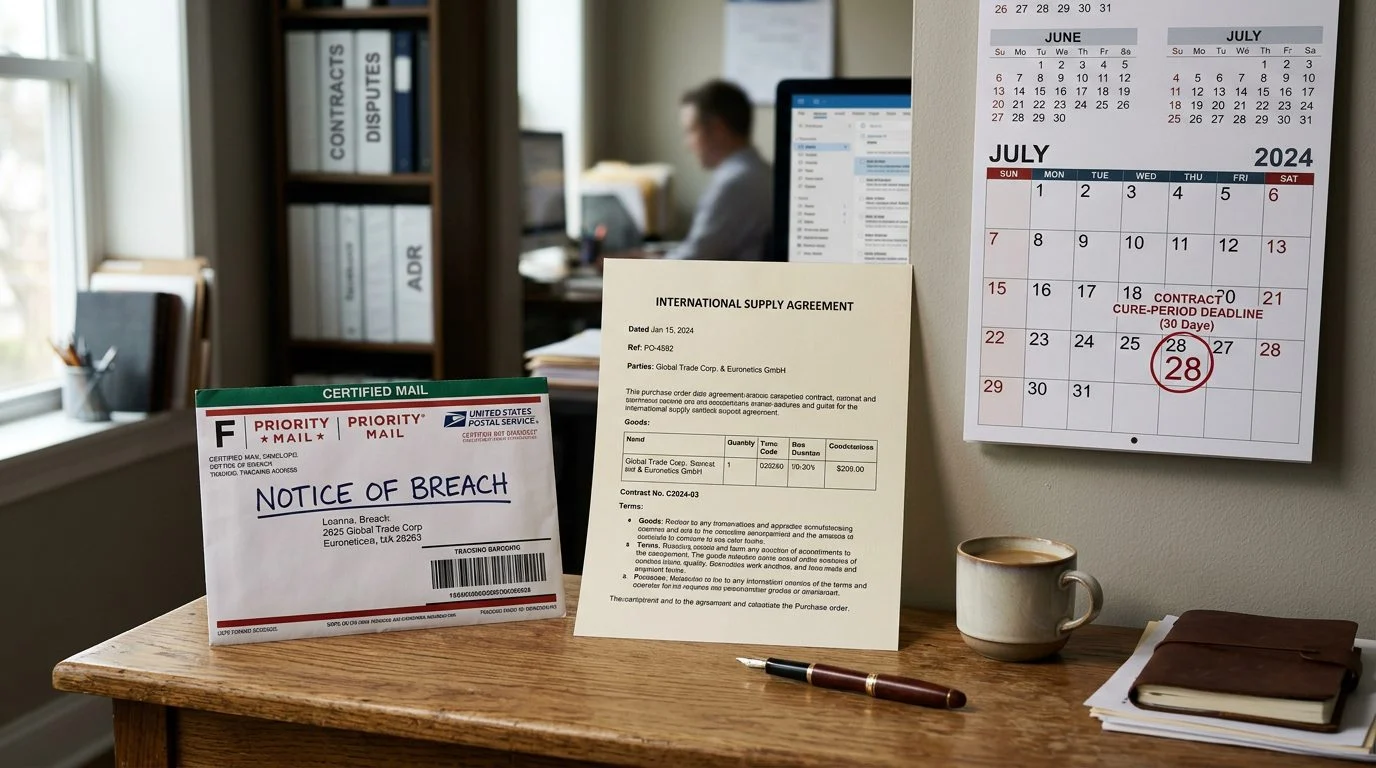
Arbitration vs litigation in an international contract is a choice about who decides a dispute and where. In arbitration, a neutral arbitrator or panel decides the case in a private process. In litigation, a court decides it under public court rules. The wording of your contract usually determines which path applies.
If your business buys, sells, builds or invests across a border, this choice affects cost, timing, privacy and how a result gets enforced. This page explains those trade-offs in plain terms, with Florida law where it applies. It doesn’t predict how any particular dispute would turn out.
What Arbitration and Litigation Mean in a Cross-Border Contract
Arbitration is a private process where a neutral decision-maker resolves the dispute. Litigation means filing a case in a court. Arbitration is not an informal talk. It still involves lawyers, documents, witnesses and a final decision that binds the parties.
Four terms appear in most international contracts:
- Arbitration clause: a promise to send future disputes to arbitration.
- Forum selection clause: names the court or place where a case will be heard.
- Governing law: the law that interprets the contract, such as Florida law or another country’s law.
- Seat of arbitration: the legal home of the arbitration, which can determine which courts oversee it.
The same dispute can look very different depending on which terms the parties chose. A clause that picks Florida law and a Florida court leads somewhere else than a clause that sends the case to a foreign arbitration center.
If your company has a supply, distribution or construction contract with a foreign party and can't tell whether a dispute would go to arbitration or to court, we're glad to talk through your clause with you. Talk it through with our team — we can walk you through how a situation like yours is usually handled and what your options are.
Why the Dispute Clause Often Decides the Forum
In most cross-border contracts, the dispute clause decides whether a claim goes to arbitration or to court. Parties set this when they sign, while they still agree. Once a fight starts, agreeing on a new path is much harder.
The exception is grounds that exist to revoke any contract. If a suit is brought in a federal court on an issue referable to arbitration under a written agreement for arbitration, the court must, on application of one of the parties and once it is satisfied the issue is referable to arbitration, stay the trial of the action until arbitration has been had in accordance with the terms of the agreement, provided the party asking for the stay is not in default in proceeding with the arbitration.
The court decides whether an arbitration agreement exists and whether a controversy falls under it. Florida arbitration code
A forum selection clause does a different job. It points to a particular court, while an arbitration clause points to a private process. When the two overlap or conflict, a court may have to decide which one controls. Read them together. For the broader context, see our international trade litigation overview in Florida.
Cost and Time: How the Two Paths Compare
Arbitration and litigation both cost money, but they spend it in different places. Arbitration costs usually include the institution’s fees, the arbitrators’ pay, the hearing venue and translation. Litigation costs usually include court filing fees, motion practice, discovery, trial and any appeal.
Arbitration can move faster when the parties agree to a tight schedule and a narrow set of issues. That speed isn’t automatic. Court calendars, appeals and the work of serving papers on a party abroad can stretch a court case. An arbitration can also slow down if the parties fight over the arbitrator, the venue or the rules.
Total cost and time depend on the facts. Those include the number of parties, the amount in dispute, where witnesses and documents are located, and how many procedural fights happen along the way. Two similar contracts can produce very different bills.
Many international sales and construction contracts name the International Chamber of Commerce. According to the ICC arbitration guidance, ICC arbitration follows the ICC Rules of Arbitration when parties agree to it, including after a dispute arises.
Confidentiality and Discovery
Arbitration is usually private, while court cases are generally public. Filings in a lawsuit are generally open to the public. Arbitration hearings and awards are usually not, but only if the contract or the chosen rules say so. Don’t assume privacy. Check the clause.
Discovery is the exchange of documents and testimony before a trial or hearing. In court, discovery follows court rules and can be broad. In arbitration, discovery is usually narrower and often set by agreement or by the arbitrator. A narrower process can save time, but it may give each side less access to the other’s records.
Cross-border evidence adds steps. Documents held abroad may need formal requests, translation and extra time. The forum you choose affects how those requests get handled.
Priorities matter too. Some businesses want a public ruling others can read. Others want a payment or construction dispute kept quiet. The choice of forum should reflect which priority matters more.

Enforcing a Judgment or Award Across Borders
An award or a court judgment only helps if it can be enforced where the losing party or its assets sit. Enforcement across borders depends on treaties and on the rules of the country where you need to collect. Plan for that before you sign.
Florida has its own rules for contracts with a Florida tie. For contracts entered into on or after June 27, 1989 (or earlier contracts if the action is commenced on or after that date), and to the extent permitted under the United States Constitution, a person may maintain an action or proceeding in Florida against a person or entity residing or located outside Florida, if the action arises out of or relates to a contract for which Florida law has been chosen under § 685.101 and which contains a provision by which the outside party agrees to Florida jurisdiction. Fla. Stat. § 685.102
Domestic and international arbitration can differ in the seat, the governing law, the institutional rules and the enforcement path. Those can change when a party or asset sits outside the United States. If the money or equipment is in another country, that location can shape which forum makes sense.
Can an Arbitration Award Be Appealed?
A court can set aside an arbitration award only on the grounds Florida lists, and the challenge has a deadline. Grounds for challenging an arbitration award, such as corruption or fraud, depend on the statute that governs the arbitration and the facts of each case. Grounds for vacating an arbitration award can include evident partiality by a neutral arbitrator or an arbitrator exceeding powers, depending on the statute that governs the arbitration.
Certain orders in arbitration proceedings can be appealed, including an order denying a motion to compel arbitration, an order confirming an award, and an order vacating an award without directing a rehearing. Some parties write an appeal process into the arbitration clause, and that process applies only if the clause spells it out.
Not sure what your next step is?
Talk it through with our team — we can walk you through how a situation like yours is usually handled and what your options are.
When Litigation May Fit Better Than Arbitration
Litigation can fit better when you need a court’s power on short notice or want a public ruling. Some situations call for urgent relief, such as an order to halt a party from moving assets. Claims involving people who never signed the arbitration clause can also be harder to combine in one arbitration.
A public court decision creates a record others can read. Some companies value that. Others want to avoid it.
If the other side ignores an award, you often need a court to confirm it. A court can then use its own enforcement tools. Arbitration depends on the parties following the award or on a court’s help.
Even a claim you think is weak can go to arbitration if the clause covers it. Treat these points as factors to weigh, not as a forecast of which forum will help you more.
Reviewing Your Dispute Clause Before a Problem Arises
The right time to choose between arbitration and court is before a dispute, while the contract is still open. Read the dispute clause with the people who negotiated the deal. Check these terms:
- The forum: arbitration, a named court, or both.
- The governing law and the seat of arbitration.
- The arbitration rules and the language.
- The number of arbitrators.
- Confidentiality terms.
- Any carve-out for urgent court relief.
- Any negotiation or mediation steps required before filing.
According to the ICC clause guidance, an international sales clause should name the governing law, the place of arbitration and the language. It should also avoid ambiguous wording that can delay a dispute.
Ayala Law PA focuses on business litigation, including commercial and contract disputes, shareholder and partnership disputes, construction litigation, real estate litigation and international trade litigation in Florida courts and arbitration. Eduardo A. Maura is the responsible lawyer for this page. The firm’s office is at 1646 W Snow Ave in Tampa, Florida, and it serves businesses in Hillsborough County and the wider Tampa Bay area.
If your company has a foreign supply, distribution or construction contract and can’t tell whether a dispute would go to arbitration or court, call Ayala Law PA at (305) 570-2208 or use our contact page to discuss the clause.
Frequently Asked Questions
Is arbitration also litigation?
Arbitration is a separate private process, not a court case. Courts can still enforce or review arbitration in limited ways.
What is the purpose of an arbitration clause?
It tells the parties how a future dispute will be resolved. That includes the forum, the rules and the number of arbitrators.
Can arbitration awards be appealed?
Florida law limits challenges to listed grounds.
Who decides arbitration questions?
Fla. Stat. § 682.02 divides these questions between the court and the arbitrator: the court shall decide whether an agreement to arbitrate exists or whether a controversy is subject to such an agreement, while an arbitrator shall decide whether a condition precedent to arbitrability has been fulfilled and whether a contract containing a valid agreement to arbitrate is enforceable.



