
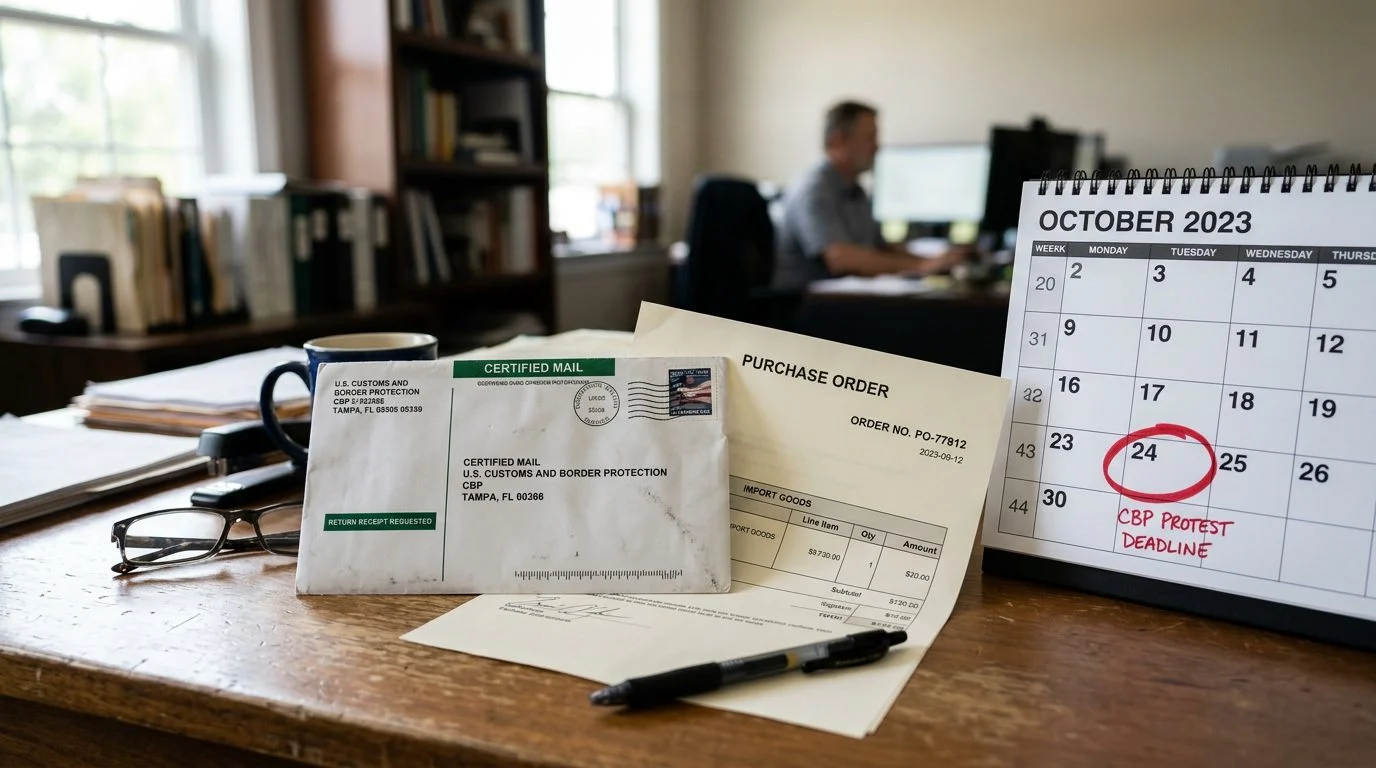
The Short Answer: The CBP Protest Deadline Is Tied to Liquidation and Notice
The CBP protest filing deadline is short, and it is tied to liquidation. Liquidation is the point at which U.S. Customs and Border Protection (CBP) settles the duty owed on an import entry. If you have a liquidation notice, its date is the first thing to check.
Many importers assume the clock starts when they open the notice or pay the bill. That assumption causes trouble. In customs matters, the dates on entry and liquidation paperwork can affect how a dispute is handled, so those records are worth reviewing carefully with a lawyer. A missed window can leave a decision in place that you wanted to challenge.
Treat that date as the most important number on the notice. Write it down, count forward, and check it against your entry records. The window matters most when money is at stake, so start the check early.
If a liquidation notice has arrived on entries your business imported, the filing window may already be running. Reach out to our office so we can check the dates with you. Talk it through with our team — we can walk you through how a situation like yours is usually handled and what your options are.
What a CBP Protest Is and How It Works
A protest is a formal written challenge to a customs decision. It is how an importer asks CBP to review a decision it disagrees with. A protest is a legal filing, not an informal question or a general complaint.
Because the filing is formal, the wording matters. A clear protest identifies the entry, names the decision being challenged, and states the reasons for the disagreement. A vague request for a second look gives CBP less to review.
A protest concerns a specific entry, so the filing should name that entry. Keep proof of when and how the filing was sent. That proof helps if the timing is ever questioned.
People often ask how to file a complaint against CBP. A protest is a specific type of challenge, and a general complaint is a different thing. Confusing the two can waste time you do not have.
Why the Liquidation Date Controls the Clock
Liquidation is the step at which CBP finally sets the duty on an entry. The liquidation notice shows that date. Timing questions about a CBP protest depend on the facts of each entry and the notices involved.
Business owners often mix up the import date and the liquidation date. They are different dates. The import date is when the goods entered. Liquidation is a separate event that comes later in the process.
Each entry can have its own liquidation date. Goods brought in during one month may be settled at a different time than goods brought in later. A business with many entries needs to track each one, not just the most recent shipment.
Surprises often come from older entries. A notice on an entry from a year ago may still have an open window. Review older notices as well as new ones.
Counting the Days to Your CBP Protest Filing Deadline
Mark the last day on your calendar, and set an earlier internal target. Plan to file well before that last day.
Waiting until the final day leaves no room for missing documents or internal delays. Build in time to gather the entry records and review the reasons for the protest. Calendar tools can help, but check the math by hand for at least one entry so you know the method works.
Keep a simple record for each entry. Note the entry number, the liquidation date from the notice, the deadline you calculated, and the date you filed. Clear records make the timeline easy to show later.
The Rules That Govern Protests
Protests follow procedural rules. Those rules cover what a filing must contain and how it is submitted. Following them is necessary, but it is not the whole job.
A protest that follows every procedure can still be decided against the importer. The procedure gets a challenge in front of CBP. It does not decide whether the challenge is right. Strong reasons matter as much as correct paperwork.
The facts drive the outcome of the review. The entry documents and the reasons for disagreeing shape the filing. Gather them early, before the deadline is close.
Document everything. Keep copies of the notice, the entry records, the protest, and proof of filing. These records support the timeline and the reasons you raise.
If a Protest Is Denied: What Comes Next
A denied protest is not always the end of the matter. Other steps may follow, and each one can involve different filings and different timing. Keep your entry records organized as the matter moves.
Some import disputes are really contract disputes. A disagreement with a supplier or buyer may turn on the terms of the contract between them. Those terms can decide who bears a cost and who must act.
For some international commercial disputes, the parties may agree to arbitration. According to the American Arbitration Association, arbitration is a private, legally binding option for international commercial disputes.
Contracts may also contain attorney-fee clauses. If a contract lets a party recover fees for enforcing it, a court may also allow reasonable fees to the other party when that party wins.
Not sure what your next step is?
Talk it through with our team — we can walk you through how a situation like yours is usually handled and what your options are.
Talk to Ayala Law PA About Your Deadline
Ayala Law PA focuses on international trade litigation, along with business, contract, and construction disputes. Eduardo A. Maura is the responsible lawyer for this page. The firm’s only office is in Tampa, and it takes on matters for businesses in Tampa, Hillsborough County, and the wider Tampa Bay area.
If a liquidation notice has arrived on entries your business imported, the filing window may already be running. Contact our office so we can review the dates on each notice with you.
Quick Answers
When does the CBP protest clock start?
The answer depends on the facts of each entry and the notices involved, so contact our office to discuss your situation.
What should I do first?
Find the liquidation date on every notice and calculate the deadline for each one.
Do you handle customs disputes for Tampa businesses?
We focus on international trade litigation. Our only office is in Tampa, and we take on matters for businesses in the Tampa Bay area.



