
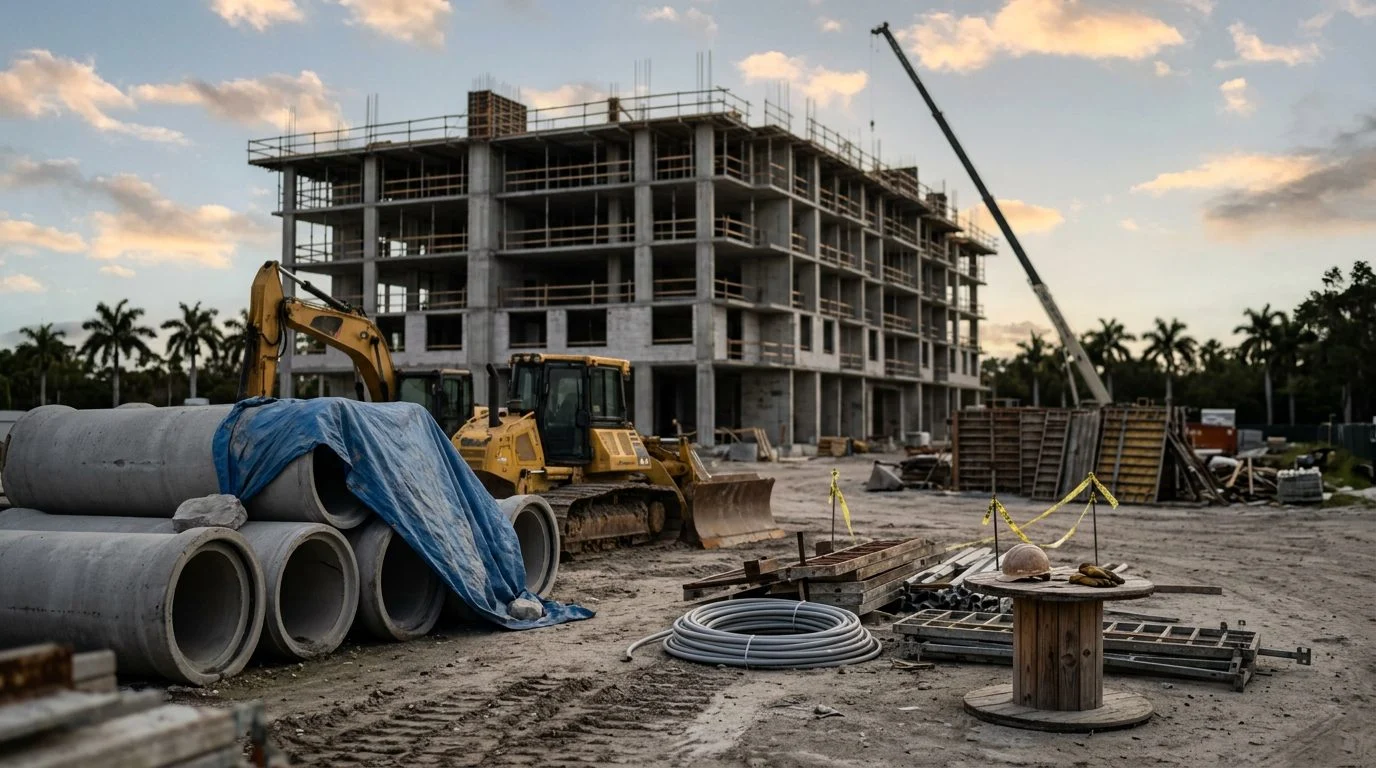
Construction Project Problems in Florida: The Core Questions
Construction project problems Florida businesses face usually come down to four questions. Who was paid? Who is still owed? What does the written contract say? Which deadlines apply? Answer those early and you keep more options open.
The most common disputes follow a few patterns. Payment stops somewhere in the project chain. A contractor walks off before the job is finished. An owner refuses to pay for work it calls flawed. Someone misrepresents facts to win work or move money. Each pattern raises different legal questions, and each one has its own clock.
Timing is the part people underestimate. A deadline can start on a date you never expected, such as the issue of a certificate you may never see. Write down the key dates as soon as a problem appears. Ayala Law PA focuses on construction litigation and contract disputes in Florida courts and arbitration. The sections below cover each pattern, the rules that set your timing, and the records worth gathering now.
Not sure what your next step is?
Talk it through with our team — we can walk you through how a situation like yours is usually handled and what your options are.
Payment Disputes Between Owners, Contractors and Subcontractors
Payment problems usually begin where money stops moving down the project chain. The owner pays the general contractor. The general contractor pays subcontractors and suppliers. When one link stops paying, the businesses farther down often feel it first.
The written contract decides much of what happens next. Many subcontracts tie payment to whether the party above has been paid. Some use wording that makes payment depend on the owner paying first. Read that language closely before you assume you’re covered. A clause that looks minor can decide who carries the risk.
Records make or break these disputes. Keep a payment ledger from the first day. Log each invoice, the date it went out, the amount, the work it covered, and every partial payment. Save emails and texts about approvals, change requests and complaints.
Don’t let a payment stall drift. Send a written demand that states the amount owed, the work it covers and the date you expect payment. A clear written record helps whether the dispute ends in a settlement or in a lawsuit.
Florida Deadlines That Control Construction Claims
The clock doesn’t start when the fight begins. It starts when the authority with jurisdiction issues a temporary certificate of occupancy, a certificate of occupancy or a certificate of completion. If the job is never finished, it starts on the date construction is abandoned. The earliest of those dates controls.
Hidden problems change the math. When the claim involves a latent defect, meaning a flaw you could not see with reasonable care, Florida’s four-year limitations period, set by Fla. Stat. § 95.11(3)(b), begins on the date the defect is found or reasonably should have been found. Even then, suit must be started within seven years after the certificate or abandonment date, whichever is earliest.
Repair work doesn’t automatically restart the clock. For construction done under a duly issued building permit and covered by the certificate, correcting or repairing completed work does not extend the deadline, even under a warranty. Pull your permit and certificate records early, because the rule turns on those dates.
A contract cannot shorten the deadline. Under Fla. Stat. § 95.03, a contract clause that sets a shorter time to sue than the statute allows is void. A counterclaim or third-party claim that arises out of the same conduct, transaction or occurrence as the pleading may also be filed within one year after that pleading is served, even if it would otherwise be late, under Fla. Stat. § 95.11(3)(b).
Arbitration Clauses in Construction Contracts
If your construction contract requires arbitration, Florida law generally enforces that promise. An arbitration clause can move your dispute out of court. Under Fla. Stat. § 682.02, a written agreement to arbitrate existing or future disputes is valid, enforceable and irrevocable. The exception is a ground that exists in law or equity for revoking a contract.
The court decides whether an agreement to arbitrate exists and whether a dispute falls under it. An arbitrator decides whether a condition set before arbitration has been met. Under Fla. Stat. § 682.03, a court may not refuse to order arbitration because the claim lacks merit. If the court orders arbitration, it must stay the court case on the claim subject to arbitration.
Timing rules also interact with arbitration. Under Fla. Stat. § 95.051, the pendency of an arbitral proceeding tolls the running of the limitations period. The statute applies to an arbitration pertaining to the dispute that is the subject of the action, so the match between the proceedings matters. Read the clause before you file anything, because the wrong forum can cost time and money.
Contractor Walk-Offs and Abandoned Projects
A contractor who walks off a job often leaves stopped work, unanswered calls and an unfinished punch list. The written contract is the first document to check. It usually sets out notice rights, deadlines and how the job can end.
Start with a timeline. Note when work stopped, what remains unfinished, what you paid and what you were promised. Keep photos of the site and copies of every notice you sent. These records show who breached the agreement and when.
Common options include a written notice to cure, which gives the contractor a set chance to fix the problem if the contract allows it. Termination under the contract’s own terms is another path. You may also seek recovery of overpayments and the extra cost of finishing the job with another builder. Each option has conditions. A wrong move can hand the other side a claim, so check the notice and termination terms before you withhold money or end the contract.
Owner Refusals to Pay for Finished Work
When an owner refuses to pay for finished work, the reason is often a claim of defects, delay or cost overruns. Those claims are tested against the contract, the change orders and the project records. The owner’s complaint does not settle the question.
A contractor or subcontractor can pursue the unpaid balance through a breach of contract lawsuit or through arbitration, depending on the contract. Your records carry the case. Signed change orders show agreed extra work. Daily logs show dates and delays. Inspection reports and written approvals show what was accepted.
Fee clauses matter too. Under Fla. Stat. § 57.105, if a contract allows attorney’s fees to a party that must enforce it, a court may allow fees to the other party when that party prevails. A fee clause can work in either direction, so read it before you file. The same statute allows sanctions against claims or defenses that lack support in the material facts or existing law. A sanctions motion must be served 21 days before it can be filed, giving the other side time to fix or withdraw the challenged paper.
Not sure what your next step is?
Talk it through with our team — we can walk you through how a situation like yours is usually handled and what your options are.
Construction Contract Fraud and Misrepresentation
Construction contract fraud happens when a builder or payee lies to win work or takes money it has no right to keep. Common examples include misrepresented licensing or insurance, inflated billing and money moved away from the project. Fraud claims depend on specific facts and documents, not general complaints.
Florida law also reaches transfers made to avoid paying creditors. Under Fla. Stat. § 726.105, a transfer is fraudulent if made with actual intent to hinder, delay or defraud a creditor. The court may consider factors such as a transfer to an insider or a debtor who was sued or threatened with suit before the transfer. Under Fla. Stat. § 726.106, a transfer without reasonably equivalent value can also be fraudulent as to an existing creditor when the debtor was insolvent at the time.
Fraud timing depends on discovery. Under Fla. Stat. § 95.031, a fraud claim runs from when the facts were discovered or should have been discovered with due diligence. It must still begin within 12 years after the fraud was committed.
Florida’s consumer statute may also apply, depending on the facts. Under Fla. Stat. § 501.204, unfair or deceptive acts in trade or commerce are unlawful. Under Fla. Stat. § 501.211, a person who suffered a loss may recover actual damages, plus attorney’s fees and court costs as provided in s. 501.2105.
Construction Defects, Incomplete Work and Residential Disputes
A construction defect is work that does not meet the contract, the approved plans or the required building standards. Ordinary wear and owner-requested changes are different. A defect is a failure in the work itself, and that distinction often decides the claim.
Many defects hide behind finished walls, under slabs or inside roofing systems. Those latent defects raise the discovery questions covered above.
Defect claims usually arise as breach of contract disputes, and they often involve money. An owner may withhold payment for repairs while the contractor sues for the balance. Each side’s position depends on the contract terms, the repair records and the timing of notices.
Residential and commercial projects can raise different facts. A homeowner may have different records and expectations than a business owner who signed a commercial agreement. The contract language and the project file shape the case in either setting.
Evidence, Records and Timing to Protect Before Taking Action
The records you gather in the first few weeks often shape how a construction dispute is framed. Collect the signed contract, every change order, payment applications, invoices, correspondence, daily logs, photographs, and permit and inspection records. Missing records are easier to fix early than late.
Build a timeline showing when work was done, when payment came due, when notices went out and when problems first appeared. Under Fla. Stat. § 95.031, a cause of action accrues when the last element constituting it occurs. Several dates may matter at once, including the certificate date, the discovery date, the default notice date and the payment due date. Each can control a different deadline.
Claims built on documents are easier to defend. Under Fla. Stat. § 57.105, a court may award fees and sanctions when a party knew or should have known that a claim was not supported by the material facts or by existing law. Gather the facts before you put a claim in writing.

Florida Options and Where Ayala Law PA Serves Construction Clients
Most construction disputes move through a written demand and negotiation first. If those fail, the next step is a notice or cure process, a breach of contract lawsuit in Florida courts, or arbitration when the contract requires it. The right order depends on the contract, the dates and the amount at stake.
Ayala Law PA is located at 1646 W Snow Ave in Tampa, Florida, and that is the firm’s only office. Ayala Law PA maintains its office in Tampa. Clients in Tampa, Hillsborough County, Brandon, Riverview, Plant City, Temple Terrace and the wider Tampa Bay area are served from the firm’s only office in Tampa.
Frequently asked questions
How long do I have to sue over a construction defect in Florida?
For hidden defects, the clock runs from discovery, but suit must be started within seven years of the certificate or abandonment date.
Does an arbitration clause keep a construction dispute out of court?
Florida generally enforces written arbitration agreements, under Fla. Stat. § 682.02. Whether a clause covers your claim depends on its wording.
Can a contract shorten the time to file suit?
No. Under Fla. Stat. § 95.03, a contract clause that sets a shorter time to sue than the statute allows is void.
Can I recover attorney’s fees in a construction contract dispute?
Possibly. If the contract allows fees to the party that must enforce it, a court may allow fees to the other side when that side prevails, under Fla. Stat. § 57.105.
If a stalled job, an unpaid balance or a suspicious payment has you checking your dates right now, contact Ayala Law PA at (305) 570-2208 or through the contact page to talk through your project.



