
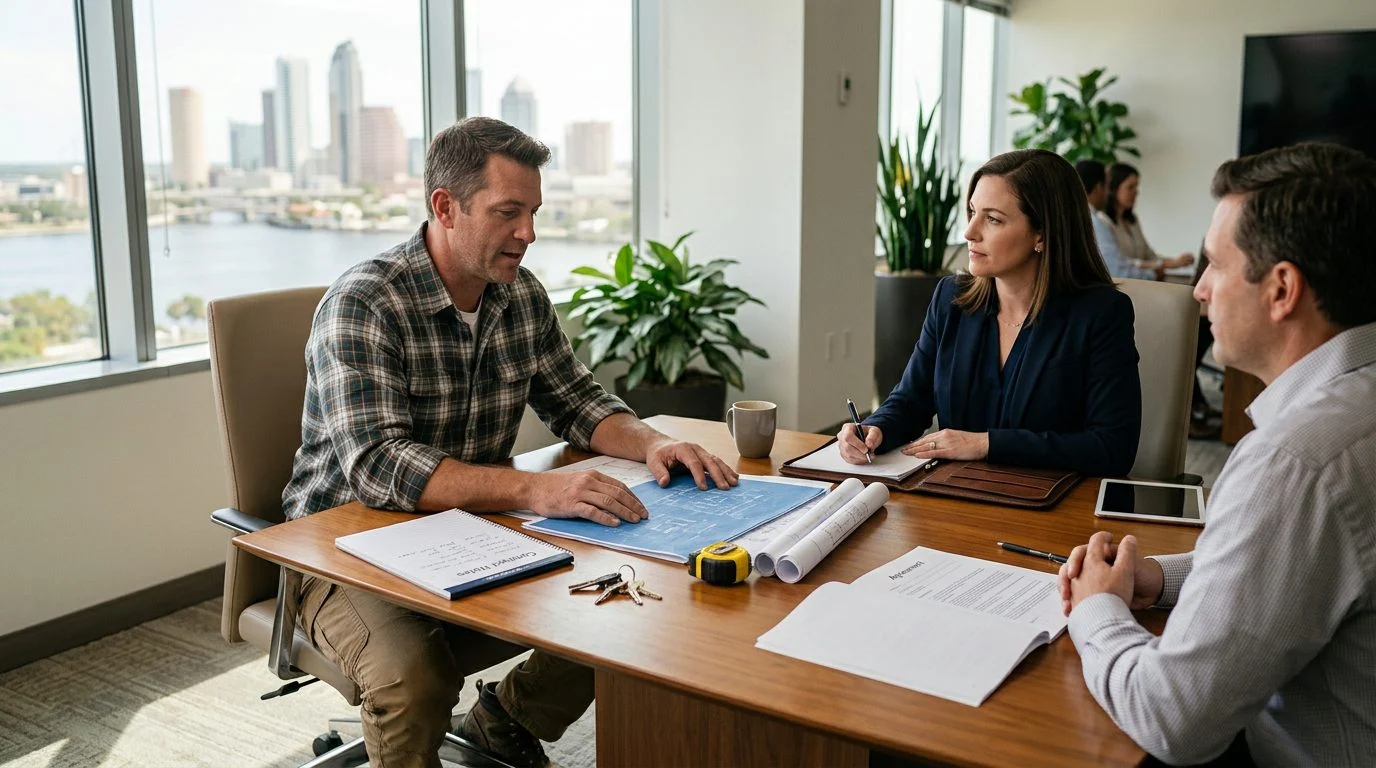
A contractor dispute is a disagreement over money, work or termination under a construction contract. If you need a contractor dispute lawyer Tampa businesses can reach, Ayala Law PA handles these claims in Florida courts and arbitration. This page explains the common claims, how the contract picks the forum, and what to gather before you reach out.
What a contractor or subcontractor dispute covers
A contractor dispute is a disagreement between a general contractor and a subcontractor, or between a contractor and an owner, over payment, performance or termination under a written construction contract. The fight usually comes down to what the contract says and what happened on the job.
This page is for general contractors, subcontractors and suppliers facing an unpaid balance, a withheld payment or a subcontract that ended mid-project. Builders in Tampa, Brandon, Riverview, Plant City, Temple Terrace and across Hillsborough County run into these problems.
Ayala Law PA limits its practice to business litigation, commercial litigation, contract disputes, shareholder disputes, construction litigation, real estate litigation and international trade litigation. Construction litigation, which covers contractor and subcontractor disputes, is one of those areas.
If a stalled progress payment or a terminated subcontract has you weighing your options, reach out to Ayala Law PA to set up a case evaluation. Talk it through with our team — we can walk you through how a situation like yours is usually handled and what your options are.

Claims this page covers
Most contractor claims involve unpaid money, unpriced extra work or a contract that ended early. Each one needs its own proof.
- Unpaid contract sums: progress billings, final payment and retainage the other side is holding back.
- Change orders: extra work that was done or directed but never priced, approved or paid.
- Wrongful termination: a subcontract or prime contract ended in a way the contract does not allow.
- Delay claims: added costs from schedule slips, idle crews and disrupted work, measured against the contract’s notice and time-extension terms.
Start gathering records early. Useful items include:
- The signed contract and any amendments
- Change order requests and written approvals
- Payment applications and invoices
- Daily logs and schedules
- Emails, letters and any formal notices sent or received
Pay-when-paid and pay-if-paid clauses in Florida
Pay-when-paid and pay-if-paid clauses tie a subcontractor’s payment to the owner’s payment. The exact wording shapes the dispute. Two similar-sounding phrases can lead to very different arguments, so read the actual sentence, not a summary.
Ask a few practical questions. Does the clause set a payment date? Does it require notice before you can make a claim? Did the owner actually pay the contractor? Your own payment schedule, notices and records can shape how the dispute is framed.
Lien rights run on a separate track. A lien claim can run alongside a contract claim, so review both early. How a clause applies depends on the contract and the project’s facts.
Litigation or arbitration: how the contract decides the forum
The dispute resolution clause in your contract usually decides whether a claim goes to court or to arbitration. Look for words such as “arbitration,” “mediation,” “venue” and “governing law.”
Florida law generally enforces written arbitration agreements. Under Fla. Stat. § 682.02, an agreement in a record to submit a controversy to arbitration is valid, enforceable and irrevocable, unless a ground exists to revoke a contract. Section 2 of the Federal Arbitration Act provides that a written provision in a contract evidencing a transaction involving commerce to settle by arbitration a controversy arising out of that contract or transaction is valid, irrevocable, and enforceable, save upon such grounds as exist at law or in equity for the revocation of any contract.
If the other side refuses to arbitrate, Fla. Stat. § 682.03 lets a court order arbitration when an enforceable agreement exists. The court may not refuse only because the claim lacks merit.
For court cases, Fla. Stat. § 47.011 says an action must be brought in the county where the defendant resides, where the cause of action accrued, or where the property in litigation is located. Under Fla. Stat. § 44.102, a court must refer most filed civil actions for money damages to mediation when one party asks and is willing and able to pay the costs, unless an exception applies.
How the process works from first call to resolution
A contractor dispute usually moves through five steps: intake, a deadline check, a written demand, a filing or arbitration demand, and resolution.
- Intake and case evaluation. You share the contract, payment history and timeline with the responsible lawyer.
- Deadline and notice review. Contract and lien notices can run before any lawsuit is filed.
- Demand or notice of claim. A written demand can open talks or mediation, depending on the contract.
- Filing or arbitration demand. The forum follows the clause, then discovery and motions begin.
- Resolution. The matter may settle, or move to a hearing, trial or arbitration award.
Time limits matter most. Florida law sets deadlines for filing construction claims, so timing matters early in a dispute. The clock runs from the earliest of a temporary certificate of occupancy, a certificate of occupancy, a certificate of completion or abandonment of unfinished work. Under Fla. Stat. § 95.11(3)(b), as amended in 2023, the seven-year repose period runs from the earliest of the temporary certificate of occupancy, certificate of occupancy, certificate of completion, or abandonment of construction, not from the date a latent defect is discovered, and a separate four-year limitations period also applies.
Under Fla. Stat. § 95.03, a contract clause that sets a shorter time to sue than the statute is void. Common mistakes include waiting to send written notice, leaving change orders unwritten and relying on texts alone. Those gaps can narrow your options. How long each step takes depends on the court or arbitrator’s calendar, the amount in dispute and the record.
Why Ayala Law PA for contractor disputes
Ayala Law PA is a business litigation practice that focuses on construction litigation, along with the other areas listed above.
This page is the responsibility of Eduardo A. Maura, and the firm’s bona fide office is located in Tampa, Florida. The firm’s only office is at 1646 W Snow Ave in Tampa, Florida. The firm handles contractor and subcontractor matters for businesses in Tampa and Hillsborough County in Florida courts and arbitration, and its only office is in Tampa, Florida.
Our team, including assistants and office staff, helps with intake and organizing documents. The legal work rests with Eduardo A. Maura. The scope of this page is the practice areas and forums described above.
Not sure what your next step is?
Talk it through with our team — we can walk you through how a situation like yours is usually handled and what your options are.
Frequently asked questions
Can a subcontractor sue a general contractor for an unpaid balance in Florida?
Often, yes. The contract, the notices and the facts decide which claims are available.
Does a pay-if-paid clause mean I can never get paid?
Not necessarily. The clause’s exact wording and the facts of the project decide how it applies.
Should my dispute go to court or arbitration?
The dispute clause in your contract usually controls. Bring the contract to your case evaluation.
How long do I have to file?
The answer depends on the claim. Florida law sets filing deadlines for some construction claims, so it is important to act promptly.
Is there a fee for a case evaluation?
The firm does not offer a free consultation. Fee terms are discussed directly with you.

Next step for a contractor with an unpaid balance or terminated subcontract
If a progress payment has stalled or a subcontract ended before the work was finished, your next step is a case evaluation. Gather the contract, change orders, payment applications and notices before you reach out. Call (305) 570-2208 or request a case evaluation through the Ayala Law PA contact page.



