
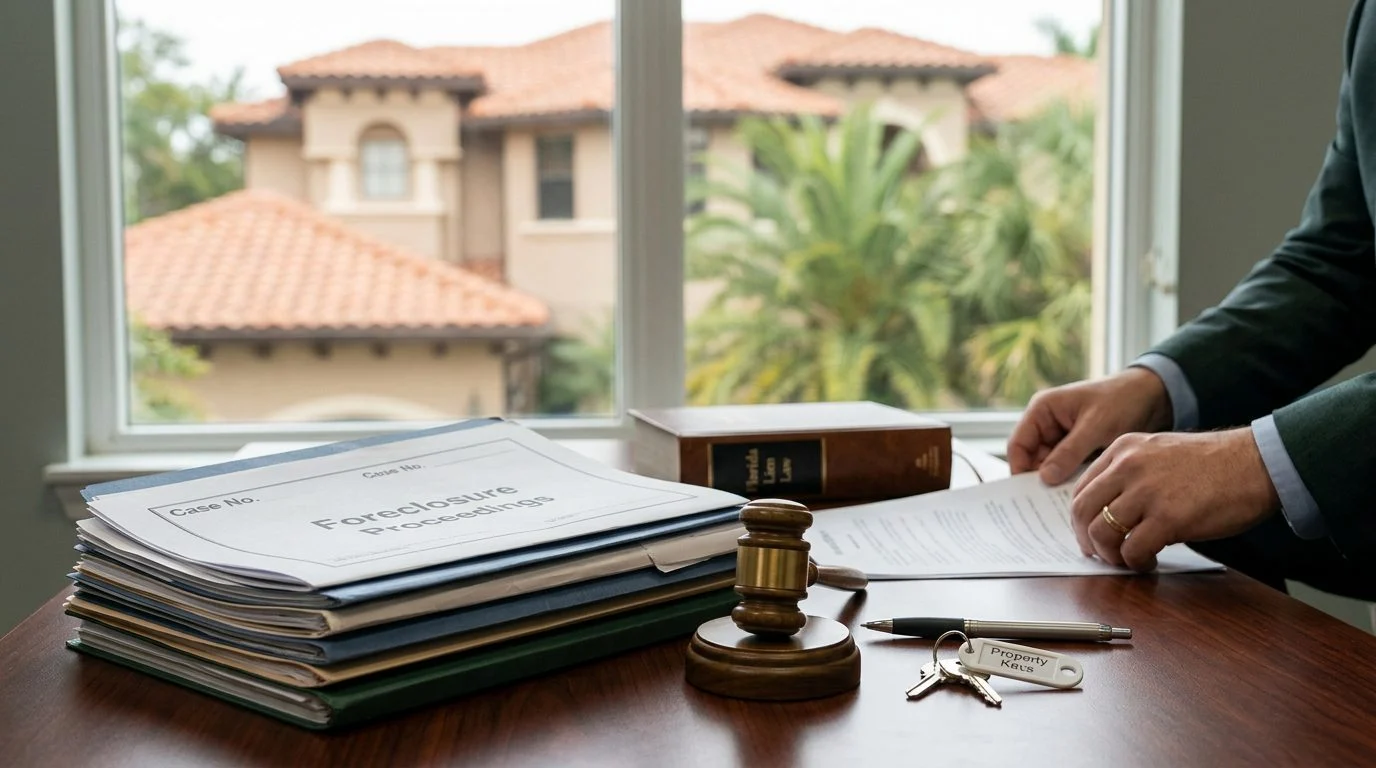
Foreclosing a construction lien in Florida means filing a lawsuit that asks a court to enforce a claim of lien against a property. The lien usually comes from unpaid work or materials on a building or improvement project. Business owners, contractors, subcontractors and suppliers in Tampa and Hillsborough County often face this process while a deadline is already running.
Looking for a lien foreclosure attorney Florida businesses can call? Start with how the process works.
What Does It Mean to Foreclose a Construction Lien in Florida?
To foreclose a construction lien means to ask a court to enforce the lien against the property. The lien is a legal claim tied to the land, not just a bill. Construction lien rights depend on the facts of each project, and the steps to preserve them are worth reviewing early. It covers notices to owner, claims of lien, deadlines, lien foreclosure and fraudulent liens.
Lien foreclosure happens through a lawsuit filed in court. The main parties are usually:
- The lienor: the contractor, subcontractor or supplier making the claim.
- The property owner.
- Lenders or other lienholders with rights in the property.
- Sometimes a surety on a payment bond.
Each party may have different rights and defenses. Who the parties are shapes how the case is built.
If a claim of lien showed up on a project you didn't choose, you don't have to sort out the deadlines alone, and our team can talk through your papers with you. Talk it through with our team — we can walk you through how a situation like yours is usually handled and what your options are.
Who Does Lien Foreclosure Affect?
Lien foreclosure affects anyone whose money or property is tied to a construction job. Common situations include:
- Property owners who received a notice or claim of lien on a project they believed was paid.
- General contractors facing a lien from a subcontractor or supplier, or chasing an unpaid balance.
- Subcontractors and suppliers who are owed money and need to know what enforcement requires.
- Commercial owners and developers whose title is clouded by a lien during a sale or refinance.
A recorded lien can stall a sale or loan while the payment dispute is still open. Often the lien is only one part of a larger contract fight.
What Does Our Construction Litigation Work Cover?
Our construction litigation work covers both sides of a lien case: enforcing a lien and defending against one. Ayala Law PA focuses on business, commercial, contract, shareholder, construction, real estate and international trade litigation in Florida courts and arbitration. Lien work sits within the construction side of that practice.
- Defending a lien suit. We review whether the lien was recorded and served properly, and whether the claimed amount is supported by the records.
- Challenging amounts. We look for unsupported extras, duplicate charges and work the records show was never performed.
- Contract fraud issues. When a lien ties to a fraud claim, the case may involve both the lien and the fraud issue.
- Enforcing a lien. We prepare and file the claim and the enforcement lawsuit where timing and documents allow.
- Payment bond claims. These follow their own timing rules, explained below.
What Deadlines Control a Lien Foreclosure Case?
Deadlines control most lien cases, and the clock can start before anyone files suit. A cause of action accrues when its last element occurs. Except as provided in subsection (2), in s. 95.051 and elsewhere in the statutes, the time to sue runs from that point (§ 95.031).
Under § 95.11, an action founded on the design, planning, or construction of an improvement to real property must be commenced within 4 years, with the time running from the date the authority having jurisdiction issues a temporary certificate of occupancy, a certificate of occupancy, or a certificate of completion, or the date of abandonment of construction if not completed, whichever date is earliest. When the action involves a latent defect, the time runs from when the defect is discovered or should have been discovered with the exercise of due diligence. In any event, the action must be commenced within 7 years after the date the authority having jurisdiction issues a temporary certificate of occupancy, a certificate of occupancy, or a certificate of completion, or the date of abandonment of construction if not completed, whichever date is earliest. It runs from the earliest of the temporary certificate of occupancy, certificate of occupancy, certificate of completion, or the date construction was abandoned. For a latent defect, the time runs from the time the defect is discovered or should have been discovered with the exercise of due diligence, but in any event suit must be commenced within 7 years after the earliest certificate or abandonment date. Even then, suit must start within seven years of that earliest date.
Venue also matters. Under § 47.011, actions must be brought where the defendant resides, where the cause of action accrued, or where the property in litigation is located; this rule does not apply to actions against nonresidents. When the property sits in Hillsborough County, that last option can point to Hillsborough County.
Exact dates depend on the project’s records and notices. Treat any deadline in a notice or summons as urgent the day it arrives.
How Does a Lien Foreclosure Case Usually Proceed?
A lien foreclosure case usually moves from document review to pleadings, discovery, and then settlement or trial. Timing depends on the facts, the court calendar and whether the parties settle. The stages below are typical, not fixed.
- Document review. We review the lien, the contract, change orders, invoices, payment records and notices.
- Deadline check. We confirm which limitations periods and venue rules apply.
- Pleadings. A complaint or response sets out each side’s claims and defenses.
- Discovery. Both sides exchange payment records, change orders and project communications.
- Mediation. On the request of one party, a court must refer a filed action for monetary damages to mediation. This applies if the requesting party is willing and able to pay the costs, or the costs can be equitably divided between the parties (§ 44.102). Under § 44.102, a court, under rules adopted by the Supreme Court, must, upon request of one party, refer to mediation any filed civil action for monetary damages, provided the requesting party is willing and able to pay the costs of the mediation or the costs can be equitably divided between the parties, unless an exception applies, such as an action filed for the purpose of collecting a debt.
- Settlement or judgment. The case ends in a settlement, or a judgment if the parties don’t resolve it.
How Can a Lawyer Stop or Narrow a Lien Foreclosure?
A lawyer can challenge a lien on timing, paperwork, the contract or the amount. No particular result can be promised, and each matter turns on its own documents and timing.
- Timing. We check whether the suit was filed within the periods in § 95.11.
- Amount. We test whether the claimed sum includes extras, duplicates or work never done.
- Contract coverage. Where an express contract covers the same subject matter, claims arising out of that contract will not support unjust enrichment (Williams v. Johnson).
- Settlement offers. Under § 45.061, which does not apply to causes of action that accrue after the effective date of the act, a written offer shall remain open for 45 days unless withdrawn sooner by a writing served on the offeree prior to acceptance by the offeree. For claims the section covers, the offeror’s motion for sanctions must come within 30 days after entry of judgment.
- Under § 90.408, evidence of a compromise offer on a disputed claim, as well as any relevant conduct or statements made in negotiations concerning a compromise, cannot be used to prove liability or absence of liability for the claim or its value. This protects lien release and partial-payment talks.
Not sure what your next step is?
Talk it through with our team — we can walk you through how a situation like yours is usually handled and what your options are.
How Are Attorney’s Fees and Costs Handled in Florida Lien Cases?
In Florida, each side generally pays its own attorney’s fees unless a contract or statute provides otherwise (Price v. Tyler). Fee shifting exists in some situations:
- Contract fee clauses. When a contract lets one party recover attorney’s fees for having to enforce it, Florida law at § 57.105 also allows the court to award reasonable attorney’s fees to the other party if that party prevails in any action on the contract, whether it brought the case or defended it. This applies to contracts entered into on or after October 1, 1988.
- Unsupported claims. Under § 57.105(1), a court may award a fee to the prevailing party where the losing side knew or should have known a claim or defense lacked support.
- Fee amounts. Whenever a court determines or awards attorney fees, § 57.104 sets a strong presumption that a lodestar fee is sufficient and reasonable.
Fee recovery is not automatic. Where the lawyer has not regularly represented the client, the basis or rate of the fee and costs must be communicated to the client, preferably in writing, under Rule 4-1.5. Lien cases can include filing fees, service and recording costs, bond costs, and inspection or witness fees where used. Ayala Law PA does not provide case evaluations as a no-fee service.
Why Work With Ayala Law PA on a Lien Matter?
Ayala Law PA focuses on business and construction litigation, including lien disputes in Florida courts and arbitration. Eduardo A. Maura is the responsible lawyer for this page. The firm’s support staff handles office and filing work for our team.
The firm’s bona fide office is at 1646 W Snow Ave, Tampa, Florida. The firm handles matters in Florida courts and arbitration for businesses located in Tampa, Hillsborough County, Brandon, Riverview, Plant City, Temple Terrace and the Tampa Bay area, from its Tampa office. A matter may be referred to another lawyer or law firm where appropriate.
If a lien notice or lawsuit has landed on a project you didn’t choose, the deadlines may already be running. Reach out to our team by calling (305) 570-2208 or by requesting a case evaluation.
Frequently Asked Questions About Lien Foreclosure in Florida
How can a lawyer stop a lien foreclosure?
A lawyer can review timing, paperwork and the amount, and raise defenses the facts support. No particular result can be promised.
Is lien foreclosure handled in court in Florida?
Yes. Lien enforcement in Florida happens through a lawsuit filed in court.
What does it mean to foreclose a lien?
It means filing a lawsuit that asks a court to enforce a claim of lien against a property.
What attorney’s fees are allowed in Florida lien cases?
Each side generally pays its own fees unless a contract or statute says otherwise. Whether fees are awarded depends on the facts.
Can a subcontractor who was not paid sue the property owner?
Lien rights depend on the project’s documents, notices and deadlines. Ayala Law PA can review those records with you.
Does a lien foreclosure always go to trial?
No. Some matters settle before trial, and the path depends on the facts and the parties.



