
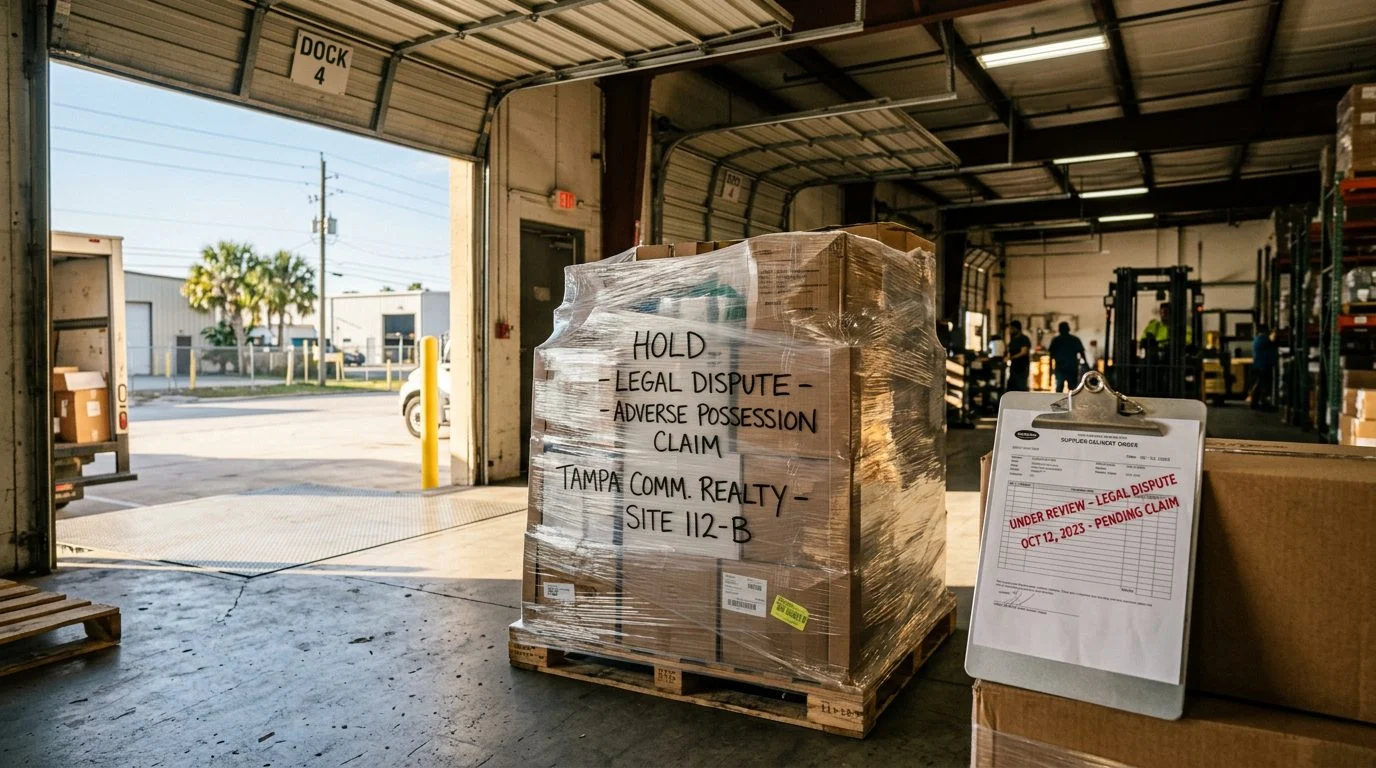
Someone is using part of a commercial property you own or manage, and you want to know how long that use has to last before it could become their land. Florida’s answer starts with seven years of continued possession. Which statute applies depends on whether the claimant has a written document, such as a deed, decree or judgment, behind the claim.
Seven years is only the starting point. Commercial parcels bring leases, shared driveways and permitted use into the picture, and each one can change whether the use counts at all. This guide covers how the period is counted, what Florida’s statutes require, and how these disputes usually move toward a court.
Short Answer: The Seven-Year Period for Adverse Possession in Florida
Florida’s adverse possession statutes generally require seven years of continued possession. Fla. Stat. § 95.16 covers possession under a written instrument, decree or judgment. Fla. Stat. § 95.18 covers possession without one, and adds tax and filing steps.
How the period applies to a specific parcel depends on the facts. The seven years measures how long possession must last. It does not measure how long a lawsuit takes, which is a separate question.
The count runs from the claimant’s possession. For an owner, the practical questions are when the use began and whether it has continued since.
If a neighbor, tenant or stranger is using part of a commercial property you own or manage, you don't have to work out the timing alone. Reach out to our team to talk through the facts of your parcel. Talk it through with our team — we can walk you through how a situation like yours is usually handled and what your options are.
What Adverse Possession Means for Commercial Property
Under § 95.18, adverse possession is a way for someone to claim title to land by occupying it for 7 years under a claim of title not founded on a written instrument, judgment, or decree, but only if the claimant pays, subject to s. 197.3335, all outstanding taxes and matured installments of special improvement liens within 1 year after entering possession, makes a return to the property appraiser within 30 days after that payment, and pays the taxes for all remaining years. The statute speaks of a claim of title “exclusive of any other right.” A use the owner allows does not fit that description well.
Commercial parcels are often used in plain view. Parking lots, loading zones, fenced storage yards and paved side lots are visible to the owner and to anyone who checks the property. That visibility can make the use easier to document, and easier for an owner to challenge.
Occupying land does not, by itself, move ownership. A claim of title is resolved by a court or settled by agreement. A claimant has to meet the statutory conditions, and an owner who disagrees has to respond through those same channels.
The Requirements Florida Statutes Set Out for Possession
The statutes describe what counts as possession. The type of use matters as much as how long it lasts. Under § 95.16, property counts as possessed when it has been usually cultivated or improved, protected by a substantial enclosure, or used for fuel, fencing timber or the ordinary use of the occupant, and when a known lot or single farm has been partly improved, the unimproved part is considered occupied for the same length of time as the improved part.
Fences matter on commercial land. If a substantial enclosure protects land, all of that land must be included in the written description. If only part is described, only that part is deemed possessed.
For claims without a written instrument, § 95.18 treats property as possessed if it has been protected by a substantial enclosure or cultivated, maintained or improved in a usual manner. Dates and photographs help show what was done and when.
Divided land raises another issue. Section 95.18 requires a full and complete legal description of the property subject to the adverse possession claim; the rule that possession of one lot is not possession of any other lot in the same tract is in § 95.16. A parcel that was subdivided needs a lot-by-lot review.
How the Seven-Year Clock Is Counted
The seven years must be continued possession. A gap in use can become a central fact in a dispute, because the claimant must show the possession lasted without a break.
Seasonal use, a change in how the land is used, or periods when the land sat unused all raise questions. Questions like these depend on the particular facts of each property.
Under § 95.16, the seven years is measured against the property described in the written instrument, decree or judgment. That description matters on a commercial parcel with multiple uses or multiple lots.
Keep a dated record. Start dates, improvements, fences, paving, tax payments and written notices are the records that tie a timeline together.
Color of Title, Taxes Paid, and the Return Requirement
Whether the claimant has a written instrument decides which statute applies and what the claimant must prove. Under § 95.16, possession under a deed, decree or judgment is the path with a written instrument.
For a possession that began after December 31, 1945, the claim is not adverse possession under color of title until the instrument is recorded with the clerk of the circuit court in the county where the property is located. Hillsborough County records are the place to check.
Under § 95.18, a claimant without a written instrument must pay all outstanding taxes and matured special improvement installments within one year after entering possession. Taxes are a real condition in this path, not a formality.
The same statute requires a return filed with the property appraiser on a Department of Revenue form within 30 days after the claimant pays those taxes.
A claim can be removed from the records. A claim can be removed from the records. That happens, among other grounds, when the claimant notifies the property appraiser in writing that the claim is withdrawn, when the owner of record provides a certified copy of a court order entered after the return was submitted establishing title in the owner of record, or when the property appraiser receives a certified copy of a recorded deed, filed after the return was submitted, from the claimant to the owner of record.
Defective deeds also matter. Check the chain of title for that.
Commercial Property Issues That Change the Timeline
On commercial land, leases, shared use and permission often decide the question before the clock does. Each one needs its own review.
Leases are the most common example. Part I of chapter 83 applies to nonresidential tenancies and all tenancies not governed by part II of this chapter, as § 83.001 states. A tenant’s use under a lease is generally the owner’s use, not an exclusive claim of title.
Shared driveways, parking areas and loading zones raise a different question. Keep those questions separate.
A sale, merger or inheritance can change who the owner of record is. Check the record after every transfer, because the owner you dealt with may no longer hold title.
Business owners should also review the lease file and any written permission. A document that shows the owner allowed the use can change the whole analysis.
Not sure what your next step is?
Talk it through with our team — we can walk you through how a situation like yours is usually handled and what your options are.
From Dispute to Court: How the Process Usually Moves
A commercial property dispute usually starts with a demand. If the matter is not resolved, it can move into a lawsuit asking a court to decide who holds title.
Lis pendens is one tool. Under § 48.23, an action operates as a lis pendens on property only if a notice is recorded in the official records of the county where the property is located. The notice generally expires one year after the action begins, unless the pending pleading shows the relief sought is founded on a duly recorded instrument or on a lien claimed under part I of chapter 713 against the property, or the court extends it on reasonable notice and for good cause.
Separate deadlines apply to recovery. Under § 95.12, no action to recover real property or its possession may be maintained unless the person seeking recovery or the person’s ancestor, predecessor, or grantor was seized or possessed of the property within seven years before the commencement of the action. That is a different clock from the adverse possession period.
Under § 95.031, a cause of action accrues when its last element occurs. The date that element occurs generally shapes when the time to sue starts running, subject to tolling: under s. 95.051, the running of time under any statute of limitations is tolled by listed events such as the absence of the person to be sued from the state. The fraud accrual rule is in a different section (s. 95.031), not in s. 95.051.
If a dispute goes to arbitration, § 95.051 provides that the pendency of an arbitral proceeding on the dispute tolls the limitations period. Federal cases go to the Tampa Division, under the Middle District of Florida local rules.
How long a case takes turns on the evidence, the court’s calendar and whether the parties reach agreement. No one can promise a timeline.
Protecting a Commercial Property While a Claim Is Unresolved
Start by collecting the records that show who used the property, when, and with whose permission. Title records, recorded surveys, lease files and tax payment history are the core set.
Write down any permission you gave and any objection you made. Keep copies of every notice sent and received. Dated written records are easier to rely on than memories.
Florida also has a limited path for removing unlawful occupants from commercial property. Under § 82.037, a property owner or authorized agent may request from the sheriff of the county where the owner’s commercial real property is located the immediate removal of any person unlawfully occupying it, but only if all of the conditions in subsection (1), paragraphs (a) through (g), are met, including that there is no litigation related to the property pending between the owner and the unauthorized person. The owner’s sworn complaint must state that no litigation is pending between the owner and the person to be removed.
That path carries risk. A person harmed by a wrongful removal may recover actual costs and damages, statutory damages equal to triple the fair market rent, court costs and reasonable attorney fees.
Can a tenant claim adverse possession of commercial property?
A tenant’s use under a lease is generally the owner’s use, not an exclusive claim of title. The lease terms and any written permission matter.
How long does a lis pendens last in Florida?
Under § 48.23, a notice of lis pendens generally expires one year after the action begins, unless the pending pleading shows the relief sought is founded on a duly recorded instrument or on a lien claimed under part I of chapter 713 against the property. The court can extend it for good cause.
Do I have to pay property taxes to claim adverse possession in Florida?
Under § 95.18, a possessor in actual continued possession for 7 years under a claim of title not founded on a written instrument, judgment, or decree must, subject to s. 197.3335, pay all outstanding taxes and matured special improvement liens within one year after entering possession; make a return to the property appraiser within 30 days after complying with that payment requirement; and subsequently pay all taxes for all remaining years necessary to establish a claim of adverse possession.
Does a commercial parcel need a recorded deed for adverse possession?
Under § 95.16, a claim based on a written instrument is not color of title for possession starting after December 31, 1945, until the instrument is recorded.
Talk With Ayala Law PA About Your Tampa Commercial Property
If someone else is using part of a commercial property you own, manage or inherited, you’re dealing with a situation you didn’t choose. You don’t have to sort out the timing alone.
Ayala Law PA focuses on business litigation, including real estate litigation, in Florida courts and arbitration. Eduardo A. Maura is the lawyer responsible for this page. The firm serves Tampa, Hillsborough County and the Tampa Bay area from its Tampa office at 1646 W Snow Ave, Tampa, FL 33606.
To talk through the facts of your parcel, contact the firm through its contact page or call (813) 414-5715. Fees for a case evaluation are discussed with you before any work begins.



