
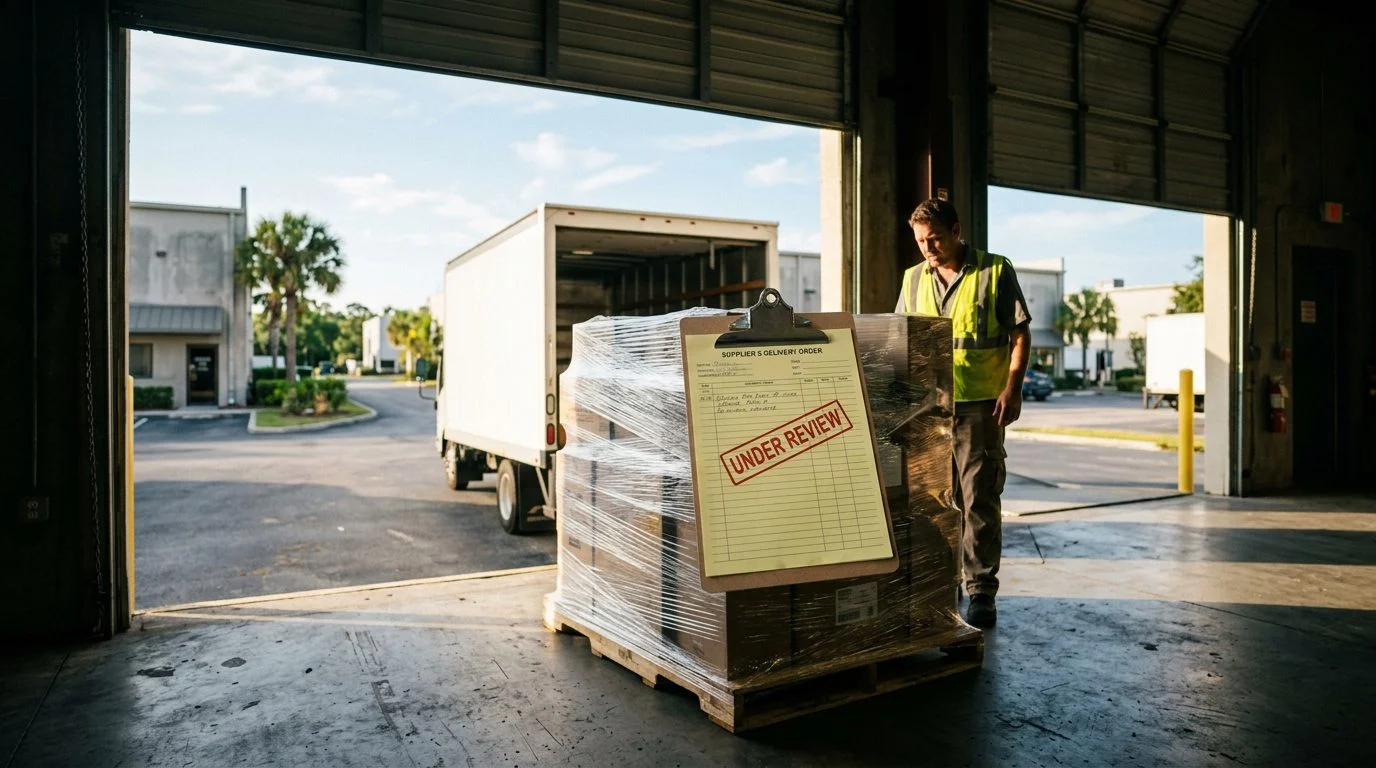
A blocked driveway, a loading dock you can’t reach, or a utility line a neighbor won’t honor can stall a business fast. This page explains what a commercial easement dispute in Tampa is and how a Florida lawsuit over access usually moves forward.
An easement is a legal right to use someone else’s land for a set purpose. The recorded documents are where that fight starts.
What a Commercial Easement or Access Dispute Is
A commercial easement dispute happens when two sides disagree about who may use part of a property, and for what. For a business, that use is usually a shared drive, parking, loading, utility lines or drainage.
Access matters because customers, delivery trucks, employees and emergency vehicles all need a route in and out. When that route closes, daily operations stop with it.
The source of the right shapes the case. An express easement is written into a deed, a plat or a recorded agreement. Other access claims rest on different grounds, such as necessity, and need their own review.
Business owners, commercial landlords and tenants, developers, neighboring owners and HOA or association boards often sit on opposite sides of these disputes.
Not sure what your next step is?
Talk it through with our team — we can walk you through how a situation like yours is usually handled and what your options are.
Common Commercial Access Disputes in Hillsborough County
Most of these fights start with a physical change: a gate, a barrier, a parked truck or a relocated drive.
- A shared driveway between commercial lots is gated, blocked or narrowed.
- Parking spaces, loading docks or service routes are reassigned or fenced off.
- The parties disagree on scope, such as whether a drive allows heavy truck traffic or a new use of the land.
- A new owner or neighbor obstructs a drainage, sewer or utility easement.
- Someone tries to move or narrow an existing route without the holder’s agreement.
Owners in Brandon, Riverview, Plant City and Temple Terrace face the same issues on their own lots. Some cases also raise title or survey questions, which get reviewed alongside the easement itself.
What Commercial Easement Litigation Can Include
Easement litigation asks a court to define the right and stop any interference with it. A typical case can include:
- Document review of the deed, plat, recorded easement, prior agreements and title records, to pin down what the right covers.
- Declaratory relief, meaning a court ruling on what the easement allows and what it does not.
- Injunctive relief, meaning an order to stop interference or remove an obstruction while the case moves forward, where the facts and law support it.
- Damages for lost income, added costs or property harm, where the evidence supports them.
- Claims tied to a contract, such as a lease, cross-access agreement or maintenance covenant that governs the route.
Florida circuit courts can issue injunctions and hear actions involving the title and boundaries of real property, under Fla. Stat. § 26.012. For a defendant who lives in Florida, Fla. Stat. § 47.011 generally limits suits to the county where the defendant resides, where the claim arose, or where the property is located. For many Tampa-area properties, that points to Hillsborough County.
How the Process Works, Step by Step
Most access disputes move from paperwork to a written demand before anyone files suit.
- Intake. You describe the obstruction, the parties, the business impact and any notices already received.
- Document review. The team pulls the recorded instruments, surveys and correspondence that define the right.
- Written demand. A letter goes to the other side. Check any notice or cure clause closely.
- A notice of lis pendens, once recorded in the county where the property sits, puts later buyers and lenders on notice. Fla. Stat. § 48.23 reads: “(1)(a) An action in any of the state or federal courts in this state operates as a lis pendens on any real or personal property involved therein or to be affected thereby only if a notice of lis pendens is recorded in the official records of the county where the property is located and such notice has not expired pursuant to subsection (2) or been withdrawn or discharged.” Under Fla. Stat. § 48.23, it generally expires one year after the case starts, unless the pending pleading shows the claim is founded on a duly recorded instrument or a chapter 713 lien, or the court extends it for good cause.
- Mediation. Under Fla. Stat. § 44.102, a court must, on one party’s request, refer a filed civil action for money damages to mediation. This applies if the requesting party is willing and able to pay the costs of the mediation or the costs can be equitably divided between the parties, unless an exception applies.
- Resolution. The case ends in a settlement, a court ruling or a trial. Timelines vary with the record and the court’s calendar.
Documents to Gather and Why Timing Matters
Gather the recorded documents first, because they define the right you are trying to protect.
- Deeds, plats, recorded easements, title commitments or owner’s policies, and surveys showing the route.
- Leases, cross-access or shared maintenance agreements, and HOA or association documents where they apply.
- Photos, videos, dated notices, emails and texts showing the obstruction and when it began.
- Records of lost sales, missed deliveries, rerouting costs or other business impact.
Deadlines come from statute, and they run from different events. Under Fla. Stat. § 95.11, the statute sets four years for an action for trespass on real property and one year for an action for specific performance of a contract. Under Fla. Stat. § 95.031, the time generally runs from when the cause of action accrues. Because each claim has its own clock, earlier review keeps more options open.
Why Work With Ayala Law PA on a Tampa Access Dispute
Ayala Law PA focuses its practice on business litigation, including commercial and contract disputes, shareholder and partnership disputes, construction litigation and real estate litigation. The firm handles these matters in Florida courts and arbitration.
- The firm serves Tampa, Hillsborough County and the Tampa Bay area from its office at 1646 W Snow Ave, Tampa, FL 33606.
- Eduardo A. Maura is the lawyer responsible for this page. Our team, including support staff, handles document gathering, filings and client communication.
- No outcome can be promised. Each access dispute turns on its own recorded documents, facts and governing law, and past matters do not predict a new one.
Not sure what your next step is?
Talk it through with our team — we can walk you through how a situation like yours is usually handled and what your options are.
Frequently Asked Questions About Commercial Easement Disputes
Most access questions come down to the recorded documents and the timing of a claim.
Can we settle a blocked-access dispute without filing a lawsuit?
Often the parties start with a written demand, and some disputes resolve at that stage. If they don’t, a lawsuit remains available.
Can a court order a gate or parked vehicles removed?
A Florida circuit court can issue injunctions, and the outcome turns on the record and governing law.
Does a lis pendens affect a property sale?
A recorded notice can put buyers and lenders on notice of a pending case. It generally expires one year after the case starts unless the pending pleading shows the claim is founded on a duly recorded instrument or a lien under chapter 713, or the court extends it for good cause.
Does the firm handle matters outside Tampa?
The firm serves Tampa, Hillsborough County and the Tampa Bay area from its Tampa office.
How much does a case evaluation cost?
Fees for a case evaluation are discussed when you call (813) 414-5715.
Contact Ayala Law PA About Your Tampa Access Dispute
Access disputes move faster when the recorded documents are reviewed early.
If a gate or parked truck is cutting off your customers or your loading dock right now, you don’t have to sort through the paperwork alone. Call (813) 414-5715 or book a case evaluation so your deed, easement and access records can be reviewed. The office is at 1646 W Snow Ave, Tampa, FL 33606. For more on the firm’s business litigation work, see business litigation in Hillsborough County.



