
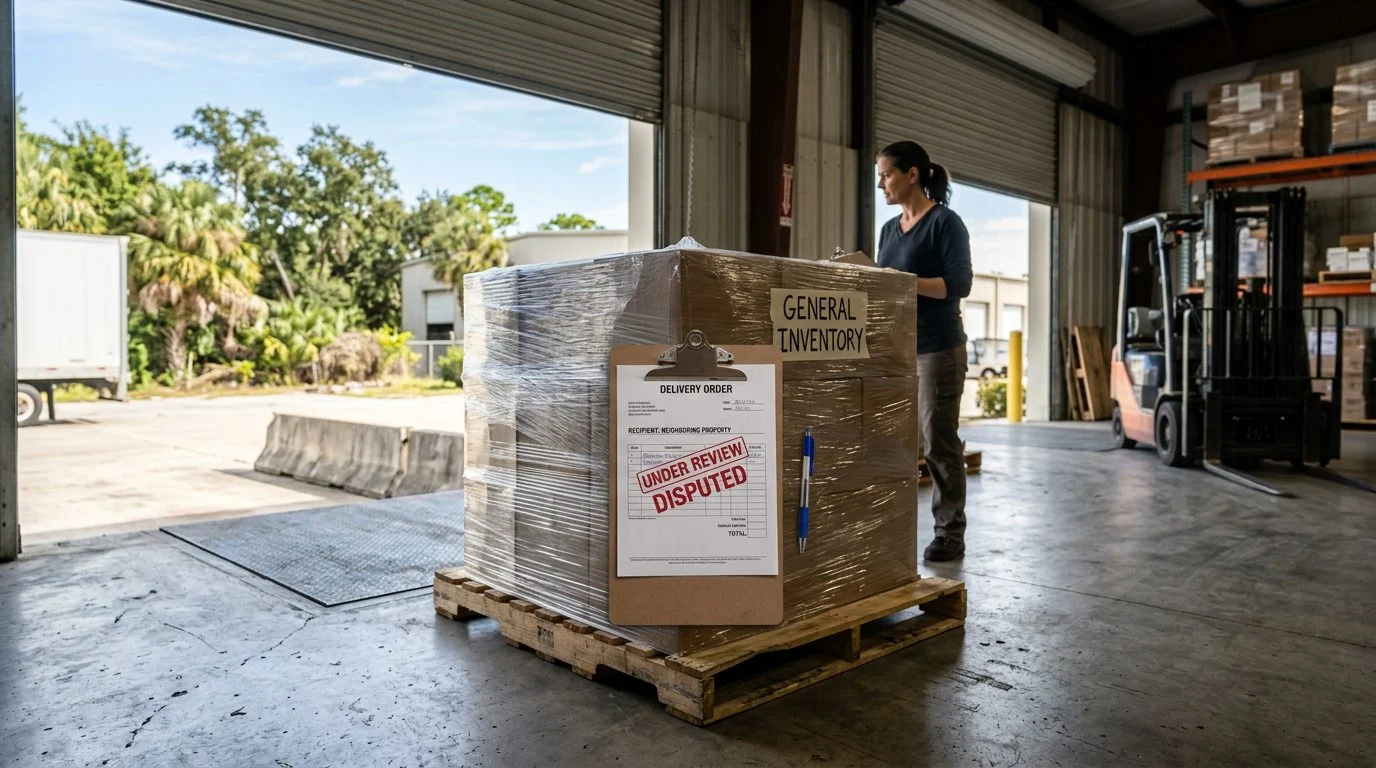
Finding that a neighbor built on your property line in Tampa is unsettling. On a commercial lot, the problem can reach a tenant, a buyer, or a lender before you have a plan.
A neighbor’s structure on your commercial lot is a boundary problem. You can address it through records, written notice, a negotiated fix, or a lawsuit in Florida court. The right path depends on how the structure got there, how long it has stood, and what the records show.
What Is an Encroachment on a Commercial Lot?
An encroachment is an improvement, such as a building, wall, fence, or parking area, that extends past the legal boundary onto a neighboring lot.
On a commercial lot, the stakes run higher than they do with a backyard fence. Parking spaces, loading access, signs, and driveway width all affect how a business runs. Lenders and buyers also look closely at the survey and the title.
Encroachments start in different ways. A contractor may have staked the building wrong. An earlier owner may have built the wall. Sometimes a site plan never matched the lot. The cause affects which options make sense, so write down what you know about where the structure came from.
This page gives general information. Every dispute turns on its own records, so the outcome of any one matter can differ from another.
If a neighbor's structure now sits on your commercial lot, you don't have to sort out the records alone. Call (813) 414-5715 or request a case evaluation at https://www.lawayala.com/contact/. Talk it through with our team — we can walk you through how a situation like yours is usually handled and what your options are.

Which Records Show Where the Boundary Is?
The deed’s legal description, any recorded plat, and a current boundary survey are the main records that show where your lot ends. Pull all three and compare them side by side.
A survey by a licensed Florida surveyor is usually the strongest evidence. An older survey, or a fence line someone assumed was the boundary, may not match the legal description. If you rely on an old survey, ask whether it reflects the current lot lines.
Keep a file of dated photos, permit records, construction plans, and emails or letters about when the structure appeared. Save the original photo files, not screenshots, so the dates stay intact.
Write a simple timeline of visits, notices, repairs, and conversations with the neighbor. Timing matters because it can decide which legal periods apply. A timeline is often the first useful document you can build.
Does the Seven-Year Rule Let a Neighbor Take Your Land?
Florida’s adverse possession rules sit in Chapter 95 of the Florida Statutes, and several of them use a seven-year period. The requirements are specific, and a structure alone does not settle who owns the land.
Under Fla. Stat. § 95.16, a claim founded on a written instrument, decree, or judgment follows different rules. It requires 7 years of continued possession of the property described in that instrument. For possession beginning after December 31, 1945, the instrument must be recorded with the clerk of the circuit court.
Under Fla. Stat. § 95.12, no action to recover real property can be maintained unless the person seeking recovery, or the person’s ancestor, predecessor, or grantor, was seized or possessed of the property within 7 years before the action began.
What this means in practice: the claim turns on whether the person seeking recovery, or an ancestor, predecessor, or grantor, was seized or possessed of the property within 7 years before the action began. Keep proof that you objected, asked for removal, or sent a written demand. Simply tolerating a structure over time does not, by itself, answer the statutory questions.
How Close Can a Building Sit to a Lot Line in Tampa?
Zoning and land development requirements that apply to a property can differ depending on its location and how the land is used. A building placed too close to the line can raise a zoning problem and a boundary problem at once.
A building permit and an approved site plan show what the city approved. They do not, by themselves, fix where the legal boundary sits. A permit can be issued for a structure that still crosses the line if the plans rested on a wrong lot description.
Check the City of Tampa and Hillsborough County records for the parcel. Permit history, zoning details, and inspection notes can show when the work happened and what was approved. Use these records alongside the survey, not in place of it.
Can You Sell or Finance a Property With an Encroachment?
A property with an encroachment can still be sold in many cases. Buyers, lenders, and title companies usually want the issue identified and addressed before closing, so plan for that early.
A title commitment may list the encroachment as an exception. That exception can change the terms a buyer or lender will accept, and a new survey often becomes part of the closing file.
Common fixes include a recorded boundary line agreement, a recorded easement, or a court judgment that resolves the claim. Each gives a buyer or lender something written to rely on.
If a lawsuit is filed over the property, a notice of lis pendens may be recorded in the county’s official records. Under Fla. Stat. § 48.23, that notice is not effectual beyond 1 year from the start of the action, unless the pleading is founded on a duly recorded instrument or a construction lien under chapter 713. The court may extend that time on reasonable notice and for good cause. Review the survey and title clauses in any sale contract before you list or close.
How Do You Resolve an Encroachment Dispute?
Most encroachment disputes start with written notice and an exchange of surveys. They then move to a negotiated fix, and only after that to court. Each step builds the record for the next one.
A negotiated fix can include relocating or removing the structure, a recorded easement, or a boundary line agreement. Put any deal in writing, and record it if it affects title.
Florida court claims may include quiet title, trespass, or ejectment. Each one has its own elements and evidence needs, so the choice turns on your lot’s records and the timeline.
If your contract, lease, or agreement has an arbitration clause, the clause matters. Under Fla. Stat. § 682.02, an agreement in a record to arbitrate is valid, enforceable, and irrevocable, except on grounds that exist for revoking a contract. The court decides whether an arbitration agreement exists. Under Fla. Stat. § 44.102, a court must, on one party’s request, refer most filed civil actions for money damages to mediation, provided the requesting party can pay the costs or the costs can be equitably divided, unless an exception applies (such as certain landlord and tenant disputes without a personal injury claim, actions governed by the Florida Small Claims Rules, or parties who agreed to voluntary trial resolution).
Check any notice or cure steps in your contract before you act.
Not sure what your next step is?
Talk it through with our team — we can walk you through how a situation like yours is usually handled and what your options are.
What If a Construction Project Caused the Encroachment?
When a contractor or subcontractor placed the structure, the dispute may involve the builder as well as the neighbor. That changes who you need to talk to first and which records matter most.
Ask who staked the building, what the contract required, and whether permits and inspections were involved. Find out what the contractor’s contract and insurance provide. Keep the contract, change orders, stake-out records, and messages with the builder in one place.
Time limits can matter here. Under Fla. Stat. § 95.11, an action founded on the design, planning, or construction of an improvement to real property must be commenced within 4 years, with the time running from the date the authority having jurisdiction issues a temporary certificate of occupancy, a certificate of occupancy, or a certificate of completion, or the date of abandonment of construction if not completed, whichever date is earliest; when the action involves a latent defect, the time runs from when the defect is discovered or should have been discovered with the exercise of due diligence, and in any event the action must be commenced within 7 years after the date the authority having jurisdiction issues one of those certificates or the date of abandonment of construction if not completed, whichever date is earliest.
Construction claims can run alongside a boundary dispute with the neighbor. Because the start date depends on the accrual rules in § 95.11(3)(b), the timing of a claim should be reviewed promptly.
What Should You Bring to a First Conversation With Ayala Law PA?
Bring the deed, the newest survey, the recorded plat, dated photos, permit records, written messages with the neighbor, and any construction contracts. Organized records help a lawyer see the timeline quickly.
Eduardo A. Maura is the responsible lawyer for this page. The firm’s only office is at 1646 W Snow Ave, Tampa, FL 33606. Tampa, Hillsborough County, and Tampa Bay matters are handled from that office. The firm explains its fee terms directly when you contact the office.
Some matters may be referred to another lawyer or firm. If that happens in your case, we will tell you.
Can a neighbor’s structure become mine in Florida?
Florida’s adverse possession statutes set specific requirements, and a structure alone does not settle title. Each claim turns on its own statute and facts.
How long do I have to act?
Time limits depend on the type of claim, so the right period comes from the statute that fits your situation. Acting early and keeping records helps.
Can you sell a property with an encroachment?
In many cases, yes. Buyers and lenders usually want the encroachment addressed before closing.
If a neighbor’s structure is sitting on your commercial lot, you don’t have to work through the records by yourself. Call (813) 414-5715 or request a case evaluation at https://www.lawayala.com/contact/ so the facts and records can be reviewed.



