
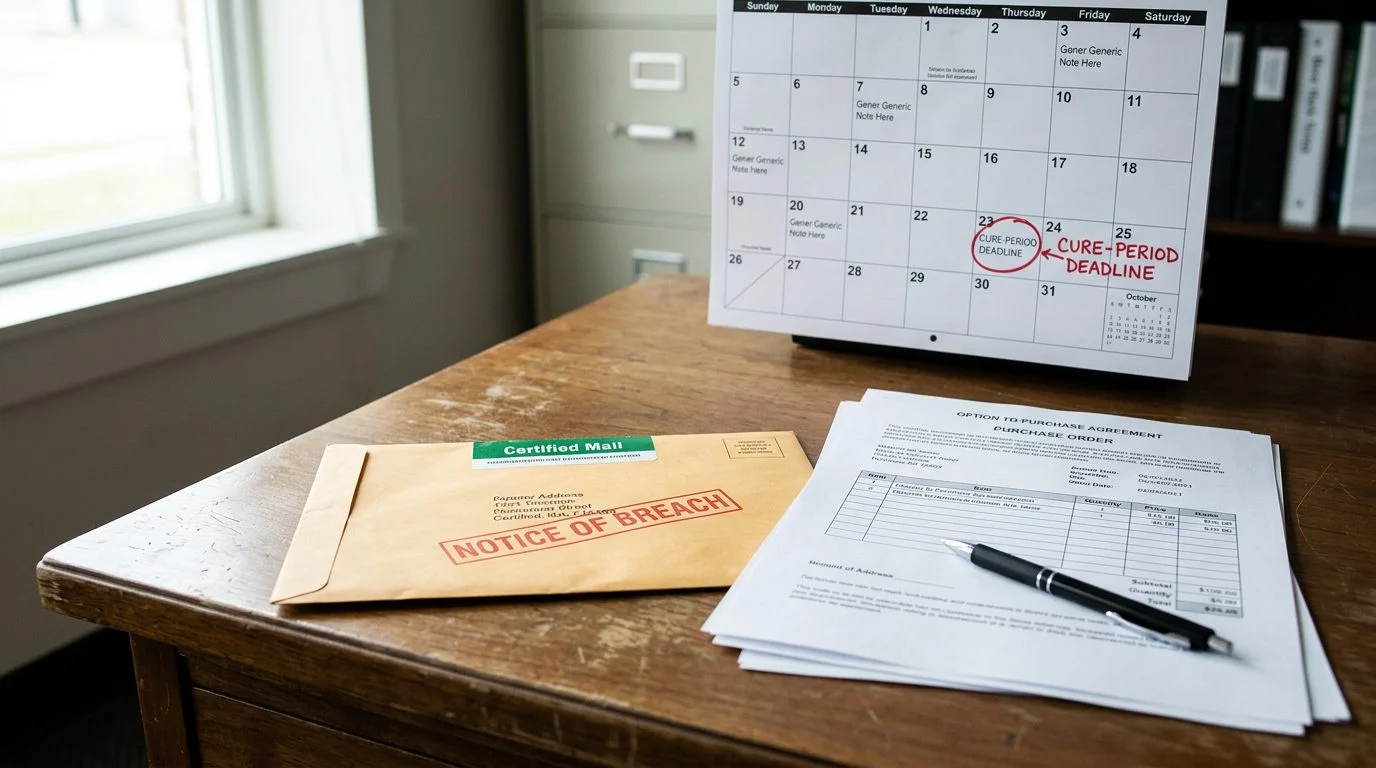
An option to purchase dispute usually turns on one question: was the option exercised correctly and on time? Florida courts and arbitrators start with the written contract. This page explains how these disputes arise, what remedies may be considered, and how a matter usually moves forward.
What an Option to Purchase Is and Who This Page Is For
An option to purchase gives one party the right, for a set time, to buy real property on stated terms. The other party must keep the offer open during that period. Holding an option is not the same as owning the property. The buyer must exercise the option, usually by written notice in the way the contract requires, before the deadline. That exercise step is where most disputes begin.
This page is for several kinds of readers:
- Business owners and commercial tenants who hold a purchase right
- Property owners and sellers who granted an option
- Developers who spent money or time relying on an option
- Owners who inherited an option signed by an earlier company or partner
Many readers are reading for a company or partner, not as the person who signed. The key question is what the signed document says and who is bound by it. Florida requires interests in real property that are freehold estates, or terms of more than one year, to be created by a signed writing. Under § 689.01, that writing must be signed in the presence of two subscribing witnesses, though no witnesses are required for a lease. Fla. Stat. § 689.01 reads: “unless by will and testament, or other testamentary appointment, duly made according to law; and no estate or interest, either of freehold, or of term of more than 1 year, or any uncertain interest of, in, to, or out of any messuages, lands, tenements, or hereditaments, shall be assigned or surrendered unless it be by instrument signed in the presence of two subscribing witnesses by the party so assigning or surrendering, or by the party’s lawfully authorized agent, or by the act and operation of law; provided, however, that no subscribing witnesses shall be required for a lease of real property or any such instrument pertaining to a lease of real property.”
Not sure what your next step is?
Talk it through with our team — we can walk you through how a situation like yours is usually handled and what your options are.
Common Reasons Commercial Option Disputes Arise
Most commercial option disputes come down to timing, notice, price, conditions, or a sale during the option period.
- Timing. Was the option exercised before the deadline? Parties often disagree about when exercise counts as delivered.
- Notice. Was written notice sent to the address, party and form the contract requires? A notice sent to the wrong place can be challenged.
- Price and closing terms. How is the price set? Which credits, adjustments or closing costs apply?
- Conditions. Financing, zoning, environmental or title conditions. One side may say a condition was never met.
- Extensions and side deals. Informal emails or unsigned changes can create a fight over what was agreed.
- Recording. Was the option, or a memorandum of it, recorded in the county public records? Check this early.
- Intervening sales. The owner lists, leases or sells the property while the option is still open.
Each point turns on the wording of the signed documents and the facts around them.
What Commercial Option Litigation Can Cover
A court or arbitrator can be asked for money, for an order requiring the sale, or for a ruling on what the option means.
- Breach of contract damages. A claim that the other side refused to honor a valid exercise. Damages are money.
- Specific performance. A request that the court order the sale to proceed on the agreed terms. This is often sought when the property itself is at the center of the dispute.
- Declaratory judgment. A request that the court decide whether the option is still open, has expired, or was validly exercised.
- Reformation. A request to correct a deed or contract when a drafting mistake does not match what the parties agreed.
- Lis pendens and injunctions. These are court tools that can come up in disputes involving property, and whether either applies depends on the facts of each case. When a dispute over a real estate closing is still unresolved, the options available to a business depend on the specific facts, so reviewing those facts early can help clarify practical next steps.
- Arbitration. When the contract requires it. Under § 682.02, a written agreement to arbitrate is valid and enforceable, except on grounds that exist for revoking a contract.
If the contract lets a party recover fees for enforcing it, § 57.105 lets a court allow fees to the other party when that party prevails on the contract, for contracts entered into on or after October 1, 1988.
How an Option to Purchase Dispute Typically Proceeds
A typical dispute moves from document review to demand, then to a filing or arbitration. Many end in mediation or settlement.
- First contact. Share the option agreement, amendments, exercise notices, correspondence, title records and a timeline of key dates.
- Document review. Confirm the option period, exercise method, notice address, price formula, conditions and any recording. Note any deadline that is running.
- Demand and negotiation. Many disputes start with a written position letter, a standstill, or a negotiated extension.
- Filing. If talks fail, a complaint may be filed in the right Florida circuit court. Under § 47.011, actions shall be brought only in the county where the defendant resides, where the cause of action accrued, or where the property in litigation is located, but this section does not apply to actions against nonresidents. For property in Hillsborough County, that county is one proper venue.
- Pleadings and discovery. Depositions, document exchange, and early motions on whether the option was validly exercised or has expired.
- Under § 44.102, a court must refer filed damages actions to mediation when one party asks, provided the requesting party is willing and able to pay the mediation costs or the costs can be equitably divided between the parties, unless an exception applies. Cases that do not settle move toward trial or a final arbitration award.
Clocks matter. Under § 95.031, a cause of action accrues when the last element constituting the cause of action occurs. A contract cannot set a shorter time to sue than the statute allows, under § 95.03. Under § 95.051, the running of the time under a statute of limitations, except ss. 95.281, 95.35, and 95.36, is tolled by the pendency of any arbitral proceeding pertaining to a dispute that is the subject of the action.
Why Ayala Law PA for Commercial Option to Purchase Disputes
Ayala Law PA focuses its practice on business and commercial litigation. That includes commercial contract disputes, shareholder and partnership disputes, construction litigation, real estate litigation, and international trade litigation in Florida courts and arbitration.
- Responsible lawyer. Eduardo A. Maura is responsible for this page. Support staff help with document organization and scheduling.
- Office. The firm’s office is at 1646 W Snow Ave, Tampa, Florida. The firm represents businesses and property owners in Tampa, Hillsborough County and the Tampa Bay area, and those clients can call (305) 570-2208.
- Approach. Early document review, then a written view of the deadlines and options. Litigation is used where it fits the client’s goals.
No outcome can be promised in any matter. Each option agreement and set of facts is different.
Questions to Answer Before You Reach Out
Gather a few facts first. They show where the dispute stands and which deadlines matter.
- Are you the buyer holding the option, or the owner who granted it?
- What is the exercise deadline, and has written notice been sent or received?
- Has the property been listed, leased, financed or sold since the option was signed?
- Was the option or a memorandum recorded in the county public records?
- Are there amendments, extensions or side letters, and were they signed by the same parties?
- Does the agreement require mediation or arbitration before a lawsuit?
Bring the agreement, amendments, correspondence, notices, title documents and any closing estimates.
Not sure what your next step is?
Talk it through with our team — we can walk you through how a situation like yours is usually handled and what your options are.
Frequently Asked Questions
How are disputes over a commercial option to purchase handled in Florida?
Whether a written contract can be enforced depends on its terms and the circumstances in which it was made. A court will not refuse to enforce a term as unconscionable unless it finds both procedural and substantive unfairness, as Basulto v. Hialeah Automotive explains.
What happens if the option deadline passes?
The option’s exercise terms and notice rules usually decide what follows. Courts read those terms closely.
Can the owner sell while an option is open?
The answer turns on the option’s terms and on whether it was recorded. A sale during an open option often calls for urgent legal review.
Can a court order the sale to go forward?
A court may be asked to order the sale on the agreed terms. Whether it does is decided case by case, and no result can be promised.
Can an owner undo the option after the fact?
A party who may undo a voidable contract can lose that right by ratification. Ratification happens when the party fails to rescind after learning the facts that warrant rescission, as Flaherty v. Flaherty states.
How do I contact the firm?
The firm’s office is at 1646 W Snow Ave, Tampa, Florida, and its phone number is (305) 570-2208.
Talk Through Your Option Dispute With Ayala Law PA
If a seller has refused to close, or a property sold while you were waiting, the deadline may be close. Ayala Law PA can review the option agreement and key dates with you and discuss the other side’s position. To discuss your dispute, call (305) 570-2208 or use the contact page.



