
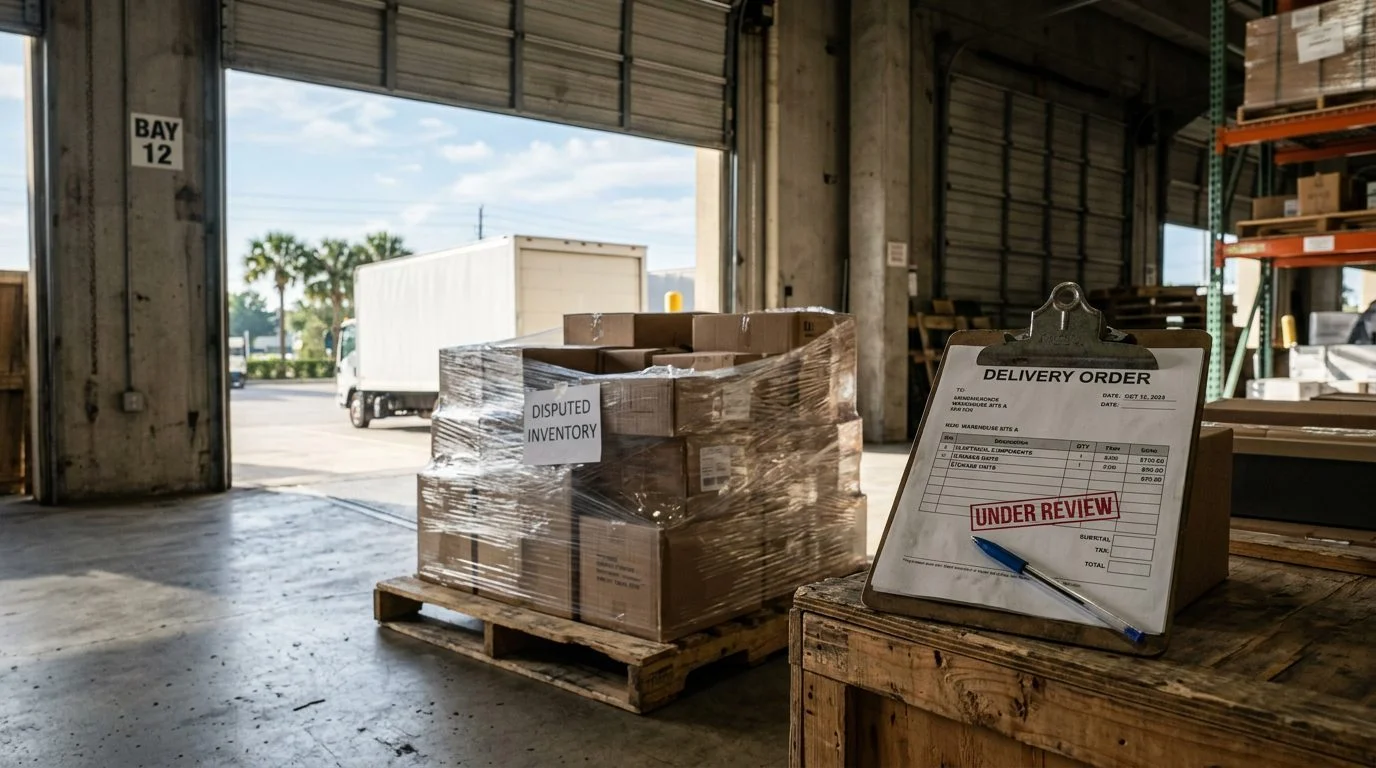
Two owners hold a commercial building together. One wants to sell, refinance, or cash out, and the other won’t agree. A partition lawsuit is the court process that can break that deadlock.
This page explains how a partition lawsuit for commercial property in Tampa works, what records to pull together, and what usually comes next.
What a Partition Lawsuit Is and Who It Fits
A partition lawsuit fits co-owners of commercial property who are stuck and cannot settle on their own. Co-ownership usually shows up in a few common ways:
- Tenants in common who bought or inherited a building together.
- LLC members who hold real estate for their company or through a company they share.
- Business partners who bought a property to run an operation from.
- Relatives who inherited a commercial building and now disagree about its future.
Typical triggers include one owner refusing to list the property, refusing to agree on a price, refusing to refinance, or stalling on a buyout. The outcome rests on the court, the property, and the co-owners’ documents. How strongly one side feels about it does not decide the case.
If a co-owner has stalled a decision on commercial property you hold together in Tampa, you do not have to face it alone, and our team can talk through your options. Talk it through with our team — we can walk you through how a situation like yours is usually handled and what your options are.
What a Partition Action Covers in Florida
Splitting one commercial building fairly is often hard, so a sale often comes up early.
Money questions usually come up next:
- Rents collected by one owner while the others received nothing.
- Improvements one owner paid for, such as a new roof or a buildout.
- Taxes, insurance, and upkeep paid by only some of the owners.
- Mortgages and recorded liens that must be addressed before any sale.
Each item can shift money between owners. In many cases, the accounting matters as much as the deed.
Records to Gather Before You File
Pull together the deed, the governing documents, and a clear money trail before anything is filed. Having these on hand makes the first review faster.
- The current deed and chain of title, showing who holds title and in what shares.
- The operating agreement, partnership agreement, or buy-sell terms, if an LLC or partnership is involved.
- Leases, rent records, and any log of who collected income and paid bills.
- Mortgage statements, recorded liens, and Hillsborough County property tax and assessment records.
- Written requests to sell or buy out, and the co-owner’s replies.
- Any mediation, arbitration, or notice clauses in the governing documents.
LLC members have a records path. In a member-managed LLC, a member may inspect and copy company records on reasonable notice during regular business hours, under Fla. Stat. § 605.0410. After a qualifying written demand, the company must tell the member in writing within 10 days what information it will provide and when and where, and give its reasons for any information it will not provide.
How the Case Moves Forward, Step by Step
A partition case moves in stages, from a document review to a court-supervised sale or a negotiated buyout. Here is the usual path.
- Case review. We review the title, the governing documents, and the co-owner’s position. A written demand may go out first.
- Filing. The complaint may be filed in the county where the property is located, which here is Hillsborough County. Circuit courts hear actions involving title to real property (Fla. Stat. § 26.012). Under Fla. Stat. § 47.011, actions must be brought in the county where the defendant resides, where the cause of action accrued, or where the property in litigation is located; this rule does not apply to actions against nonresidents.
- Recording a notice. The lawsuit operates as a lis pendens on the property only if a notice of lis pendens is recorded in the official records of the county where the property is located and has not expired or been withdrawn or discharged. The notice must contain the names of the parties, the date the action was instituted (or the clerk’s electronic receipt date or the case number), the name of the court where it is pending, a description of the property, and a statement of the relief sought as to the property. It generally expires one year after the case starts, unless the pending pleading shows the relief sought is founded on a duly recorded instrument or a lien under part I of chapter 713, or the court extends the time on reasonable notice and for good cause (Fla. Stat. § 48.23).
- Responses. The other owners may dispute ownership shares, claim credit for improvements, or ask for a buyout.
- A court must, on one party’s request, refer a filed civil action for monetary damages to mediation under rules set by the Florida Supreme Court, provided the requesting party is willing and able to pay the costs of the mediation or the costs can be equitably divided between the parties, unless an exception applies, and may refer other filed civil actions to mediation (Fla. Stat. § 44.102).
- Valuation and ruling. An appraisal may be needed. The court then decides whether the property can be divided or must be sold.
- Sale and payout. The rest goes to the owners.
Timing varies with the number of parties, the contested issues, and the court’s calendar.
Common Objections Co-Owners Raise
Most objections come down to money, timing, and what the governing documents say.
- “We can’t afford to buy out the other owner.” A court-ordered sale is one route. A buyout negotiated during the case is another.
- “The operating agreement says we have to work this out first.” An LLC’s operating agreement generally governs relations among members. Where the operating agreement does not otherwise provide for a matter it governs, such as relations among members and between the members and the company, the statute fills the gap (Fla. Stat. § 605.0105). Read the exact wording before relying on it or skipping it.
- “Waiting for the market to improve will solve this.” Delay can add unpaid taxes, lien exposure, and carrying costs. Those costs reduce what every owner keeps.
- “A sale will hurt the business that operates there.” Lease terms and the business’s needs belong in the plan from the start.
Why Ayala Law PA Handles These Disputes
Partition fights often overlap with the business and real estate issues Ayala Law PA focuses on.
- The firm focuses on business litigation, commercial litigation, contract disputes, shareholder and partnership disputes, construction litigation, real estate litigation, and international trade litigation.
- A partition case often involves LLC member rights, partnership winding up, and construction liens on the same property.
- Eduardo A. Maura is the responsible lawyer for this page. The firm serves Tampa, Hillsborough County, and the Tampa Bay area from its Tampa office at 1646 W Snow Ave, Tampa, FL 33606.
- Support staff help with documents and scheduling.
- For a related issue, see our guide to boundary disputes for commercial property.
Not sure what your next step is?
Talk it through with our team — we can walk you through how a situation like yours is usually handled and what your options are.
Frequently Asked Questions
Can one co-owner force a sale of commercial property in Florida?
A partition action is the court process co-owners use when they cannot agree on jointly held property. Whether a court orders a sale turns on the facts of the case.
How much does a partition action cost in Florida?
Costs vary from case to case. Ayala Law PA discusses fees directly with you before any work begins.
What is a letter warning of partition action?
It is a letter saying a partition lawsuit may be filed if the owners do not resolve the matter. Review it promptly against your governing documents.
How do partition lawsuits work?
A court supervises the division or sale of the property.
Can co-owners settle before filing?
Yes. Owners can settle through a negotiated buyout or sale terms before filing or during mediation.

Talk With Ayala Law PA About Your Co-Owned Property
You may be holding a stake in a business or family property while one owner blocks every option. That is a hard place to wait. If you want to talk through where things stand, call (813) 414-5715 or request a case evaluation.



