
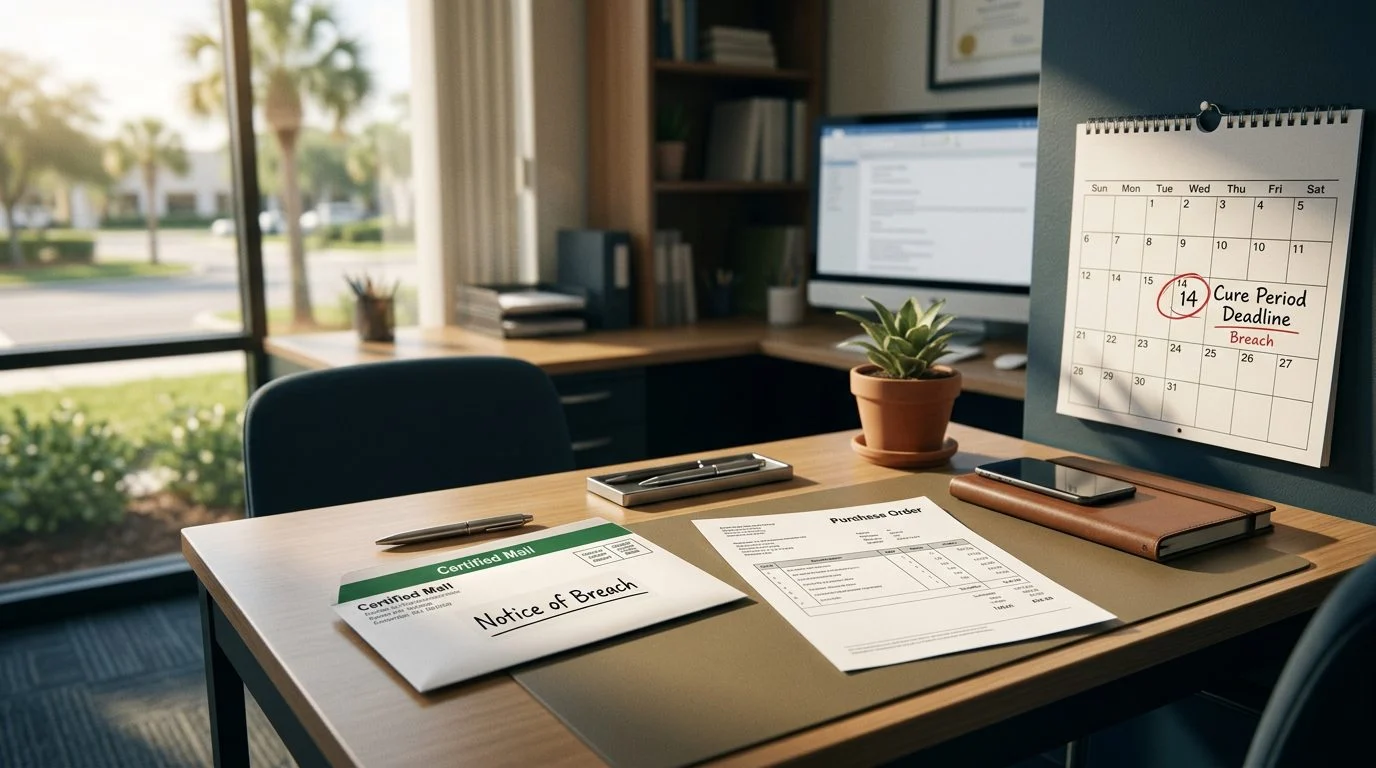
A payment is overdue, a vendor walked off a job, or a partner stopped doing their share. If you run a business in Tampa, you need to know whether that counts as breach of contract.
Whether a given situation fits that description depends on the facts, the contract’s wording, and the records behind it.
What Breach of Contract Means for a Business in Florida
For a business, that often looks like a missed payment, a late delivery, or work that does not match the plans. Not every problem is a breach, though.
Agreements don’t need to sit on one signed page. Florida’s highest court has said an oral contract must still meet the basics of contract law: an offer, an acceptance, consideration, and essential terms stated clearly enough (St. Joe Corp. v. McIver). For goods, a deal can also form through conduct that shows both sides agreed, such as one side ordering and the other side shipping (Fla. Stat. § 672.204).
That means a handshake deal, a text exchange, or a purchase order can all matter. The question is whether the parties really agreed and what each side promised to do.
When a late payment or a stalled job puts your business in a bind, our team at Ayala Law PA can talk through the facts with you, and you don't have to sort them out alone. Talk it through with our team — we can walk you through how a situation like yours is usually handled and what your options are.
The Elements a Florida Court Looks For
Courts usually sort a breach claim into a few questions. Was there a valid agreement? Did you perform your side, or do you have a legal reason you could not? Did the other side fail to perform? And did that failure cause a loss you can show?
A missing signature does not always end the question. For a sale of goods priced at $500 or more, Florida generally requires a record signed by the party against whom enforcement is sought. There are exceptions, including goods made specially for the buyer and goods already paid for and accepted (Fla. Stat. § 672.201). Between merchants, a written confirmation can count against a recipient if it is received within a reasonable time and the recipient has reason to know its contents, unless the recipient gives written notice of objection within 10 days (Fla. Stat. § 672.201).
Your own performance matters too. A party that did not do its part may have trouble enforcing the deal later. That is why a clear record of what your company delivered, paid, or completed carries so much weight.
Material Breach Versus a Minor Breach
The line between the two matters, because it shapes what the other side owes you.
A short delay on a shipment usually looks different from a supplier who never sends the product at all.
Contract language can change the picture. Many agreements require written notice of a problem and a set period to fix it before anyone sues. Florida law gives sellers of goods a similar chance. A seller whose nonconforming delivery was rejected may notify the buyer it intends to cure, then deliver a conforming product within the contract time (Fla. Stat. § 672.508).
Which Situations Are Examples of Breach of Contract?
Common examples include an unpaid invoice, goods that do not match the order, and a contractor who walks off a job. Each one is a failure to do something the contract required.
A Tampa business may see non-payment or late payment on an invoice, a supply agreement, or an equipment lease with clear payment terms. Late delivery or products that miss the agreed specifications or quantities are also common. In construction, a contractor may abandon a job, depart from the plans, or refuse to finish agreed work. An owner or subcontractor may also fail to pay under a subcontract.
Real estate and commercial leases raise the same questions. So do shareholder and partnership agreements, where a partner might skip agreed capital contributions or ignore buyout terms. Some international sale agreements follow the same analysis. In those deals, the governing law and dispute resolution clauses often shape where and how a claim proceeds.
How Long a Business Has to File a Breach of Contract Claim in Florida
Florida sets filing deadlines in Section 95.11 of the Florida Statutes, and the type of claim decides which deadline applies. Other contract claims fall under different parts of that same statute, so the right deadline depends on what kind of claim you have.
Under § 95.11(3)(b), an action founded on the design, planning, or construction of an improvement to real property must be commenced within four years. The four years runs from the earliest of the date the authority having jurisdiction issues a temporary certificate of occupancy, a certificate of occupancy, or a certificate of completion, or the date of abandonment of construction if the work is not completed. For a latent defect, the time runs from when the defect is discovered or should have been discovered with the exercise of due diligence, but in any event the action must be commenced within 7 years after that same earliest date. For an action founded on alleged abuse, incest, or a s. 787.061 action, § 95.11 allows the action to be commenced within 7 years after the age of majority, or within 4 years after the injured person leaves the dependency of the abuser, or within 4 years from discovery of both the injury and its causal relationship to the abuse, whichever occurs later (Fla. Stat. § 95.11).
An action for specific performance of a contract has a one-year limit under the same statute. Because a clock may start on a specific event, write down the dates now. Note when work was finished or abandoned, when a defect was found, and when you sent any notice.
How a Tampa Business Shows a Breach: The Records That Matter
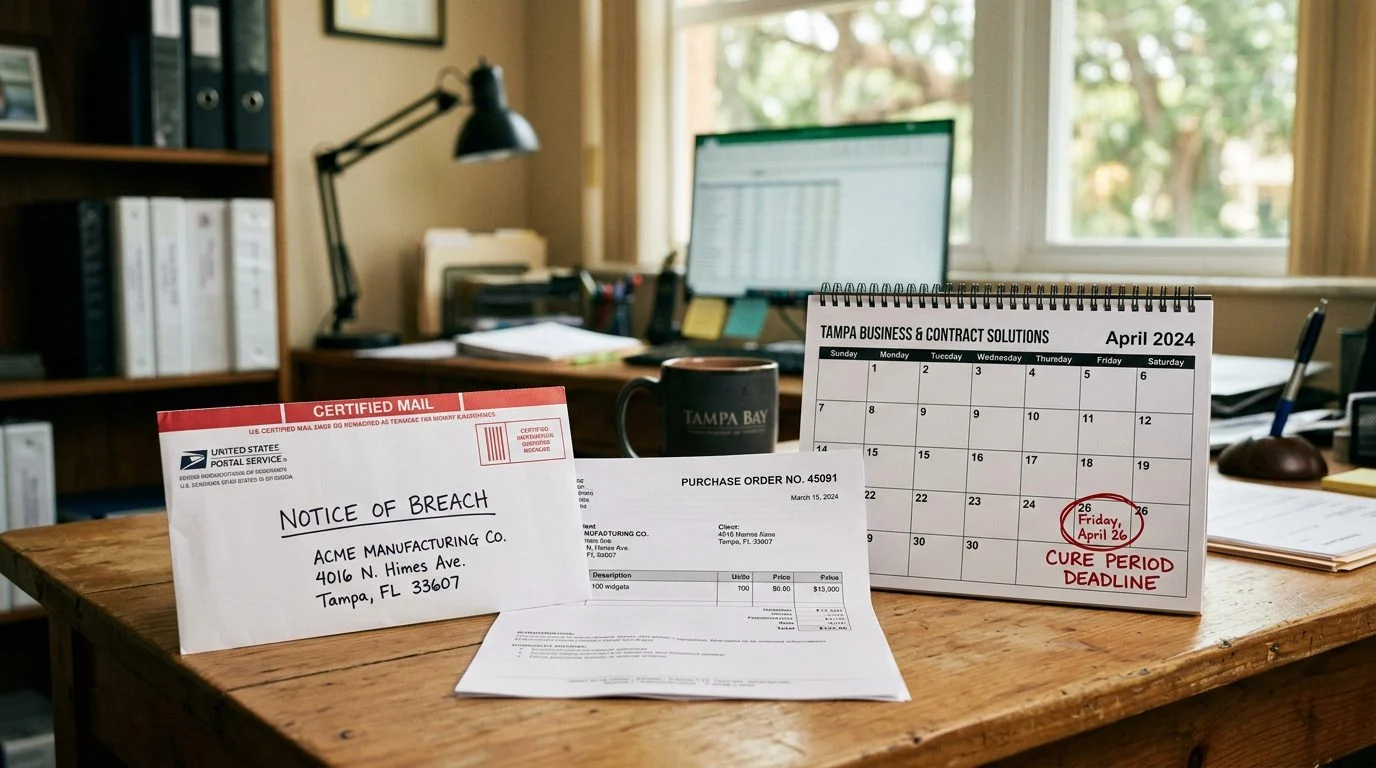
The strongest breach claims rest on a paper trail. Start with the signed or written agreement. Then add purchase orders, change orders, invoices, delivery receipts, payment records, and any amendments. Keep them in one place, organized by date.
Communications matter as well. Emails, text messages, and meeting notes show what was promised, what was requested, and how the other side responded. A text saying the order will ship Friday shows a promise in the other side’s own words.
Notice matters for goods too. If you accepted goods, Florida law requires you to notify the seller of a breach within a reasonable time after you discover or should have discovered it. Otherwise you may be barred from any remedy (Fla. Stat. § 672.607). Waiting too long can cost you the claim.
Finally, build a simple timeline. Tie each promise to each failure and to the money your business lost. A clear timeline makes the story easy to follow for a judge, a mediator, or the other side’s lawyer.
Not sure what your next step is?
Talk it through with our team — we can walk you through how a situation like yours is usually handled and what your options are.
Damages, Remedies, and Attorney’s Fees in a Florida Contract Case
The usual goal of a contract claim is money. Some losses are direct, like the extra cost of replacing defective work. Others are indirect, and they take more proof to show.
Florida generally follows the American rule. Each side pays its own attorney’s fees unless a contract or statute provides otherwise (Price v. Tyler). That makes fee clauses important. If a contract lets a party recover fees for enforcing it, a court may also allow reasonable fees to the other side when that side prevails (Fla. Stat. § 57.105).
Florida’s sanctions rule also reaches claims and defenses. A sanctions motion must be served first. The other side then has 21 days to withdraw or correct the challenged claim before the motion can be filed (Fla. Stat. § 57.105). Review any fee clause in your contract early, because it can change the cost picture for both sides.
Common Defenses the Other Side May Raise
Most breach defenses come down to a few arguments. The other side may say no valid contract existed, the deadline has passed, a required step was skipped, or you broke the deal first. Each argument needs proof.
Some defenses target a contract term itself. To refuse to enforce a term as unconscionable, a Florida court must find both procedural unfairness in how the deal was made and substantive unfairness in the terms. We conclude that both the procedural and substantive aspects of unconscionability must be present, although not necessarily to the same degree, and both should be evaluated interdependently rather than as independent elements (Basulto v. Hialeah Automotive).
The other side may also argue that you did not limit your losses. A log of what you did to keep costs down can answer that argument.
Your records can support your position against each defense. A signed agreement or a clear written confirmation answers a no-contract argument. Dated notices answer a timing argument. A record of your reasonable steps answers a mitigation argument. That is why the records checklist matters from the first day of a dispute.
Where a Tampa Business Dispute Gets Resolved
Contract disputes usually go to a Florida court or to arbitration, depending on what the agreement says. A written agreement to arbitrate is valid and enforceable under Florida’s arbitration code, except on grounds that exist for revoking any contract. A court decides whether that agreement exists (Fla. Stat. § 682.02).
For court cases, an action must be brought in the county where the defendant resides, where the cause of action accrued, or where the property in litigation is located, but this rule does not apply to actions against nonresidents (Fla. Stat. § 47.011). For a Hillsborough County dispute, that may mean filing where the other company lives or where the problem happened.
For a step-by-step look at filing in Hillsborough County, read our how to sue a company guide. For the broader picture, see the Florida contract disputes guide.
Is an oral contract enforceable in Florida?
An oral deal needs an offer, an acceptance, consideration, and clear essential terms, and proof is harder without writing.
Does a business contract need a signature?
Not always. For goods priced at $500 or more, Florida generally requires a signed record, with exceptions.
Who pays attorney’s fees in a contract case?
Generally, each side pays its own, unless a contract or statute says otherwise.
Talk With Ayala Law PA About Your Contract Dispute
Breach problems often show up in the middle of running a business, when a payment is late and a job is on hold. You may also be gathering facts for a co-owner or a family member who runs the company, and that is a hard place to be.
If you have started pulling together your contract, invoices, and messages, you can request a case evaluation or call (813) 414-5715 and walk through what happened.
Ayala Law PA works from its Tampa office at 1646 W Snow Ave, Tampa, FL 33606, and serves businesses in Tampa and Hillsborough County from that location. Eduardo A. Maura is the responsible lawyer for this page.



