
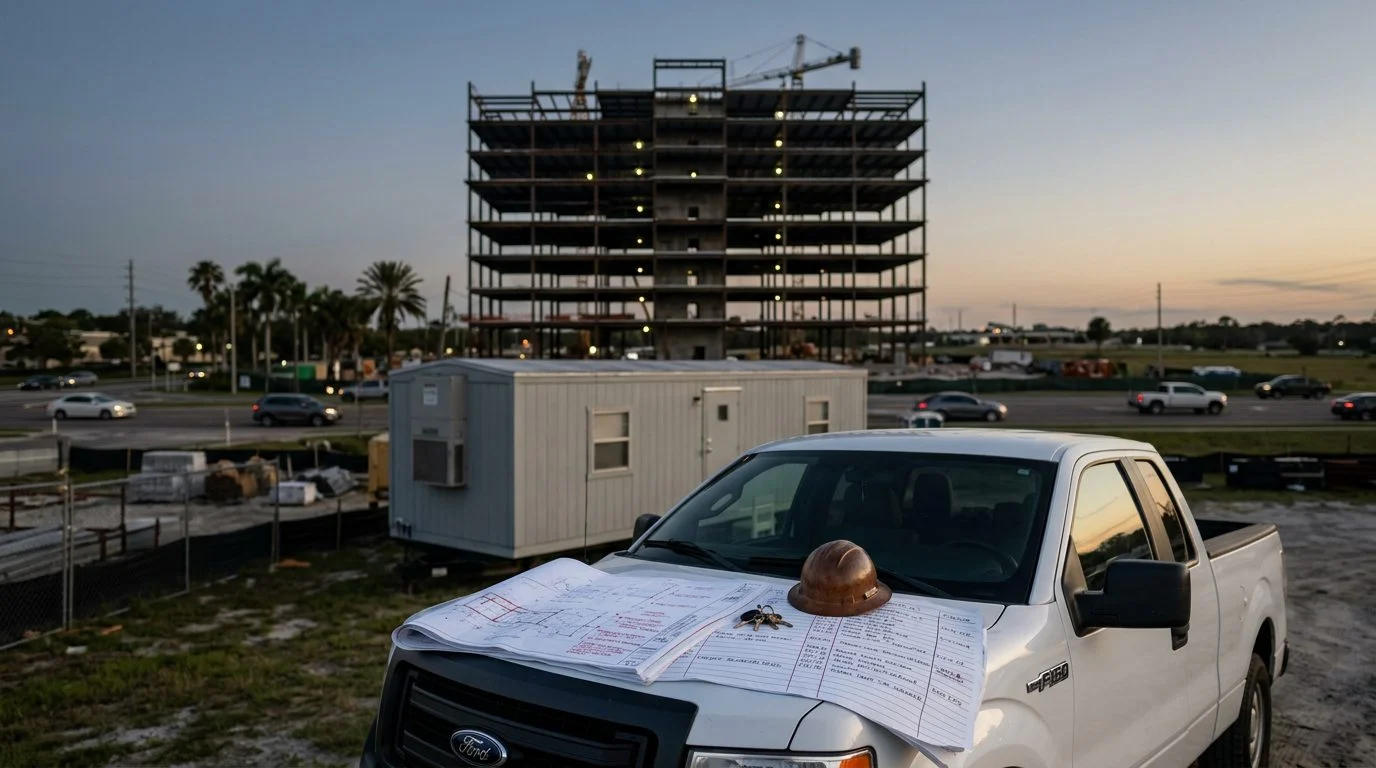
You paid your contractor, and now a notice says a subcontractor or supplier recorded a construction lien on your property. That’s stressful, and it can feel like you’re paying twice.
A construction lien is a claim recorded against the property itself. The first steps are to pull the recorded claim, check its details, and write down every date.
What Does an Unpaid Construction Lien Mean for a Hillsborough County Owner?
An unpaid construction lien means someone who worked on or supplied materials for your project filed a claim against your property because they weren’t paid. The claim runs against the land, not just against your contract with the general contractor.
Subcontractors and suppliers usually file because they never received payment from the company they worked for. They often have no contract with you, which is why paying your contractor doesn’t always end the matter. The Pinellas County lien law summary explains the risks a construction lien can pose to an owner’s property. It also covers Notice of Commencement requirements and lien releases.
Don’t ignore the notice. Waiting can cost you time, and some of the deadlines discussed below may already be running.
If a recorded lien has you worried about your Hillsborough County property, Ayala Law PA can talk through your options with you when you reach out. Talk it through with our team — we can walk you through how a situation like yours is usually handled and what your options are.

What Should You Check First on a Recorded Construction Lien?
Start by pulling the recorded claim of lien from the Hillsborough County Clerk of Court’s Official Records. Then compare each detail with your own files.
- Property address and legal description. Does it match your property exactly?
- Owner name. Does it name you, your co-owner, or someone else?
- Claimant name. Who filed the claim, and did you hire them?
- Amount. Does it match the contract price, change orders, and payments you made?
- Dates. When did work start and stop, and when was the claim recorded?
- Notice of Commencement. Was one recorded for the project, and who does it name?
Gather your contract, invoices, proof of each payment, and any lien waivers you received. Write the details on one page with dates beside them. You’ll need that page for every step that follows.
How Long Do You Have to Act on a Construction Lien in Florida?
Florida sets more than one deadline, and the one that applies depends on the type of claim. Timing turns on the facts of your project, so write down the key dates now.
Florida’s limitations statute gives one year to enforce an equitable lien arising from furnishing labor, services, or material for improvement of real property. It also gives one year for a claim against a payment bond when the principal is a contractor, subcontractor, or sub-subcontractor, for private work as well as public work, except for actions governed by s. 255.05(10), s. 337.18(1), or s. 713.23(1)(e). That year runs from the last furnishing of labor, services, or materials, or, if the contractor is the principal on a bond on the same construction project, from the contractor’s last furnishing, whichever is later, except for actions governed by s. 255.05(10), s. 337.18(1), or s. 713.23(1)(e) (Fla. Stat. § 95.11).
Actions founded on the design, planning, or construction of an improvement to real property generally must be commenced within four years. That period runs from the earliest of the issuance of a temporary certificate of occupancy, a certificate of occupancy, or a certificate of completion, or the date of abandonment of construction if not completed. For a latent defect, the time runs from when the defect is discovered or should have been discovered with the exercise of due diligence, and in any event the action must be commenced within 7 years after that earliest date (Fla. Stat. § 95.11). Fla. Stat. § 95.11 reads: “(3) WITHIN FOUR YEARS.— … (b) An action founded on the design, planning, or construction of an improvement to real property, with the time running from the date the authority having jurisdiction issues a temporary certificate of occupancy, a certificate of occupancy, or a certificate of completion, or the date of abandonment of construction if not completed, whichever date is earliest; except that, when the action involves a latent defect, the time runs from the time the defect is discovered or should have been discovered with the exercise of due diligence.” Under Florida law, a cause of action accrues when its last element occurs (Fla. Stat. § 95.031).
Who Can File a Construction Lien in Florida?
Anyone who furnished labor, services, or materials for the improvement of your property may have lien rights.
Your contractor’s subcontractors, sub-subcontractors, and material suppliers are the usual people who file. The Pinellas County summary covers who may enforce a construction lien, so it’s a useful background source for these categories.
Every construction dispute turns on its own facts, so questions about a particular lien belong with a lawyer who reviews your documents.
What Lien Paperwork Defects Are Worth a Lawyer’s Review?
Errors in the property description, owner name, amount, or timing can matter. Whether an error changes the lien is a question a lawyer should answer.
- The legal description or property identification is wrong or missing.
- The amount includes unrelated work, duplicate charges, or sums you never agreed to.
- The claim names the wrong owner or the wrong project.
Don’t assume a defect ends the claim, and don’t assume it doesn’t matter. Keep a copy of the recorded claim with the date you received it. Bring your documents and questions to our team to discuss your situation.
What Can an Owner Do When the Contractor Has Not Paid Subcontractors?
Start by asking the contractor in writing for proof of payment, the names of unpaid subcontractors and suppliers, and lien releases for amounts you paid. Written requests create a record you can use later.
Review your contract for payment, retainage, indemnity, and dispute terms. A contract clause that sets a shorter time to sue than the statute allows is void (Fla. Stat. § 95.03). Waiting on that review can cost you time.
Check whether your contract includes an attorney’s fee clause. Under Florida law, each party generally pays its own attorneys’ fees unless a contract or statute provides otherwise (Price v. Tyler). For contracts entered into on or after October 1, 1988, if a contract allows fees to a party that must enforce it, a court may allow reasonable fees to the other party when that party prevails (Fla. Stat. § 57.105).
Keep every payment record, notice, text, and invoice tied to the project.
Not sure what your next step is?
Talk it through with our team — we can walk you through how a situation like yours is usually handled and what your options are.
Can a Contractor Face Criminal Charges for Not Paying Subcontractors?
In some situations, a contractor’s nonpayment can raise criminal questions. The answer turns on intent and the specific facts.
A criminal matter runs on its own track. It doesn’t replace the civil steps needed for a lien on your property. Your lien still needs its own review, even if a criminal question also exists.
Whether conduct is a crime and whether a lien is valid are separate questions. Keep the same records for both. Don’t count on another party’s criminal case to resolve the lien on your title.
What Happens After a Lien Is Contested or Sued On?
A lien dispute can end in payment, a release, a settlement, or a lawsuit. The path forward depends on the facts of each project.
- Lien foreclosure. If the lienor sues, the case may proceed as a lien foreclosure action in circuit court. Venue rules say an action must be brought where the defendant resides, where the cause of action accrued, or where the property in litigation is located, though this does not apply to actions against nonresidents (Fla. Stat. § 47.011). For a Hillsborough County property, the county where the property sits is one place where the action may be brought, alongside the county where the defendant resides or where the cause of action accrued.
- Mediation. For a filed civil action for monetary damages, a court must refer the case to mediation on one party’s request, if the requesting party is willing and able to pay the costs of the mediation or the costs can be equitably divided between the parties, unless a listed exception applies (Fla. Stat. § 44.102).
- Settlement offers. Under Fla. Stat. § 45.061(1), a written offer of settlement remains open for 45 days unless withdrawn sooner, but under § 45.061(6) the section does not apply to causes of action that accrue after the effective date of the act. Fla. Stat. § 45.061(1) reads: “The offer shall remain open for 45 days unless withdrawn sooner by a writing served on the offeree prior to acceptance by the offeree.” Under § 45.061(6), however, the section does not apply to causes of action that accrue after the effective date of the act. An offer not accepted within that time is deemed rejected (Fla. Stat. § 45.061).
Missing a filing deadline can end a claim. Owners and lienors both need to track those dates closely.
When Should an Owner Talk to a Construction Litigation Lawyer?
Talk to a lawyer when a lawsuit is filed, a deadline is running, or the contractor disputes the work.
Ayala Law PA focuses on construction litigation, including contractor and subcontractor disputes, lien foreclosure, and construction contract fraud. The firm also handles business, commercial, and real estate litigation. The firm’s only office is in Tampa at 1646 W Snow Ave, Tampa, FL 33606. It serves clients in Hillsborough County, Brandon, Riverview, Plant City, and Temple Terrace from that office.
Eduardo A. Maura is the responsible lawyer for this page. Fees for a case evaluation are discussed directly with the firm when you call.

Frequently Asked Questions
How long do you have to contest a lien in Florida?
Florida’s limitations statute sets a one-year period for certain lien-related claims, including enforcing an equitable lien. Chapter 713 sets its own lien rules, so check the dates on your recorded lien now.
What can I do if my contractor hasn’t paid its subcontractors?
Ask the contractor in writing for proof of payment and lien releases, and keep every record. Review your contract, and talk with a lawyer before any deadline passes.
Can a contractor be criminally charged in Florida?
Some nonpayment situations can raise criminal questions. The answer turns on intent and the facts, and a criminal question runs separately from the civil lien on your property.
If a recorded lien has you wondering what it means for your Hillsborough County property, you don’t have to sort out the deadlines alone. Call (813) 414-5715 or reach out through the Ayala Law PA contact page to talk about your next steps.



