
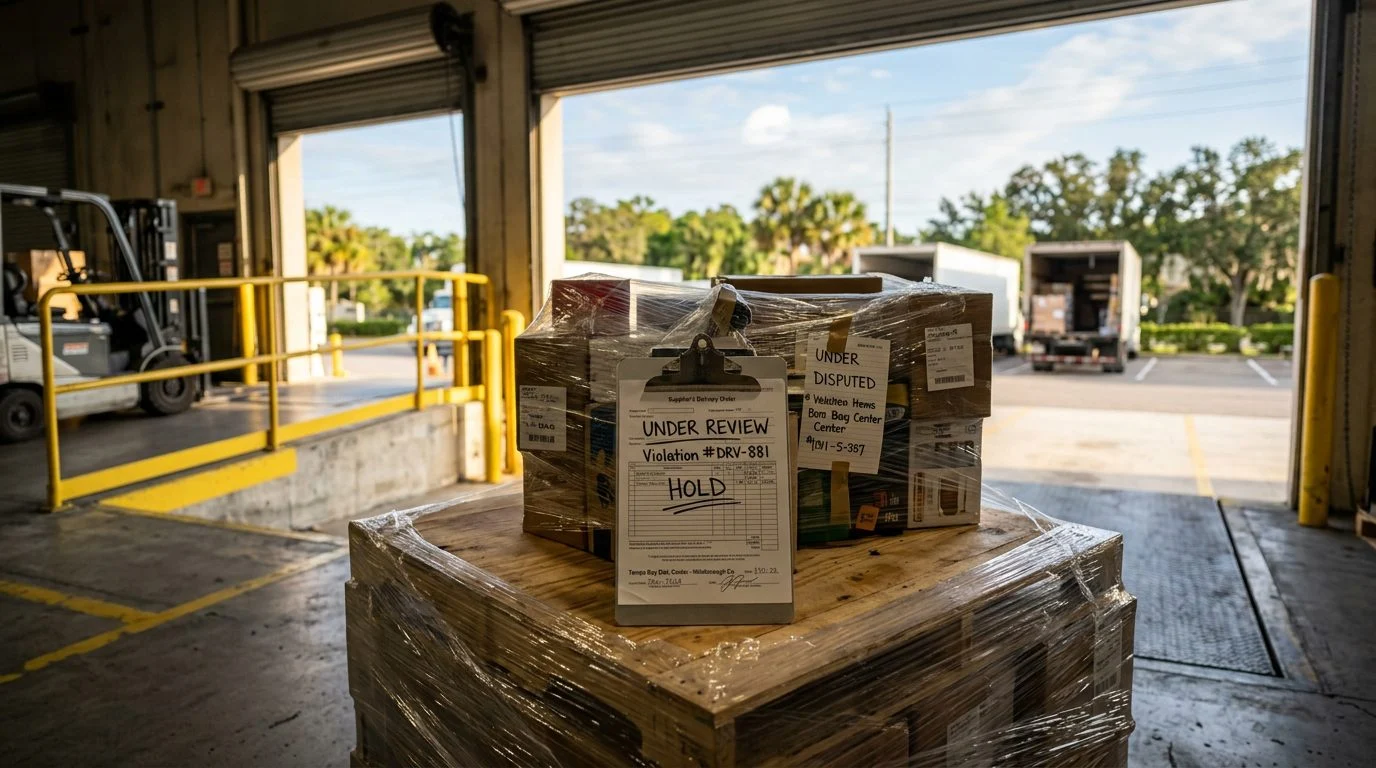
Received a notice that your commercial property breaks a recorded deed restriction? You likely want to know what it means and what you can do next.
A deed restriction violation on a commercial property in Tampa means the land is used, built on, or kept in a way that a recorded document prohibits. Your options usually follow a clear sequence: check the records, fix the problem or negotiate, answer with a formal demand, and, if needed, go to court in Hillsborough County.
What a Deed Restriction on a Commercial Property Is
A deed restriction is a recorded limit on how land may be used, built on, or maintained. Developers and owners often record these limits in a deed, a plat, or a declaration of covenants. Lawyers and courts often call them restrictive covenants.
For a commercial parcel, a restriction might control the type of business allowed, signs, setbacks, parking, hours, or how the building looks from the street. The text sits in the county’s official records, where anyone can look it up.
Restrictions usually run with the land. That means a later owner or tenant can be bound even if they never signed the document. Check the records before you assume a restriction doesn’t apply to you.
If a violation notice has reached your Tampa commercial property, our team can go over the recorded documents and your deadlines with you, so reach out today. Talk it through with our team — we can walk you through how a situation like yours is usually handled and what your options are.

What Kinds of Commercial Restrictions Are Common in Florida?
Most commercial restrictions fall into four groups: use limits, design controls, operating limits, and maintenance standards. Start with the document that names your parcel, because each one reads differently.
- Use limits control the kind of business allowed on the parcel.
- Design controls require approval before building changes, facade work, or new signs. If an association governs the parcel, Fla. Stat. § 720.3035 limits its committee to what the declaration states or reasonably implies, or to other published guidelines and standards authorized by the declaration. When a request to build a structure or improvement is denied, the association must give written notice stating with specificity the rule it relied on and the specific part of the proposed improvement that does not conform to that rule.
- Operating limits cover parking, delivery hours, and occupancy.
- Maintenance standards require upkeep of landscaping, exteriors, and common areas.
Not every commercial parcel sits under an association. Confirm whether one does before you apply that statute to your property.
How Do You Confirm a Violation and Who Can Enforce It?
You confirm a violation by matching the exact recorded language to the facts. Then you identify who has the right to enforce it.
Start with the recorded deed, declaration, plat, and any amendments in the Hillsborough County official records. Note the recording references and the date of each change. A restriction can be amended, so an older text may not be the final one.
Next, identify who holds enforcement rights. The document may name an adjoining owner, a property owners association, a developer, or another party. Also note whether the violator is the owner, a tenant, a contractor, or a buyer, since each may face different responsibility.
Finally, read the clauses that control steps before a lawsuit. Look for notice-and-cure periods, fee clauses, and mediation requirements. Florida courts do not favor treating a step as a condition that must happen first. A common mistake is treating a notice clause as a formality when its words say the step must come first.
What Are Your Practical Options When a Violation Is Alleged?
You can correct the problem, negotiate a written fix, send a demand letter, or ask a court to enforce the restriction. The right path turns on the document and the property’s history.
- Compliance. Stop the use or correct the condition. Keep dated photos and a written record of the fix.
- Negotiation. Propose a signed agreement with a timeline, an approved change, or a written accommodation from the party with enforcement rights. Fla. Stat. § 689.01 requires that an estate or interest of freehold, a term of more than 1 year, or any uncertain interest in land be created, transferred, or released by a signed written instrument, signed in the presence of two subscribing witnesses, except for a lease of real property, and that requirement may be satisfied by witnesses present through audio-video communication technology. Get any waiver or release in writing.
- Demand letter. A formal notice names the restriction, the violation, the cure requested, and a response deadline. It puts the dispute on paper.
- Court enforcement. A lawsuit in Hillsborough County can seek an injunction to stop or reverse the violation, and in some cases damages.
- Whether they apply depends on the recorded documents and the property’s history.
A written fix can avoid litigation when the other side agrees. Demand letters often come first because they put the restriction and the deadline in writing.
What Deadlines and Timing Issues Can Affect a Restriction Dispute?
Timing can decide what you can still do, so act soon after you receive a notice. Response deadlines in demand letters and recorded documents can run quickly.
Florida sets limitation periods by statute. The clock starts when a cause of action accrues, which is when its last element occurs (Fla. Stat. § 95.031). The period depends on the type of claim, so identify the claim early.
If a lawsuit affects title, a notice of lis pendens must be recorded in the county where the property sits to affect it (Fla. Stat. § 48.23). That notice expires one year after the case starts, unless the claim rests on a duly recorded instrument or on a lien claimed under part I of chapter 713, or the court extends the time on reasonable notice and for good cause. A sale or refinance during a dispute can complicate title for this reason.
Does a new owner have to follow a recorded deed restriction?
Usually yes, because restrictions generally run with the land. Buyers should review the recorded documents before closing.
Where is a deed restriction lawsuit filed in Florida?
Under Fla. Stat. § 47.011, actions are brought only in the county where the defendant resides, where the cause of action accrued, or where the property in litigation is located; this rule does not apply to actions against nonresidents.
What Documents Should You Gather Before Speaking With a Lawyer?
Gather the recorded documents, your title papers, every notice and photo, and a dated timeline. Having them ready helps a lawyer review your situation faster.
- The recorded deed, declaration, plat, and amendments, with recording references.
- The title commitment or owner’s policy, plus any survey of the parcel and improvements.
- Every notice, email, letter, and photo about the alleged violation, with dates.
- Leases, construction contracts, permits, and approvals for the work at issue.
- A short timeline of when the use or construction began and how the other side responded.
Keep originals and copies together. Bring the names of the owners, tenants, and any association involved.
Not sure what your next step is?
Talk it through with our team — we can walk you through how a situation like yours is usually handled and what your options are.

Talk With Ayala Law PA About Your Commercial Property
Ayala Law PA handles business, commercial, and real estate litigation for owners and operators in Tampa and Hillsborough County. The firm works from its Tampa office at 1646 W Snow Ave, Tampa, FL 33606, and serves Tampa, Brandon, Riverview, Plant City, Temple Terrace, and the Tampa Bay area from there. Eduardo A. Maura is the responsible lawyer for this page. For a broader view, see commercial litigation in Hillsborough County.
If a violation notice has reached your Tampa commercial property, call (813) 414-5715 or request a case evaluation. Every matter turns on its own facts, and no result can be promised.



