
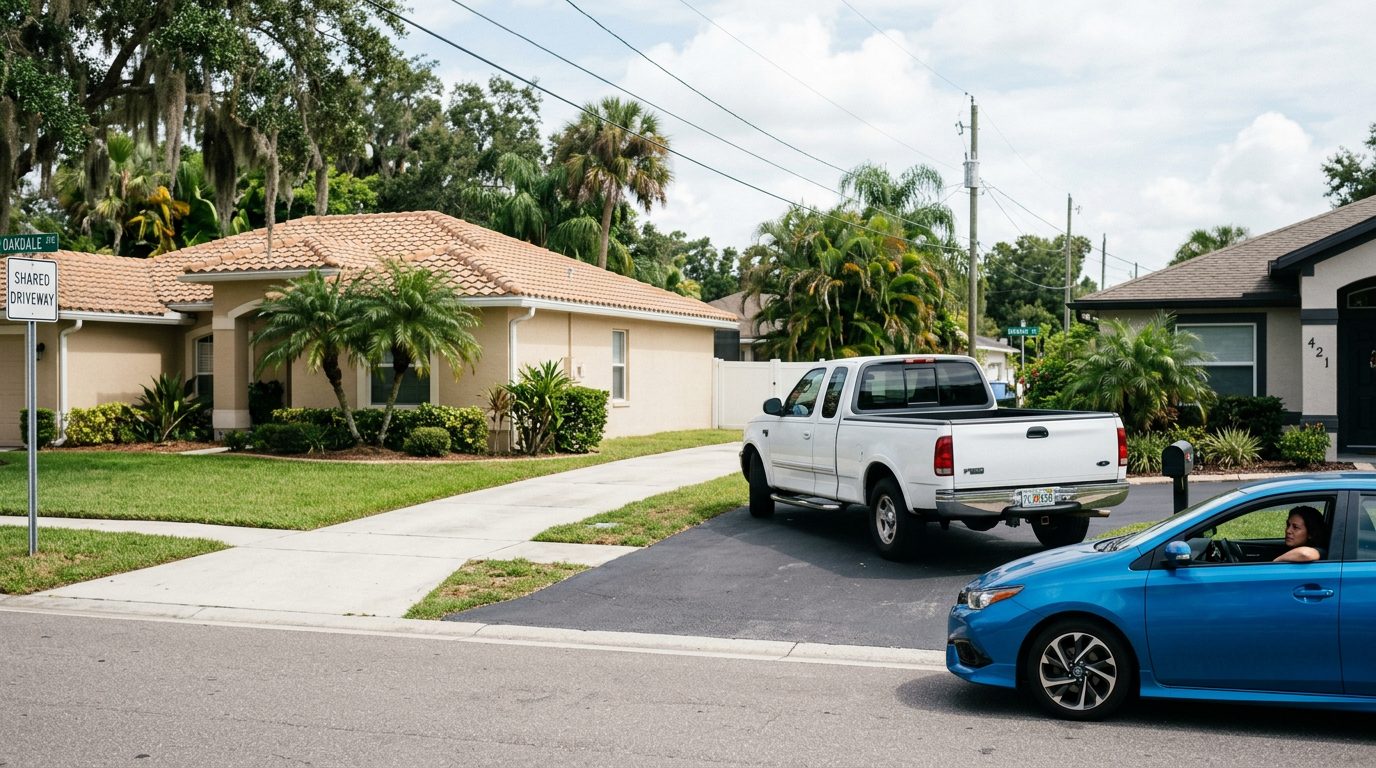
A neighbor blocking your shared driveway or easement can cut off deliveries, customers and daily access in a single afternoon. For commercial owners in Tampa, the first question is what rights are actually on record.
A parked truck or a new fence may violate that right, or it may be a dispute you need to document and raise the right way.
What Counts as Blocking a Shared Driveway or Easement
Blocking is any obstruction that keeps you from using the shared route the way your right allows. An easement is a legal right to use someone else’s land for a set purpose. For a shared driveway, that purpose is usually access.
Each source leads to different proof, so start by finding out which one applies to you.
Blocking takes many forms. A neighbor’s car, a delivery truck, a dumpster, a bollard, a locked gate, a fence or a pile of materials can all cut off the path. Any of these can interfere with the access you hold.
A one-time obstruction is different from a continuing one. A truck parked for an hour during a delivery is a short interruption. A fence that permanently narrows the route is an ongoing problem. Whether a given obstruction crosses the legal line turns on the facts, including the exact words of the grant.
If a neighbor's obstruction is cutting off your shared access in Tampa, we can talk through your recorded rights and the options that fit your situation. Talk it through with our team — we can walk you through how a situation like yours is usually handled and what your options are.
Pull the Recorded Documents First
Start with the paperwork that creates your access right. Those documents define what the neighbor must allow.
Gather the deed for each parcel, any recorded plat, the easement instrument, any maintenance or cost-sharing agreement, restrictive covenants, and any lease terms that touch access. Records for Hillsborough County property are kept in the official records maintained by the Clerk of Court, so start there.
Read the wording closely. An easement that describes a fixed strip along a named boundary is easier to enforce than one that grants “access across the property.” Vague language often leads to a fight over where the path actually runs, and that fight can take months.
A survey shows what is on the ground. The recorded documents show what rights exist. When the route or boundary is in question, a current survey can show whether the obstruction sits inside the described area. Order it before you send any demand. A demand that points to the wrong strip of land weakens your position.
Document the Obstruction Before You Confront the Neighbor
Keep a dated, factual record of each blocking incident before you raise it with the neighbor. A record made at the time is harder to challenge than a summary written weeks later.
For each incident, note the date, the time, how long the route was blocked, and what was in the way. Describe the vehicle or object in plain terms. Write down the effect: a missed delivery, a customer who turned away, a tenant who could not reach a loading door, or an employee who had to walk around.
Take clear photos and short videos that show the full route, the obstruction and the surrounding area. Keep the original files, not edited copies, so the date and location data stay attached. Save texts, emails, voicemails and any earlier written agreement about use of the shared space.
Note any witnesses, such as delivery drivers, tenants or staff. Record their names and what they saw. Witnesses are easy to identify on the day of a problem and much harder to find months later.
Written Demand and Direct Communication
A calm, written demand is usually the first practical step, and it creates a clear record of notice. Keep the tone factual and short.
The letter should name the recorded right and cite the document. It should describe each obstruction by date and ask the neighbor to remove it and confirm access by a stated date. A reasonable deadline tied to the facts reads as serious. An unreasonable one can look like a setup.
Avoid threats, insults and comments about the neighbor’s character. Those messages can be used against you later. Keep copies of everything you send and everything you receive. The neighbor’s reply, or silence, becomes part of the record.
Check the easement or shared-use agreement for any notice-and-cure step before you act. Some agreements require notice and a chance to fix the problem first. Florida courts do not favor treating a contract step as a condition precedent. Florida’s Fourth District Court of Appeal has stated that “as a general rule, conditions precedent are not favored, and courts will not construe provisions to be such, unless required to do so by plain, unambiguous language or by necessary implication.” A condition precedent is an act that must occur before a party has a right to perform and before a breach occurs, per Land Co. of Osceola County v. Genesis Concepts.
Can You Report the Blocking to Local Authorities?
A report can be appropriate in some cases, but it does not decide who holds the easement. Many blocked-driveway complaints are private property disputes rather than police matters.
A report may make sense when the obstruction creates a safety hazard, blocks emergency access, or involves conduct that looks unlawful. Florida law makes it a crime to willfully and maliciously damage property that belongs to another, which is criminal mischief under Fla. Stat. § 806.13. Fla. Stat. § 806.13 covers criminal mischief, which is willfully and maliciously injuring or damaging property belonging to another; it does not address staying on property after notice to leave. Under Fla. Stat. § 810.09, a person who, without being authorized, licensed or invited, willfully enters or remains on property other than a structure or conveyance commits trespass if notice against entering or remaining was given, either by actual communication to the person or by posting, fencing, or cultivation, or if the property is the unenclosed curtilage of a dwelling and the person enters or remains intending to commit an offense there other than trespass. Defying an order to leave personally communicated by the owner or an authorized person is a first-degree misdemeanor.
A report does not create a record of your access right. Your own file of documents, the log and the demand letters is still needed. Keep any report short and factual. Give the time, the vehicle or object, and any immediate hazard. Describe what you saw, not what you think the neighbor intended.
Why Self-Help Removal Can Create Liability
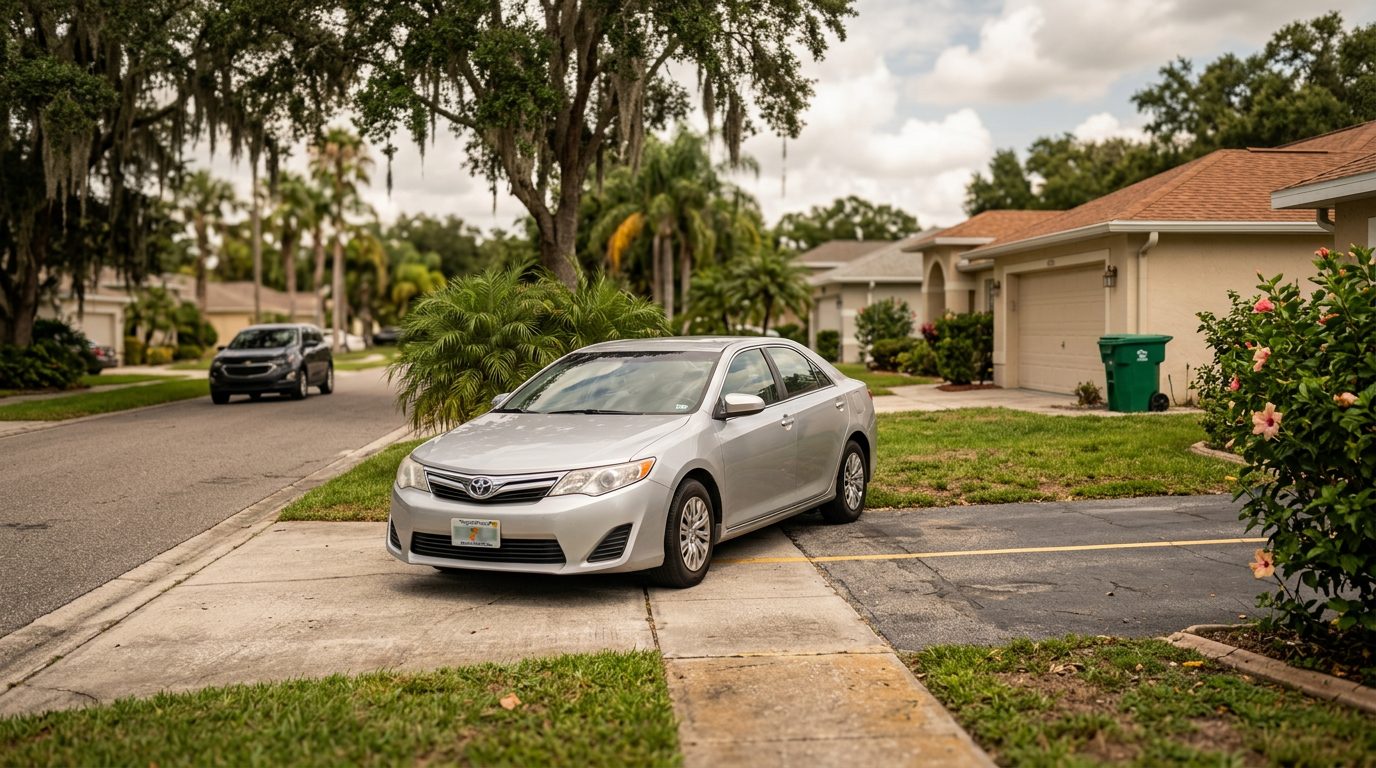
Removing a neighbor’s gate, fence, vehicle or materials yourself can create legal exposure, even when your easement is valid. A court order or a written agreement is the safer path.
Florida law makes it a crime to willfully and maliciously injure or damage property that belongs to another. A violator may also be required to pay for the damage, as § 806.13 states.
Self-help also changes the story. A dispute about a blocked route can quickly become a dispute about your conduct. The focus shifts away from the obstruction, and the neighbor can start to look like the one who was harmed.
Florida law can also shift attorney’s fees. Before you act, confirm that your claim has a factual and legal basis. Keep the status quo, document everything, and choose a legal path before any physical change.
Not sure what your next step is?
Talk it through with our team — we can walk you through how a situation like yours is usually handled and what your options are.
Court Options Under Florida Law
Florida circuit courts have exclusive jurisdiction over actions involving the title and boundaries of real property, and they may issue injunctions, per § 26.012. Venue under § 47.011 requires that actions be brought only in the county where the defendant resides, where the cause of action accrued, or where the property in litigation is located, and this section does not apply to actions against nonresidents. For many Tampa-area driveway disputes, that points to Hillsborough County.
Each has its own procedure and proof.
If a lawsuit affects property, a notice of lis pendens may be recorded. Under § 48.23, the notice must be recorded in the county where the property is located, and it generally expires after one year unless an exception applies or the court extends it. Fla. Stat. § 48.23 reads: “(2) A notice of lis pendens is not effectual for any purpose beyond 1 year from the commencement of the action and will expire at that time, unless the relief sought is disclosed by the pending pleading to be founded on a duly recorded instrument or on a lien claimed under part I of chapter 713 against the property involved, except when the court extends the time of expiration on reasonable notice and for good cause.” Courts may also refer civil cases to mediation under § 44.102, which lists when referral is required and which cases are excluded.
Commercial Owner Considerations Beyond the Driveway
For a business, a blocked route affects more than convenience. It can touch revenue, lease duties, lender requirements and emergency access.
Consider the losses: customers who cannot reach the entrance, delayed deliveries, equipment that cannot reach a loading area, and fire or emergency access that may be restricted. Track these with invoices, delivery schedules, receipts and time records. Dated numbers carry more weight than general statements about lost business.
A commercial lease may divide responsibility for access and common areas between landlord and tenant. That split can change who should act first and who must send notice. Review the lease, and check whether any loan or insurance document requires notice of a property dispute.
A sale, refinancing or lease renewal can bring the dispute to the attention of a buyer, lender or title company. Organize your records early. A clear file is far easier to present than a dispute that surfaces at closing.
Talk Through Your Driveway or Easement Situation with Ayala Law PA
A blocked shared route is stressful, especially when deliveries, tenants and staff all rely on it every day. You didn’t choose this dispute, and an active blockage can make every decision feel urgent.
Common Questions
What is an easement?
An easement is a legal right to use someone else’s land for a set purpose, such as access across a shared driveway. It usually comes from a recorded deed, plat or written agreement.
Damaging a neighbor’s property without legal authority can create liability, so a court order or written agreement is the safer route.
It does not decide who holds the easement.
Where would a lawsuit be filed?
In many Tampa-area cases, the county where the property sits is a proper place to file, which points to Hillsborough County.
If a neighbor is blocking your access right now, call Ayala Law PA at (813) 414-5715 or send your details through the contact page to talk through your recorded documents and the options in Tampa and Hillsborough County. Eduardo A. Maura is the responsible lawyer for this page. The firm serves Tampa, Hillsborough County and the Tampa Bay area from its only office at 1646 W Snow Ave, Tampa, FL 33606. Some matters may be referred to another lawyer or firm when that is appropriate.



