
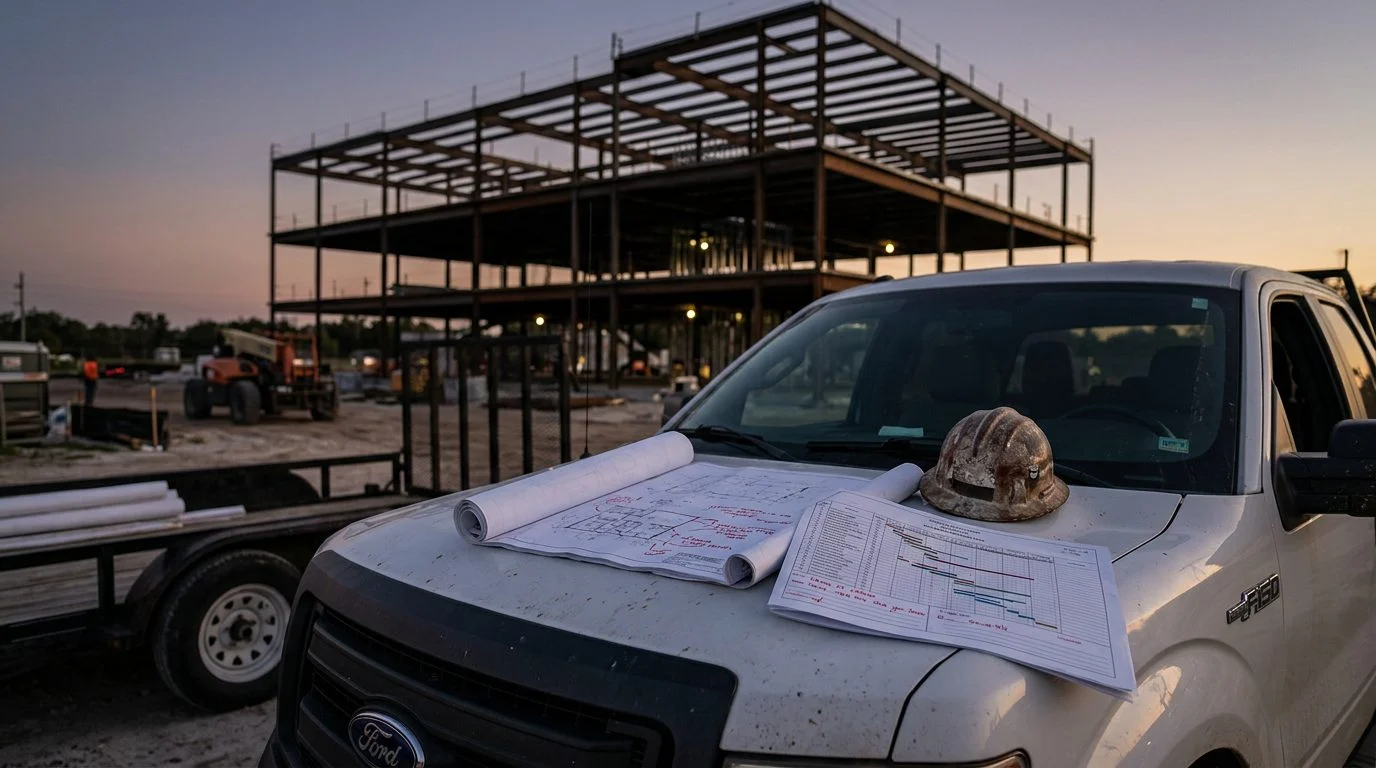
Construction Litigation in Riverview, Florida
Construction litigation in Riverview usually starts with money. An invoice goes unpaid, a change order never gets signed, or a lien shows up on the property. Owners, contractors, subcontractors and suppliers in that spot need to know three things: what the contract says, what has been paid, and which deadlines may apply. Ayala Law PA handles construction litigation and related business disputes in Florida courts and arbitration, including matters in Hillsborough County.
If an unpaid invoice or a lien on your Riverview job has you stuck, reach out to our team and we'll talk through the details of your dispute. Talk it through with our team — we can walk you through how a situation like yours is usually handled and what your options are.

Construction disputes Riverview owners and contractors run into
Most construction disputes come from money, scope or paperwork. Riverview has a mix of home builds, remodels and commercial improvements. Each job creates a chain of invoices, changes and notices. Four problems come up again and again:
- Progress billings that stop being paid partway through a job.
- Change orders agreed on site but never put in writing.
- Schedule delays that raise costs for one side.
- Work that does not match the signed plans or specifications.
Early paperwork makes the difference. Keep the contract, every change order, daily logs, invoices, payment records, lien notices and key emails in one place. A claim is easier to evaluate when the record is complete. Gaps usually hurt the side that was supposed to keep the records.
Contractor and subcontractor payment disputes under Florida law
A subcontractor usually gets paid by the contractor it works for, not by the owner. One unpaid bill can pass through several contracts. A contract needs offer, acceptance, consideration and clearly stated essential terms, even when it is oral (St. Joe Corp. v. McIver).
Contract wording also controls timing. A pay-when-paid clause ties a subcontractor’s payment to the owner paying the contractor. Read those words closely, because they shape the argument. A contract clause that sets a shorter time to sue than the statute allows is void (§ 95.03).
Retainage is money held back from each payment, often until the job is finished. Ask what the contract says about when it is released. Write down every amount withheld and the date it was withheld. Outcomes depend on the facts of each job, and the contract’s exact words drive much of the analysis.
Construction lien and lien foreclosure disputes in Hillsborough County
A construction lien is a claim against property for unpaid work or materials. Construction lien issues in Florida depend on the facts of each project and the documents involved, so it helps to review them with a business litigation attorney early. Check each date on the project timeline.
Lawsuit deadlines run on their own clocks. For an action founded on the design, planning or construction of an improvement to real property, § 95.11 sets a four-year period. The clock starts from the earliest of the temporary certificate of occupancy, certificate of occupancy, certificate of completion, or the date work was abandoned. Fla. Stat. § 95.11 reads: “(b) An action founded on the design, planning, or construction of an improvement to real property, with the time running from the date the authority having jurisdiction issues a temporary certificate of occupancy, a certificate of occupancy, or a certificate of completion, or the date of abandonment of construction if not completed, whichever date is earliest; except that, when the action involves a latent defect, the time runs from the time the defect is discovered or should have been discovered with the exercise of due diligence.” For a latent defect, the clock starts when the defect is or should have been discovered. Fla. Stat. § 95.11 reads: “(b) An action founded on the design, planning, or construction of an improvement to real property, with the time running from the date the authority having jurisdiction issues a temporary certificate of occupancy, a certificate of occupancy, or a certificate of completion, or the date of abandonment of construction if not completed, whichever date is earliest; except that, when the action involves a latent defect, the time runs from the time the defect is discovered or should have been discovered with the exercise of due diligence.” Suit must still come within seven years of that earliest date.
Hillsborough County cases are heard in the Thirteenth Judicial Circuit. Under § 47.011, actions must be brought in the county where the defendant resides, where the cause of action accrued, or where the property in litigation is located; this section does not apply to actions against nonresidents. A judgment can also become a lien. Under § 55.10, a certified copy recorded in a county, with the lienholder’s address, creates a lien on real property there. Under Fla. Stat. § 55.10, a judgment, order, or decree becomes a lien on real property in any county when a certified copy of it is recorded in the official records or judgment lien record of the county, whichever is maintained at the time of recordation, provided that the judgment, order, or decree contains the address of the person who has a lien as a result of it, or a separate affidavit stating that address is recorded simultaneously. If the certified copy is first recorded on or after July 1, 1994, the judgment, order, or decree is a lien in that county for an initial period of 10 years from the date of the recording.
Construction contract fraud and misrepresented work
Construction contract fraud usually means one side misstated what it did, billed or planned to do. Common examples include materials billed but never delivered, work invoiced but not performed, and duplicate or inflated invoices. These claims need real proof. A bad result on a job is not enough.
Labels matter. A party generally cannot recover in tort for what is really a contract dispute, unless the tort is independent of the contract. The Third District applied that rule in Frutafino v. Dole Chile. A promise of future work can be fraud if the person making it never intended to perform.
Unjust enrichment claims also have limits. Given an express contract on the same subject, those claims generally will not support recovery, as explained in Williams v. Johnson. Fraud has its own timing. Under § 95.031, a fraud claim under s. 95.11(3), including constructive fraud, generally runs from when the facts were or should have been discovered, but in any event not beyond 12 years after the fraud was committed.
How a Riverview construction dispute is evaluated
A dispute is evaluated by asking three questions. Who owes what? What does the contract require? What notices were sent, and when? The answers shape the whole case.
Before you contact a lawyer, gather the contract, change orders, payment history, lien or demand notices, correspondence and dated photos. Build a simple timeline of key dates. That list often shows what matters most.
Forum rules also matter. Florida law generally enforces a written arbitration agreement, and the court decides whether one exists (§ 682.02). The running of time is tolled while an arbitration about the same dispute is pending (§ 95.051). When one party asks, and provided the requesting party is willing and able to pay the mediation costs or the costs can be equitably divided between the parties, a court must generally refer a civil damages case to mediation, with listed exceptions (§ 44.102). Fla. Stat. § 44.102 reads: “(2) A court, under rules adopted by the Supreme Court: (a) Must, upon request of one party, refer to mediation any filed civil action for monetary damages, provided the requesting party is willing and able to pay the costs of the mediation or the costs can be equitably divided between the parties, unless: 1.”
If a matter may be referred to another lawyer or firm, we will tell you so.
Not sure what your next step is?
Talk it through with our team — we can walk you through how a situation like yours is usually handled and what your options are.
Working with Ayala Law PA on a Riverview construction matter
Ayala Law PA focuses on business litigation in Florida courts and arbitration. That includes construction litigation, contract disputes, shareholder disputes, real estate litigation and international trade litigation. Businesses in Riverview and Hillsborough County can reach the firm’s Tampa office at 1646 W Snow Ave, Tampa, or call (305) 570-2208. Eduardo A. Maura is the responsible lawyer for this page. Our team supports each matter with document handling and scheduling.
Frequently asked questions
What should I know about deadlines for construction disputes in Florida?
Deadlines for construction claims depend on the facts of each project and the type of claim, so timing should be reviewed early. The start date ties to the project’s certificate or abandonment date.
Can a judgment become a lien on property?
Yes. A recorded certified copy with the lienholder’s address creates a lien on real property in that county for an initial period of 10 years from recording, under § 55.10.
Does an arbitration clause stop a lawsuit?
A written arbitration clause is generally enforceable, so it can move the dispute out of court, under § 682.02.
If an unpaid draw or a lien is on your Riverview project, contact Ayala Law PA through our contact page or call (305) 570-2208 to discuss the specific project, invoice or lien.



