
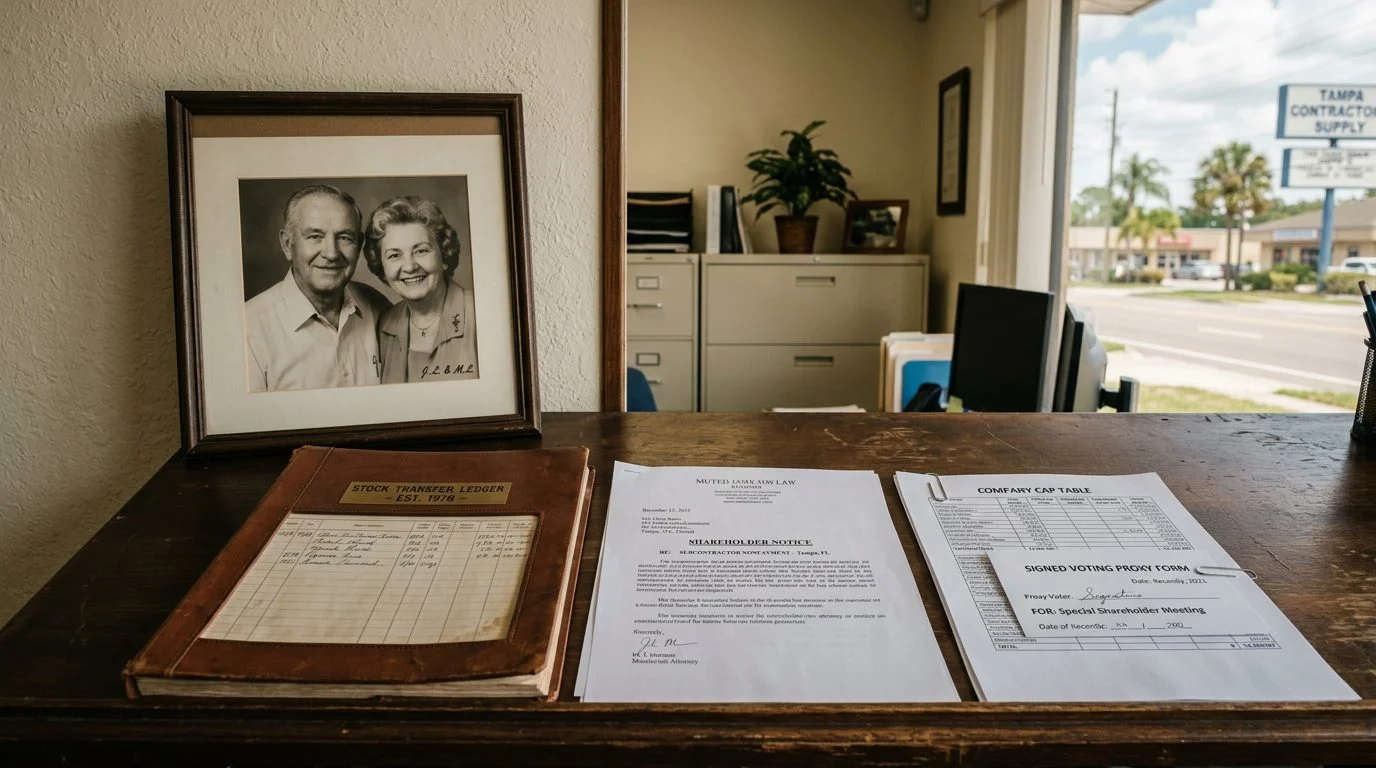
Received a Subcontractor Nonpayment Notice in Tampa: What’s Next
A notice from a subcontractor saying it hasn’t been paid is stressful. If you received a notice of nonpayment in Tampa, know this first: it is a written claim, not a court order. It can still start deadlines you need to track right away.
What you do next turns on the dates, your contract, and whether the money is really owed.
If a subcontractor's notice of nonpayment just landed on your Tampa project, the dates in it may already be running, and we can review them with you. Talk it through with our team — we can walk you through how a situation like yours is usually handled and what your options are.

What a Notice of Nonpayment Means in Florida
A notice of nonpayment is a written claim that someone who worked or supplied materials on your project has not been paid. In Florida, the phrase has a specific legal meaning. A sworn notice of nonpayment goes to the general contractor, with a copy to the surety on a payment bond. Before recovering under that bond, the unpaid party must have both notices given, if the statute requires them (Fla. Stat. § 713.23).
Many people use the phrase for any payment demand. Your notice may be a different document.
A notice to owner is not a lien.
Think of the notice as a warning with a clock. It tells you who is unpaid, on which project, and for how much. Under Fla. Stat. § 713.012, notices, demands, or requests permitted or required under Part I of Chapter 713 must be in writing, except any required by s. 713.14, which requires a payer to designate the contract under which a payment is made or the items of account to which it is to be applied.
Read the Notice Before You Respond
Start by checking the notice against your own records. Go line by line before you reply or pay.
Confirm these items:
- The project address and any permit number.
- The contract or purchase order the sender cites.
- The amount claimed and how it was calculated.
- The dates the work or materials were furnished.
- The sender’s name, address, and signature.
Then compare the amount to your pay applications, change orders, and payments already made. Write down every mismatch.
A claim of lien must state the owner’s name and the amount unpaid (Fla. Stat. § 713.08). Small errors do not always defeat a claim. The statute looks at whether the omission hurt the owner.
Circle any language about a lien, a bond, a demand to pay within a set number of days, or a deadline to dispute. Put each date on your calendar.
The Deadlines That Start Running
Several deadlines matter most, including the 90-day limit for serving a notice of nonpayment under Fla. Stat. § 713.23(1)(d). Each one starts from a different event, so check them one at a time.
The notice to owner. A lienor other than a laborer must serve this notice before it starts work, or no later than 45 days after it starts, but in any event before the owner disburses final payment after the contractor has furnished its final payment affidavit (Fla. Stat. § 713.06). Failing to serve it on time is a complete defense to enforcing a lien, by any person. Serving the notice does not replace recording the claim of lien.
The lienor must record its claim no later than 90 days after its final work or delivery, or, if the original contract is terminated under s. 713.07(4), within 90 days after that termination if earlier (Fla. Stat. § 713.08). Recording gives constructive notice to everyone of what the claim says.
Enforcing the lien. A lien does not last more than one year after recording. It continues past that point only if an action to enforce it starts in time (Fla. Stat. § 713.22).
Two more rules affect your calendar. If the last day falls on a weekend or holiday, the period runs to the next business day (Fla. Stat. § 713.011). An action on a contractor’s payment bond must be instituted or prosecuted within 1 year after the performance of the labor or completion of delivery of the materials and supplies (Fla. Stat. § 713.23).
The exact dates depend on the facts of each project. Reviewing the documents themselves is a useful starting point.
How a Subcontractor’s Claim Can Reach the Owner’s Property
A recorded claim of lien can attach to your property. That can happen even if you already paid your general contractor, and many owners find that surprising.
The notice rules explain why. The statute requires the notice “regardless of the method of payments by the owner, whether proper or improper” (Fla. Stat. § 713.06). Paying the contractor does not, by itself, remove a subcontractor’s lien rights.
Several routes can end a lien:
- Recorded release. The lienor signs a release that is notarized and recorded (Fla. Stat. § 713.21).
- Missed deadline. The lienor fails to start an action to enforce the lien in time (Fla. Stat. § 713.21).
- Lien transfer. You can post a cash deposit or surety bond. It must equal the amount demanded, plus interest for 3 years, plus $5,000 or 25 percent of the amount demanded, whichever is greater (Fla. Stat. § 713.24). Once the transfer is filed, the property is released from the lien.
Claims of lien are recorded with the clerk’s office where the property sits; if the property is in two or more counties, the claim of lien must be recorded in the clerk’s office in each of those counties (Fla. Stat. § 713.08). Check those public records for your parcel.
What Happens If the Dispute Goes to Court
If the amount is not resolved, the dispute can move into court. A lien enforcement suit has to start within the one-year window, or the lien ends.
Lien disputes can turn on a few key questions. Was the notice to owner served on time? Was the claim recorded properly? Is the amount actually owed?
The payment statute has a useful limit. Its remedies do not apply to the extent of a bona fide dispute over any part of the contract price (Fla. Stat. § 713.346). A real disagreement over the amount can limit what a claimant can recover under that section.
That section also has a 30-day rule. Undisputed amounts left unpaid 30 days after the work or materials were furnished and payment became due, or 30 days after the payer received payment for them, whichever is later, can trigger its procedures. The prevailing party in a proceeding under that section recovers costs, including a reasonable attorney’s fee, at trial and on appeal (Fla. Stat. § 713.346).
Contract claims can run alongside a lien claim. Examples include breach of the subcontract and payment fights between a contractor and its subcontractor. Read your contract for any dispute clause, including one that requires arbitration.
Not sure what your next step is?
Talk it through with our team — we can walk you through how a situation like yours is usually handled and what your options are.
Steps to Take in the First Two Weeks
In the first two weeks, save your records, pause payments and admissions, and put every reply in writing.
- Save everything. Keep the signed contract, change orders, pay applications, delivery tickets, daily logs, inspection reports, and every email and text with the claimant.
- Hold payments. Send no payment, release, or admission until someone has checked the amount and the lien rights. Casual messages can shape a dispute later.
- Read waivers closely. A right to lien cannot be waived in advance. A waiver covers only what was actually furnished (Fla. Stat. § 713.20). Do not sign one broader than the payment you received.
- Know the check rule. A lienor may tie its waiver to a check. Without a payment bond protecting you, you may withhold from payments to the contractor the amount of any unpaid check until the lienor’s condition is satisfied (Fla. Stat. § 713.20).
- Check retainage. Confirm what funds are still payable under the contract.
Common Mistakes That Narrow Your Options
One common mistake is waiting. An owner may be tempted to set a notice aside because no lien has been recorded yet. The claimant can still record within the 90-day window, which runs not later than 90 days after its final furnishing of labor, services, or materials (Fla. Stat. § 713.08).
Other mistakes that narrow your options:
- Paying without checking. Paying the claimed amount without review, or without getting a release, can leave the property exposed.
- Missing a deadline. A missed date in the notice or the contract can limit the defenses you would otherwise have.
- Assuming the contractor covers it. Review the owner-contractor agreement and any recorded lien papers yourself.
- Assuming a lien lasts forever. A lien generally ends one year after recording unless suit is started in that time (Fla. Stat. § 713.22).

Talk Through Your Notice With Ayala Law PA
Ayala Law PA handles construction litigation, including contractor and subcontractor disputes and lien foreclosure, along with commercial contract disputes. Eduardo A. Maura is the responsible attorney for this page. Our Tampa office is at 1646 W Snow Ave, Tampa, FL 33606. We serve Tampa, Hillsborough County, and the Tampa Bay area from that office.
Does a notice to owner mean a lien is already on my property?
No. A notice to owner is not a lien. Serving it does not replace recording a claim of lien.
How long does a construction lien last in Florida?
A lien generally lasts one year after it is recorded. It continues only if a suit to enforce it starts within that year.
Can I shorten the time a lienor has to sue?
Florida law gives more than one party a way to shorten the time to sue on a payment bond claim. A contractor or its attorney may record a notice of contest of claim at any time after a notice of nonpayment, if required, has been served for the claim. Under section 713.22(2), Florida Statutes, an owner or the owner’s attorney may also record a notice of contest to shorten the time to start an action on a claim against a bond under section 713.23. The lienor then has 60 days after service to sue on the payment bond, or its claim against the bond is extinguished automatically.
If a notice of nonpayment on your Tampa project has you weighing whether to pay, dispute, or act, send us the notice and the contract so we can map the dates together. Call (813) 414-5715 or request a case evaluation. We explain fee terms before any engagement.



