
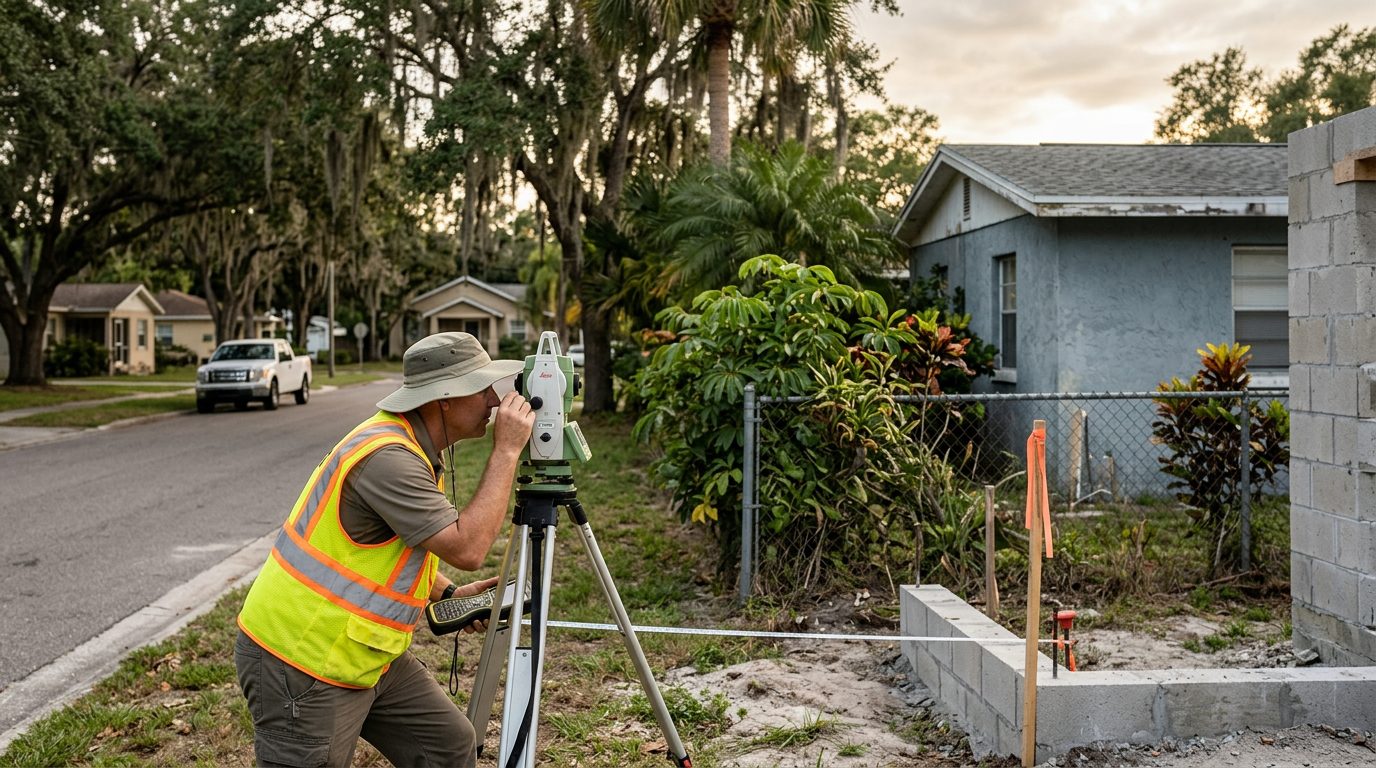
Your encroachment survey just came back, and it shows part of your commercial property in Tampa sits on the neighbor’s land. That’s a hard thing to read. A survey measures where things sit. It does not, by itself, settle who owns the strip. Your next steps are to gather records, check Florida’s timing rules, and weigh agreements or court options if talks stall.
What a Survey Showing Encroachment Actually Means
An encroachment is any part of a building, footing, fence, or parking area that sits on land described in someone else’s legal description. A boundary survey is the document that shows it. A licensed Florida professional surveyor and mapper measures the site against recorded lines and marks what they find.
That’s what a survey proves: where the structure sits compared with the recorded lines. It doesn’t say whether the neighbor’s title, the age of the structure, or past conduct changes who owns the strip.
Check four things on the survey itself. Look at the date. Look at the recorded plat or deed it references. Look at the monuments found or set at the corners. Look for notes about gaps or conflicts in the records.
Surveys don’t always agree. An older survey may place the line differently. Which description controls is often where a dispute begins. Put both surveys side by side and ask the surveyor to explain any difference in writing.
If your survey shows your building crossing onto a neighbor's land, you don't have to work out the next steps alone. Call Ayala Law PA at (813) 414-5715 to talk through your situation. Talk it through with our team — we can walk you through how a situation like yours is usually handled and what your options are.
Gather the Records Before You Respond
Gather your records before you answer the neighbor or send anything to the surveyor. The file should show where the line is and how the building got there. Start with these:
- Your vesting deed and the neighbor’s deed
- The recorded plat for both parcels
- Your title insurance policy and commitment
- Every earlier survey you can find
- Building permits, approved site plans, and construction drawings showing where the structure was placed
- Recorded easements, access or party-wall agreements, and leases
- Letters, emails, and texts with the neighbor, a contractor, or a prior owner
Keep originals in a safe place and copy everything. Start a dated log of when you received the survey, who sent it, and what you did next. That timeline matters if the matter becomes contested. Missing paperwork doesn’t end the question, but it usually slows every later step.
Why Timing Matters Under Florida Law
Timing matters because Florida sets time limits for actions other than recovery of real property under Fla. Stat. § 95.11, and the clock can start from different events. Under Fla. Stat. § 95.12, no action to recover real property or its possession may be maintained unless the person seeking recovery, or an ancestor, predecessor, or grantor, was seized or possessed of the property within 7 years before the commencement of the action.
Adverse possession follows its own rules.
Under Fla. Stat. § 95.18, a claim without a written instrument has its own steps.
Other clocks run too. Trespass on real property must be started within four years under Fla. Stat. § 95.11. If a contractor placed the building, construction-related claims generally must be filed within four years. That time runs from the earliest of the temporary certificate of occupancy, certificate of occupancy, certificate of completion, or abandonment of construction. For a latent defect, the four years run from when the defect is discovered or should have been discovered, but in any event suit must be filed within 7 years of that earliest date. A construction defect claim also needs written notice at least 60 days before suit under Fla. Stat. § 558.004, or at least 120 days before an action involving an association representing more than 20 parcels.
Practical point: the date you discovered the problem can matter as much as the date the building went up. Document early.
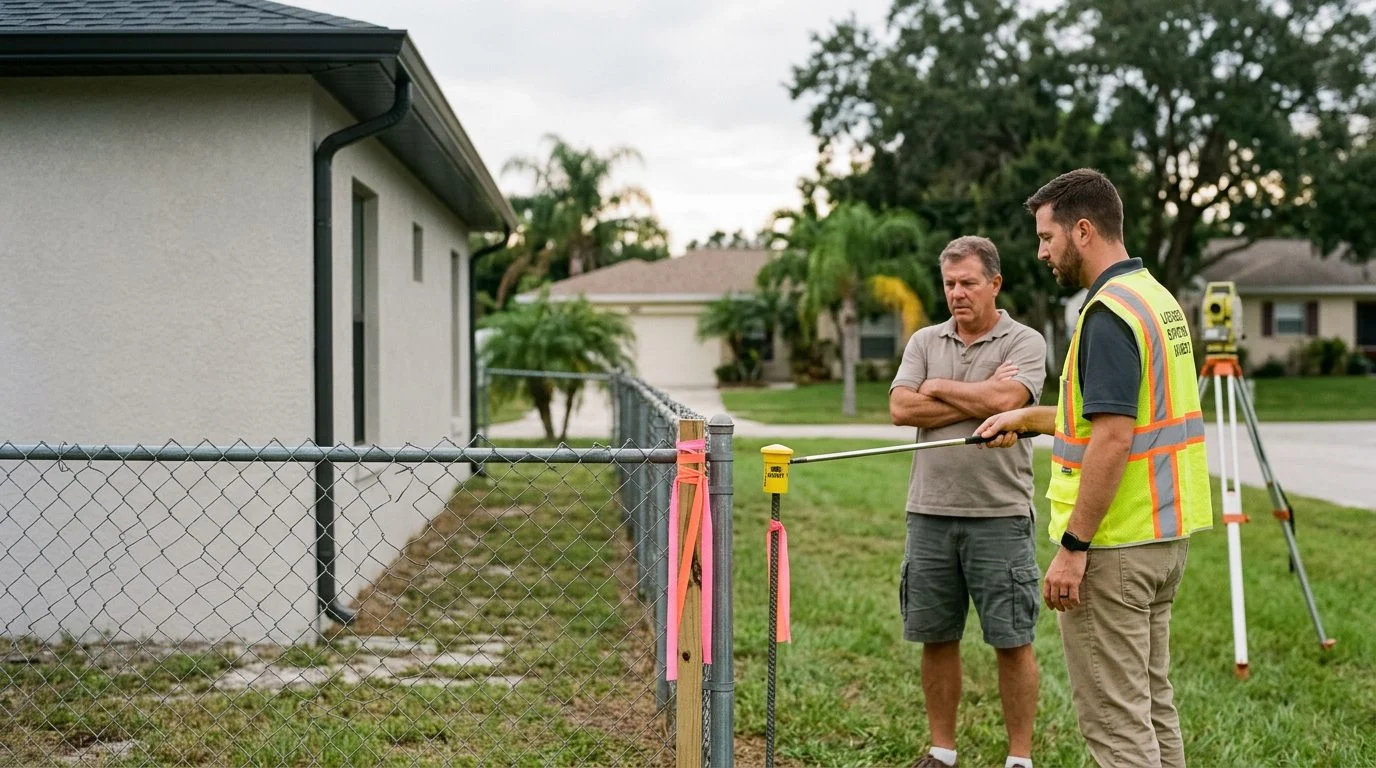
Options for Resolving an Encroachment Before Court
Some encroachment problems are resolved by agreement before anyone files suit. Any agreement that moves an interest in land should be in writing. Under Fla. Stat. § 689.01, an interest in land lasting more than one year generally needs a signed writing witnessed by two subscribing witnesses. A lease is exempt from the witness requirement. A handshake deal may not hold.
The usual paths include these:
- Encroachment or license agreement. The structure stays for a set term, and the terms are recorded so future owners are bound.
- Boundary line agreement or lot-line adjustment. Both owners sign.
- Relocation. You move a fence, trim an overhang, or redesign a parking layout. Compare the cost and timing of each option.
- Purchase or exchange of the strip. Title and survey work must be done correctly to close.
Be careful with what you put in writing. Early letters can become admissions that shape later positions. Have each statement reviewed before it goes out.
When a Boundary Dispute Moves Into Florida Courts or Arbitration
A boundary dispute usually moves to court when talks stall. It moves to arbitration when a contract requires it. Under Fla. Stat. § 47.011, an action must be brought in the county where the defendant resides, where the cause of action accrued, or where the property in litigation is located, but this section does not apply to actions against nonresidents. Tampa is located in Hillsborough County.
Which claim fits depends on the facts. Claims in these cases may include quiet title, declaratory relief, trespass, or ejectment.
If a lease, sale contract, or construction agreement has an arbitration clause, that clause can move the dispute out of court. Under Fla. Stat. § 682.02, a written agreement to arbitrate existing or later disputes is generally valid and enforceable. Federal law states the same rule for contracts involving commerce under 9 U.S.C. § 2.
A court case typically involves pleadings, discovery, surveyor testimony, mediation, and possible settlement before trial. A boundary dispute can also affect a sale, a loan, or title insurance. Timing often matters to a business or family’s plans. No one can predict how a boundary case will end. Some matters may be referred to another lawyer or firm.
Next Steps for Tampa Owners Facing an Encroachment Question
Your next steps are to preserve records, avoid changes to the disputed strip, and track every deadline in writing. Do note any deadlines stated in letters. Don’t build, fence, or remove anything on the disputed strip without review. Don’t ignore a demand letter.
Review the survey together with the building’s history and the parties’ positions. The records, the timeline, and the relationship with the neighbor shape which option makes sense.
Does a survey showing an encroachment decide who owns the land?
No. The survey shows where the structure sits against recorded lines. Ownership turns on the deeds, the recorded documents, and the law that applies.
How long must someone possess land to claim it in Florida?
Under Florida law, adverse possession generally requires 7 years of continued possession under a claim of title exclusive of any other right, but not founded on a written instrument, judgment, or decree.
If your survey shows a building crossing onto a neighbor’s land, you’re probably weighing whether to talk to the neighbor, protect the property, or go to court. Ayala Law PA represents businesses and property owners in real estate litigation in Florida courts and arbitration. Call (813) 414-5715 or request a case evaluation. Fee arrangements are discussed directly with the firm when you call. Eduardo A. Maura is responsible for this page. The firm’s office is at 1646 W Snow Ave, Tampa, FL 33606.



