
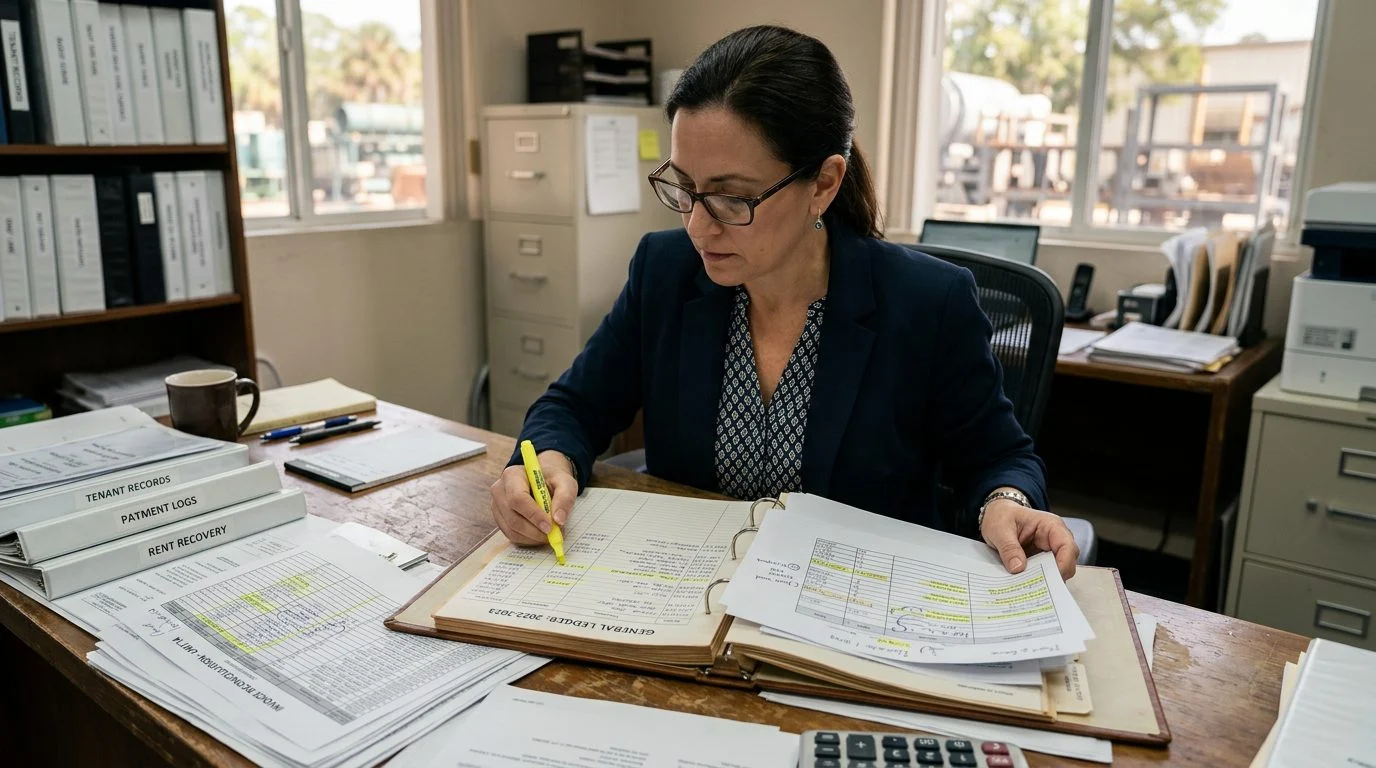
A Florida landlord may be able to recover unpaid rent from a business tenant who leaves before the lease ends. How much, and how, depends mostly on the lease. The claim usually rests on the signed lease, a clear rent ledger and proof that the tenant stopped using the space. This guide covers the steps that matter most, from the first records to a lawsuit and collection, and the mistakes that weaken a claim.
What Happens When a Business Tenant Leaves Before the Lease Ends
A business tenant that stops paying and moves out mid-lease is usually in default, but the lease decides what that default means. Abandonment, in plain terms, is when the tenant stops paying, moves out or stops running its business in the space while the term still runs. Florida’s rules for nonresidential tenancies are in Part I of chapter 83, which applies to nonresidential tenancies.
The unpaid rent under the lease is the core of the claim. So the first job is gathering facts, not sending letters. Pull together:
- The date of the last rent payment
- Move-out proof, such as returned keys, removed equipment or a utility shut-off
- Every written notice sent or received
- The rent ledger, showing each charge and payment
Landlords who rely on memory often struggle to prove when the tenant really left. Write the timeline down while it is fresh.

Check the Lease First: Default, Abandonment and Survival Clauses
The lease sets the rules, so read its default, notice and survival terms before you send a demand or change anything at the property. Start with the default and notice provisions. Many leases require written notice and a cure period, a set time for the tenant to fix the problem, before the landlord can use certain remedies. Skipping that step can weaken the claim.
Next, look at the abandonment clause. It may define what counts as leaving the space and what the landlord may do next. Then check the survival clause. It often says which duties, including rent, continue after the lease ends or is terminated.
Other terms change the number. An acceleration clause may make the remaining rent due at once. Late fee and interest terms may add to the claim. A separate written promise from an owner or parent company to pay the rent may add a second party to the claim.
Attorney fee terms need care. Under Fla. Stat. § 57.105, if a contract lets one party recover fees for enforcing it, a court may also allow reasonable fees to the other side when that side prevails. This applies only to contracts entered into on or after October 1, 1988. That rule cuts both ways.
Common drafting mistakes include vague notice language, missing notice addresses and rent figures that do not match the ledger.
Does Florida Require a Landlord to Try to Re-Rent the Space?
Whether a landlord must try to re-rent abandoned space turns on the lease and the facts, so landlords should be ready to show what they tried. The idea is called mitigation. Every lease dispute turns on its own facts, and the steps each side took once a problem appeared are often reviewed closely.
Records help most. Keep proof of listings with a broker or online, broker contacts, showing logs, and offers received, including why any offer was turned down. Note the dates of each step.
The lease also shapes the issue. Some leases spell out re-letting rights, and others say little. A new lease signed at a lower rent or for a shorter term changes the math, so track those numbers too.
The mistake to avoid is sitting on empty space with no marketing record, then trying to rebuild the timeline months later.
What Florida Landlords Are Not Allowed to Do: Self-Help Limits
Those steps can lead to claims from the tenant. They can also muddy the rent case, because the tenant will argue the landlord caused the problem.
Possession and money are separate questions. A landlord who wants both the space back and the unpaid rent usually works through the court process. Civil cases in Florida courts follow procedural rules, and the Florida Rules of Civil Procedure are published on The Florida Bar’s website. The holdover and eviction service page on this site covers those steps in more detail.
Calculating and Documenting the Unpaid Rent Claim
A rent claim is built from the lease terms, a clean rent ledger and records that show what was owed and when. Typical pieces include unpaid base rent, common area maintenance charges, and late fees or interest if the lease allows them. Documented cleanup or repair costs may also belong in the claim when the lease supports them.
Interest matters too. Under Fla. Stat. § 83.06, all contracts for rent, written or verbal, bear interest from the time the rent becomes due. That same section lets a landlord demand double the monthly rent when a tenant refuses to give up possession at the end of the lease. That is a holdover rule, so it applies when the tenant stays past the lease end, not to every abandonment.
Timing is also important. Deadlines for suing on a written contract are set by Florida law, so timing should be reviewed early in any dispute. Whether past rent can be recovered during an eviction turns on the lease terms and how the claim is pleaded.
Gather the signed lease, the ledger, every notice, move-out proof and mitigation records. Then make sure the demand figure matches the ledger exactly.
Pursuing the Claim: Demand, Lawsuit and Collection
Most unpaid-rent claims start with a written demand and move to a lawsuit only if the balance is not resolved. The demand should follow the notice terms in the lease. A demand that skips those terms gives the tenant an easy argument.
Where the case is filed matters. Under Fla. Stat. § 47.011, an action must be brought in the county where the defendant resides, where the cause of action accrued, or where the property in litigation is located, but this section does not apply to actions against nonresidents. For space in Hillsborough County, the property’s county is one of the places the statute names.
Mediation rules have limits. Under Fla. Stat. § 44.102, on request of one party a court must refer to mediation any filed civil action for monetary damages, provided the requesting party is willing and able to pay the costs of the mediation or the costs can be equitably divided between the parties, unless an exception applies. That rule excludes a landlord-tenant dispute with no personal injury claim, and an action filed to collect a debt. A court may still refer those cases.
Whether a written offer of settlement under Fla. Stat. § 45.061 can be used depends on timing, because the section does not apply to causes of action that accrue after its effective date. Under Fla. Stat. § 45.061, for causes of action that accrued before the statute’s effective date, an offer remains open for 45 days unless it is withdrawn or accepted, and the section does not apply to causes of action that accrue after that date. Fla. Stat. § 45.061 provides that the offer shall remain open for 45 days unless withdrawn sooner by a writing served on the offeree prior to acceptance by the offeree, and that an offer shall be presumed to have been unreasonably rejected by a defendant if the judgment entered is at least 25 percent greater than the offer rejected. The section does not apply to causes of action that accrue after the effective date of this act (Fla. Stat. § 45.061).
After judgment, collection takes work. Under Fla. Stat. § 55.10, a judgment, order, or decree becomes a lien on real property in a county when a certified copy is recorded in that county’s official records or judgment lien record, provided the judgment, order, or decree contains the address of the person who has the lien or a separate affidavit stating that address is recorded simultaneously; for a certified copy first recorded on or after July 1, 1994, the lien lasts an initial 10 years from the date of recording (Fla. Stat. § 55.10). The Chief Financial Officer sets the statutory rate quarterly, but a judgment’s interest rate is established when the judgment is obtained and is adjusted annually on January 1 of each year under Fla. Stat. § 55.03, except for judgments entered by the clerk of the court under ss. 55.141, 61.14, 938.29, and 938.30, which are not adjusted annually. If a debtor moves assets out of reach, Fla. Stat. § 726.105 lists factors a court may consider in determining actual intent, such as whether the debtor had been sued or threatened with suit before the transfer.
Whether to sue turns on the amount owed, the lease terms, the evidence and whether the tenant has assets to pay.

Talk Through Your Abandoned-Space Situation With Ayala Law PA
If a business tenant has left mid-lease and stopped paying, a short review of the lease and the records is a practical next step. You may be deciding whether to re-rent, send a demand letter or file in court, and each choice affects the others.
Eduardo A. Maura is the responsible lawyer for this page. The firm’s bona fide office is at 1646 W Snow Ave in Tampa. Ayala Law PA represents businesses in Tampa, Hillsborough County, Brandon, Riverview, Plant City, Temple Terrace and the wider Tampa Bay area. Fee details are explained during intake.
Common Questions
Common questions in lease disputes
Every situation differs, so the facts of each dispute shape how it is evaluated. Those steps can lead to claims from the tenant.
Is it worth suing for unpaid rent?
That turns on the amount owed, the lease terms, the evidence and whether the tenant can pay. Those are the questions to weigh first.
Can a landlord recover past rent during an eviction?
It turns on the lease terms and how the claim is pleaded.
How long does a landlord have to sue for unpaid commercial rent?
Florida law sets a filing deadline for breach of a written contract claim, so timing should be reviewed early.
If a business tenant walked away mid-lease and stopped paying, you may have a claim worth reviewing, and our team can talk through the lease and next steps with you. Call (305) 570-2208 or request a case evaluation.



