
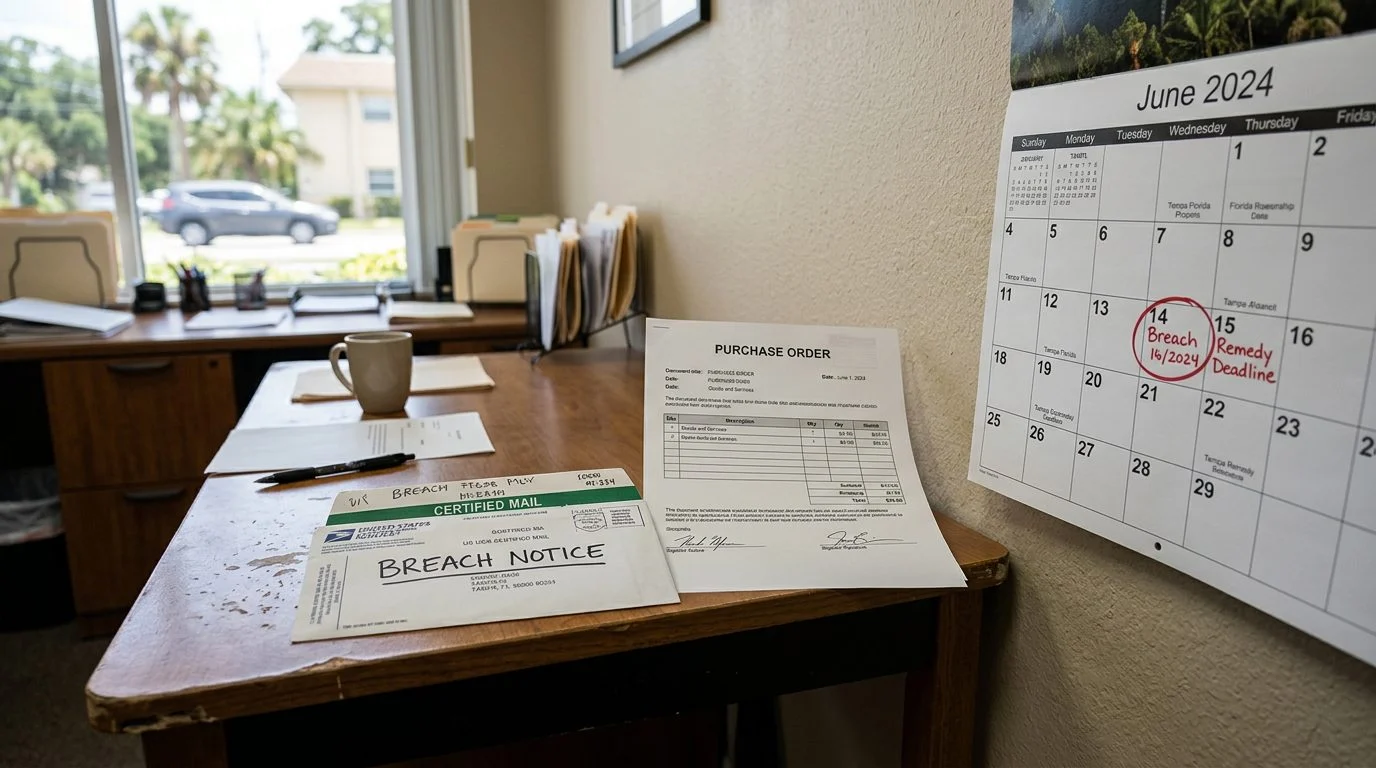
A letter saying your company broke a contract can arrive with little warning. If you just received a notice of breach in Tampa, the first ten days matter, and so does the order you work in.
In short, read the notice against the full contract, write down every deadline, keep every record, and check the timing rules before you reply. This page walks through those steps day by day.
Where You Are Right Now: What a Breach of Contract Notice Is
A breach of contract notice is a written claim that the other side failed to do something the contract required. It is not a court ruling, and it does not decide who is right.
Still, it matters. Many notices set a deadline, demand a fix, or invite talks before anyone files suit. Some contracts also require notice and a chance to cure before a party can sue.
If you are reading this for a business partner, an employee, or a family member who runs the company, you are not alone in that position. Take a breath. You have time to work through the steps in order.
If a breach notice with a deadline has landed on your desk, you do not have to sort through it alone. Call Ayala Law PA at (813) 414-5715 to talk through the notice and your options. Talk it through with our team — we can walk you through how a situation like yours is usually handled and what your options are.
Days 1 and 2: Read the Notice and the Contract Closely
In the first two days, compare the notice to the full signed contract, line by line.
Start by pulling four facts from the notice: who sent it, what obligation they say was missed, what they want, and any deadline they set. Write each one down in plain words.
Next, find every version of the contract. Gather the signed agreement, amendments, change orders, purchase orders, and attached exhibits. A notice often points to a term that sits in an attachment or a later change.
Then check the notice and cure terms. Look at how notice must be given, to what address, and whether the contract gives a cure period. Florida courts do not favor reading a term as a condition precedent. They treat a step as a condition only when plain language or necessary implication requires it.
Flag the dispute clauses too: arbitration, venue, governing law, and attorney’s fees. Florida law generally treats a written agreement to arbitrate as valid and enforceable, with exceptions for grounds that can cancel any contract. Under § 47.011, a suit generally must be brought where the defendant resides, where the claim arose, or where the property is located, but this section does not apply to actions against nonresidents.
Finally, put every deadline on a calendar before doing anything else.
Days 2 to 4: What Qualifies as a Breach of Contract
Most breach claims rest on a few points: a valid contract, the claimant’s own performance or a valid excuse, a failure to perform a required term, and harm that followed.
A valid contract needs the basics. Florida’s high court says even an oral contract needs offer, acceptance, consideration, and essential terms stated clearly enough.
Not every failure is the same. A material breach goes to the heart of the deal. A minor or technical miss usually leaves the rest of the agreement in place. That difference often changes what remedy is realistic.
Order of performance matters too. If the other side broke the contract first, your failure to keep going may not count as a default. Florida courts have applied that rule in Ryan v. Landsource Holding Co.
A notice’s label is not a court finding. The sender calls it a breach. A judge or arbitrator looks at what was actually performed, what was paid, and what the contract says.
Days 3 to 6: Preserve Records Before You Respond
Preserve every record about the contract before you send any reply.
Start with the paper trail: emails, text messages, invoices, purchase orders, delivery receipts, meeting notes, and project logs. Each one can become evidence.
Payment records often drive these disputes. Pull bank statements, canceled checks, ACH confirmations, and ledger entries for the full contract period.
Stop routine deletion now. Turn off auto-delete on phones and email, and tell staff to keep related files. Deleting messages after a dispute starts can hurt your position.
Build one written timeline of key dates and events. Base it on documents, not memory, and note the source beside each date.
Do not edit, annotate, or clean up original documents. Keep the originals as they are. If you need notes, write them in a separate file.
Days 5 to 7: Check Timing Rules and Whether the Contract Holds Up
Many business disputes are subject to deadlines for filing a lawsuit, and the time limit that applies depends on the type of claim involved. § 95.11 sets different filing deadlines for different kinds of actions, so the time limit that applies to a contract dispute depends on the nature of the claim and should be confirmed early.
Under § 95.031, a claim accrues when its last element occurs.
A contract cannot shorten that window. Under § 95.03, a contract term that sets a shorter period than the statute is void.
Enforceability is the next question. A contract can fail if it lacks an element such as offer, acceptance, or consideration. Florida courts also look at fairness. To refuse to enforce a term as unconscionable, a court must find both procedural and substantive unfairness, weighed together.
A voidable contract can also be ratified. Ratification happens when the party who could cancel it does not act after learning the facts that justify cancelling. Under Flaherty v. Flaherty, ratification occurs when a party entitled to rescind a voidable contract fails to do so after the discovery of facts that warrant a rescission.
Days 7 to 9: Response Options, Settlement, and Proposals for Settlement
Your main choices are a written denial, a written reply that answers specific points, a cure within the contract’s period, or talks toward a settlement.
Any written response should stick to facts you can document. Review it carefully before sending. What you say early can be used later.
If you reach a settlement, read the release language, the payment schedule, and the enforcement terms closely.
A proposal for settlement is a formal written offer. Under § 45.061, a written settlement offer is not filed with the court and stays open for 45 days unless it is withdrawn sooner by a writing served on the offeree before acceptance. The section does not apply to causes of action that accrue after the effective date of the act, so it does not reach a claim that accrued later. Fla. Stat. § 45.061 reads: “The offer shall remain open for 45 days unless withdrawn sooner by a writing served on the offeree prior to acceptance by the offeree.” The statute presumes an unreasonable rejection when the judgment is at least 25 percent greater than a defendant’s rejected offer, or at least 25 percent less than a plaintiff’s rejected offer.
Mediation can pause some of these clocks. When a court orders mediation, response time for a settlement offer is tolled until an impasse is declared or the mediator reports no agreement.
If you have been served with a lawsuit or an arbitration demand, do not ignore it. Note each response deadline from the date of service.
Not sure what your next step is?
Talk it through with our team — we can walk you through how a situation like yours is usually handled and what your options are.
Days 9 and 10: Weighing Whether the Dispute Is Worth Pursuing
Whether a breach claim is worth pursuing depends on the facts, the money involved, and what your business needs most.
Look at the amount at stake and the cost of a lawsuit or arbitration. Look at how strong your documents are. Ask whether the other party still matters to your business.
Check the contract’s fee terms. If a contract allows attorney’s fees to a party that must enforce it, a court may also allow fees to the other side when that side prevails, under § 57.105. This applies only to contracts entered into on or after October 1, 1988. That rule runs both ways. That rule runs both ways.
Careful review of the facts before you file or defend is part of managing that risk.
Other paths exist besides a lawsuit: a demand letter, a negotiated cure, mediation, or a settlement. Each has different costs and risks.
Your 10-Day Checklist and How Ayala Law PA Can Help
Ayala Law PA focuses on business litigation, commercial litigation, contract disputes, and related matters. The firm serves Tampa and the Tampa Bay area from its office at 1646 W Snow Ave, Tampa, FL 33606. Eduardo A. Maura is the responsible lawyer for this page.
Use this checklist over the first ten days:
- Day 1: Read the notice. Write down the sender, the claim, the demand, and any deadline.
- Day 2: Pull the full contract, amendments, and exhibits.
- Day 2: Check the notice, cure, dispute, and fee terms.
- Days 3 to 6: Preserve emails, texts, invoices, and payment records. Stop auto-delete.
- Days 3 to 6: Build a dated timeline from documents.
- Days 5 to 7: Review timing rules and enforceability questions.
- Days 7 to 9: Choose a response and review it before sending.
- Days 9 and 10: Weigh cost, risk, and goals. Note every response deadline.
For broader context, read the Florida contract disputes guide for Tampa-area businesses. If a lawsuit has already been filed against your business, see the defending a breach of contract lawsuit page.
Case evaluations are paid services, and fee terms are explained when you call.
If a breach notice with a deadline has landed on your desk, you do not have to sort through it alone. Call Ayala Law PA at (813) 414-5715 or use the firm’s contact page to talk through the notice and your options.
Quick Answers
What is the breach of contract deadline in Florida?
Under Florida’s limitations statute, the filing deadline depends on the type of action, so the applicable period has to be matched to the specific claim. The § 95.11 limitations periods control.
When might a contract problem be worth a closer look?
Your facts decide each point.
Is it worth suing for breach of contract?
That turns on the amount at stake, the strength of your documents, and your business goals.



